Saturday, October 11, 2014

Walking on Eggshells: An Overanalysis of "Kill the Moon"

Certainly the coolest episode title since "Let's Kill Hitler"

I've read several times (although never from an official source) that Eric Saward, script editor in the 6th Doctor era, had a plan for Colin Baker's 6th Doctor that he never really got a chance to pull off.  The 6th Doctor was supposed to start off repulsive and unlikeable, but that was supposed to lead into an arc where, through a series of events including the death of his companion, the 6th Doctor was going to mellow and begin to remember the kind hearted person he used to be.  Unfortunately, before Saward was able to put this into action, the show came under attack from the BBC, whose controller criticized the show's low-budget cheesy special effects (he was sleeping with Colin Baker's ex-wife, at the time, so take that with a grain of salt), from the fans who didn't like the change to such a mean and pompous Doctor, and from conservative groups, who already thought the show was a little too violent, and now thought it was way too violent.  The production team was forced to pivot and rework the plan for the second season, switching from the arc they had planned to the horribly muddled "Trial of a Timelord" arc.  Had the 6th Doctor's arc been allowed to roll out the way it was supposed to, we might have seen a remarkable transformation in which the Doctor rediscovered his true self.  Approximately 30 years later, enter Peter Capaldi's 12th Doctor, who is just as arrogant as the 6th Doctor ever was, but in very different ways.  His new persona hasn't endeared him to everyone around him, and has flat out alienated some people like Danny Pink.  Clara has been accused of making excuses for him, demonstrating a compassion for him that few others share.  Now, even Clara has been pushed past her breaking point, meaning the Doctor is going to have to re-evalutate how he's been acting.  Are we perhaps seeing, about 3 decades later, the introduction of Colin Baker's lost arc in Peter Capaldi's era?

As I watched this episode, 2 things slowly became abundantly clear to me. 1) This episode was not meant as some sort of allegory for abortion.  2) A lot of people are going to think that it is.  Peter Harness, who wrote this episode, is a first time Doctor Who writer, so I don't know his political leanings or anything like that.  I do, however, know that Doctor Who is a left-leaning show, even if Glenn Beck has recently come out as a fan.  Between the number of openly gay people who have worked as writers, show-runners, and actors on Doctor Who, the constant themes of racial equality that have pervaded the show since day one, and the Doctor's adamant dislike for all things military, I think that suggesting that anyone who writes Doctor Who has a conservative bone in their body is laughable.

The morning after the episode aired, I went online looking for the inevitable discussions about this episode and abortion and, wouldn't you know, I wasn't wrong that someone was going to think this.  But what I wasn't expecting was that, on more than one of these websites and message boards I've seen discussing this episode's "metaphor" for abortion, I found actual British people chiming in basically saying "Um, we weren't thinking that at all.  That sounds like it may just be an American interpretation.  Abortion may be a hot button topic, still, in the United States, but it's been legal in the UK for so long, we really don't argue about it anymore."  I looked up this claim and, while these Brits were a little off in that it hasn't been legal in England that much longer than the United States (the UK legalized it 6 years earlier than the US), I did notice that the British legalized it by a law passed through their legislature, unlike in the United States where it was legalized by a Supreme Court case.  I doubt it ever could have become a law in this country through Congress because we're still so evenly and bitterly divided about it here, which makes me think that the British had a little more public consensus on this issue than we did, which would support the idea that it's not really a hugely hot button topic over there.

However, not all Brits think that's just an American point of view, as the Telegraph came up with the same interpretation.  So let's put it this way:  I see the parallels here.  There are parts that are screaming out for this metaphor, but there are also problems.  First of all, if you want to try to look at this as an anti-choice argument, you've got the problem that the Doctor left the choice up to all the people for whom it was appropriate to make the choice, not just all the humans...but all the women.  Danny Pink is conspicuously absent from this episode (until the very end), and even the President of the United States, mentioned in passing as someone who should be making this decision, is a woman.  Nobody said that everyone supporting choice is a big fan of abortions, just that we all believe that having them legal is better in the long run than having them illegal, and that the choice should be there.  Furthermore, this is a creature in the last hour of a 100,000 year maturing process, which would make this pretty much just a baby at this point, so at best you could call this an argument against super-late-term abortions, if anything.  If there is any intent for the metaphor we're seeing, it's not, as the Telegraph's wishful thinking department contends, a "Christian Pro-Life" episode.

While I may be pro-choice, I still find the thought of abortions squiggy, so to clean the mental palate, here's an adorable picture:

Just don't think about puppy abortions!

Moving on...

That being said, I would not have made the same choice Clara did.  An entire planet of people, my people, are about to be destroyed, and all I have to do is kill one creature that I'm not even entirely sure is intelligent?  Yeah, I probably would have hit detonate a long time before they decided to in this episode.  And, the more I think about it, that's why I feel like I can relate to Clara's anger so much here.  There was no 3rd option of hiding Earth in its own little pocket of space time.  It's a terrifying predicament, and knowing that I would have hit the button when I didn't need to, that makes me all the more furious at the Doctor for not giving Clara that information and forcing her to make that decision on her own.

I thought it was interesting that the episode talked about Earth having lost interest in space travel, as we all know we have right now.  As much as we will always love our sci-fi, we aren't so big on sending anyone into space anymore.  Here's the thing:  Why are there so many British astronauts in the future on Doctor Who?  To date, England has produced 6 astronauts ever, and they all went up on other country's ships.  What, they suddenly start becoming the dominant country in the space program in the future, along with, according to this episode, Mexico?  The Mexican Space Agency, in case you're wondering, was, in the real world, formed in 2010.  They don't have a rocket yet.

In a deleted scene, the Doctor removes the whale they left on the moon.

I still haven't seen enough of Courtney Woods yet to really form a strong opinion on her one way or the other.  Mostly, it felt like, in this episode, Courtney's main role was to be the victim of the Doctor's abuse.  One of the 11th Doctor's defining traits was that he was really good with children, but Courtney's not really a child, she's a teenager.  And this isn't the 11th Doctor, it's the 12th.  Admittedly, the 12th Doctor showed some of 11's magic with children when he met young Danny Pink back in "Listen," but he's shown a distinct lack of common decency, let alone charm, when dealing with pour Courtney.  He tried to give a little bit of comfort to Courtney by dropping little compliments about how "special" she is, but the truly revealing moment is the one that comes when he proves he doesn't understand how old Courtney actually is.  I think this is another one of the symptoms of the Doctor being a lost, angry, scared man who is taking it out on those around him.  If this is the story of the Doctor's redemption, I can't wait to see where it's going.

My girlfriend would like me to let you know that she figured out what Danny's "bad day" was at the end of the episode.  I figured it out before she pointed it out to me, but she'd still like me to let you know.  His statement, when comforting Clara, that he had had a bad day was clearly foreshadowing.  There's no way that someone would put that line in there unless it was setting something up.  More than likely, he's been on his own adventure with the Doctor, and the Doctor just managed to drop both Clara and Danny off from separate adventures at the same point in time.  It might also explain why Danny doesn't really seem as inclined to try to get Clara to leave the Doctor as he might have been last week.  He understands her frustration, but he also understands that she still cares about the Doctor, and he won't let her forget that.

The preview of next week's episode interestingly avoided showing us who the companion would be.  I could probably look up the cast list for next week (I've seen it before, but it was a long time ago so I don't remember) and then reveal it here, but that's a spoiler I'd rather not give you.  My guess is it'll be a one-off companion, or else it'll be Danny Pink's Terrible, Horrible, No Good, Very Bad Day that he referenced at the end of this episode.

Missy is absent from this episode entirely, leaving us with only one arc to look at:  the arc of the Doctor's relationship with Clara.  She's angry at him, with good reason, and I'm wondering what happens next in their relationship.  I'm hoping we do see a slow progression of the Doctor finding himself again.  My biggest question is, what has made this Doctor so much more unfriendly and abrasive?  It's something that's been bugging me since Moffat announced that the 12th Doctor would be a little rougher, a little meaner:  Why?  He just saved Gallifrey, even if it's still hidden away somewhere.  This should be the lightest his soul has felt since the Time War, and instead he's gotten bitter and petty.  Perhaps old age is really getting to him.  Perhaps moving beyond the number of regenerations he's supposed to have is making him sour and cranky.  Peter Capaldi's performance is brilliant, and because it's brilliant, I can see something in the Doctor that is really scared and really crying for help.  It's the most vulnerable we've ever seen him.  I want to walk into the screen and get the poor guy some help.

Saturday, October 4, 2014

Pride and Prejudice: An Overanalysis of "The Caretaker"


(Another one that's just barely going to make it to print before the airing of the next episode in the US, and possibly later than the UK broadcast.  I think we need to just learn to start expecting this from me.)

Gareth Roberts knew what he was doing when he inserted Jane Austen's novel Pride and Prejudice, although if he was looking for thematic resonance this episode actually bears a much stronger resemblance to the plot of Jane Austen's Persuasion.  (Yes, I know a thing or two about classic British literature.  What?  I can be a nerd about multiple things.)  While Gareth Roberts' first two episodes for Doctor Who were about aliens attacking famous literary figures ("The Shakespeare Code" and "The Unicorn and the Wasp"), since the beginning of the Moffat era, Roberts's forte has really been episodes that bring Doctor Who down to a very human level.  In "The Lodger" and its sequel "Closing Time," Roberts brought us very human stories about love, friendship, career, and family, not entirely unlike Jane Austen.  So when you have a season arc that includes a love story, and you need someone to really dig out the human element of that love story--particularly when you need to demonstrate the conflicting pride and prejudices of two very proud men--you call for Gareth Roberts.

While this episode does bear a lot of resemblance to Gareth Roberts's last two episodes--although it's not a second sequel to "The Lodger" as many on social media annoyingly worried about--it also brings to mind Chris Chibnall's "The Power of Three" from last season.  It was last season, Amy and Rory's last season, that Moffat introduced the concept of a companion who doesn't necessarily travel with the Doctor, but more of a part time companion who can return to their life at will, but will, at random times, go off for adventures with the Doctor.  This episode, and "The Power of Three," are the ones that really take a look at how difficult that life can be.  Balancing a normal life with the extraordinary life of a TARDIS passenger would have to make for a truly bizarre dichotomy.  It's an interesting idea, and it's surprising, once you think about it, that nobody has thought of it before.  The closest we come to anything like this in the classic series is the brief time in the 3rd Doctor era when the Doctor was stranded on Earth without the use of his TARDIS, meaning that his companions had to stay on Earth and live their lives, because the Doctor had nowhere to take them.  As soon as the TARDIS got up and running on a regular basis, though, the Doctor and his new companion, Sarah Jane Smith, started traveling together again, and no other companion was allowed to live a regular life on Earth while traveling with the Doctor until Amy and Rory settled down in quiet suburbia.  Perhaps the reason that nobody came up with the idea of a part-time companion in the classic series is because the first two Doctors didn't actually know how to steer the TARDIS.  The Doctor just pressed some buttons and it took him somewhere in time and space.  He could never predict where.  This didn't really allow for part time companions, as he couldn't figure out how to bring them home.  By the time the Doctor gained the ability to steer the TARDIS--which, again, came in the 3rd Doctor era when he finally regained use of his TARDIS--the idea of a full time companion was so orthodox that nobody thought of trying anything else.

Considering his inability to steer the TARDIS, the 1st Doctor's kidnapping of his original companions seems extra-dickish.
But where Amy and Rory had each other to share their secret with, Clara has been living a double life while trying to date.  That's a little more difficult.  Back in "Listen," I kept getting so annoyed with Clara for never mentioning to the Doctor that the little boy whose timeline they keep ending up in was the guy she was on a date with.  I realize the Doctor's prejudice against soldiers was set up back in "Into the Dalek," but I thought that she could easily mention that she had a date without bringing up that he was a soldier.  But this episode made things a little clearer:  the fear of the Doctor rejecting Danny is a crippling fear.  The Doctor plays a very strange role in her life--taking up the unlikely position that lies somewhere between father figure and ex-boyfriend--and the Doctor rejecting someone she loves, so much so that she may have to choose between them, is so terrifying, it kept her from really being able to take even the simplest of actions.

Moffat has said that, as much as he loves Rory and Mickey, he felt like they were never really competitors with the Doctor for their various girlfriends' affections, and he wanted to make Danny someone who actually could compete with the Doctor.  Well, I don't know if I agree with him about Rory, but I can see what he's doing.  Danny isn't a passive man in any way.  Danny is someone who has the Doctor's number from the beginning, and that's the worst thing the Doctor can imagine.  Much has been made in the new series about the Doctor being a "soldier" from the Time War, but Danny had a different interpretation of it.  He's not a soldier, he's an officer.  That's an interesting twist, and not one I've never thought of before:  the Doctor as an officer, his companions as his willing soldiers.  I think in his short time meeting with the Doctor, Danny has a better idea of who the Doctor really is than Clara, who has now travelled with him for over a year and also managed to, in one form or another, visit every incarnation of the Doctor.

The Doctor's prejudice against soldiers isn't entirely a new one, but its ferocity is very particular to this new, 12th incarnation.  The 3rd Doctor was stranded on Earth, forced to work with the military operation U.N.I.T., and his best friend, really, became Brigadier Lethbridge-Stewart, an officer in his own right.  The Doctor got along with the rank and file of U.N.I.T. pretty well, too.  He didn't hate them, but he quite often clashed with them about whether military solutions were appropriate or not.  The 4th, 5th, and 7th Doctors found their paths crossing with the Brigadier yet again, and the 9th, 10th, and 11th Doctors each found themselves working for U.N.I.T. again at least once.  The 10th Doctor said, in "The Sontaran Stratagem," upon running in to U.N.I.T. again, that he'd prefer if the Brigadier were there.  And the 11th Doctor, upon learning the ever sad news that the Brigadier had died (reflecting the real life death of the actor who played him, Nicholas Courtney), it was what finally brought him back down to Earth to realize he couldn't run from the Silence anymore.  So really, this particular prejudice, at least in this particular form, is very much the 12th Doctor's, not the Doctor's in general.  The others had no problem with soldiers until they started pointing guns around without very good reason, at which point they always incurred the Doctor's wrath.

Also, he seems to get along with this guy pretty well.
Maybe it's because the Doctor thinks of him less as a soldier, more as a potato with a gun.

I'd like to say, for the record, that the Doctor's continuous use of the name "John Smith" as an alias has always tickled me, as that's my dad's name.  Although, none of them have tickled me quite as much as "Midnight," which has the great line:  "No one's called John Smith. Come off it. "

On a side note, as a fan of classic British literature, when Clara went on her tirade about her imagined adventures of the Doctor and Jane Austen fighting aliens and meeting Buddy Holly, all I could think was:  "I want to see that episode!"  As an upcoming episode from this season, "Mummy on the Orient Express," is clearly based on an adventure-that-never-was that was brought up at the end of "The Big Bang" but never actually happened on screen, I'd like to think that this little Jane Austen adventure was a set-up for an episode that someone will someday pick up and run with and actually produce!

Courtney (no doubt named after the aforementioned Nicholas Courtney, much as Clara is named for Elizabeth Clara Sladen) is an interesting character, and certainly being set up for a return, bringing us to the often rumored return of the original TARDIS residency of 1963:  a student from Coal Hill School, 2 of her teachers, and a 55 year old actor who plays the Doctor.  Her running joke where she says (or writes on the window) a number of variations on the phrase "Ozzie loves the Squaddie" struck me as a clue at first, something that an alien presence had somehow placed in her mind to repeat around the Doctor to give him some sort of clue.  I was disappointed to find on discussion boards around the Internet that it was just a bit of slang I didn't understand:  "squaddie" is British slang for a soldier, and the kids have apparently turned the name "Ms. Oswald" into the nickname "Ozzie."  Thus, "Ozzie loves the Squaddie" is just a joke for the kids to let on that they know their teachers are hooking up.

In the end, we see another moment in paradise, when the police officer ends up at the reception desk for heaven.  Missy's newest assistant, seen in this scene, is played by Chris Addison, Peter Capaldi's co-star from The Thick of It and In the Loop.  At first, I didn't recognize Addison, as he seems to have lost weight since The Thick of It, and ditched his glasses for this role.  As long as we're reuniting cast members from The Thick of It, how about just a full cast reunion?


The five people we'll meet in "heaven"?


We don't learn much about "the afterlife," despite this being our longest scene about it since back in "Deep Breath."  But one thing we learn is that it does seem to be a strangely bloated bureaucracy.  For a place that's supposed to be heaven itself, it seems to be filled with stuffy pencil pushers and anal-retentive control freaks.  Heaven as the DMV.  I think we can be pretty sure, to begin with, that this isn't the real "heaven," but the sterile, bureaucratic nature of this "promised land" should prove to us, beyond a doubt, that this is an artificial heaven.

What Danny's place is going to be for the rest of the season remains unclear.  He wasn't asked to join the Doctor and Clara as companions in the TARDIS yet, but I think we have to assume he will be, sooner or later, unless Moffat is somehow setting him up to just be someone we see on Earth and never someone we see traveling with the Doctor.  Such a set-up would be odd, and a truly missed opportunity, so I look forward to Danny's first full excursion in the TARDIS, whenever it may come!

Saturday, September 27, 2014

Fun Lovin' Criminals: An Overanalysis of "Time Heist"

"Running around robbing banks all whacked off the [memory worms]..."

Sorry about the late post this week, just barely getting this one out before the new episode airs.  I have fewer excuses than usual.  I actually had this week off.  But give me too much free time, and I'll surely waste it.  So here we go:

The Doctor has always been the guy you go to when you need somebody to save lives.  But even in his days where he was forced to live on Earth and work for UNIT, nobody was ever dumb enough to ask him to help them recover stolen goods, unless those stolen goods included a weapon that could be used to hurt others.  I always wanted to see someone try, because I imagine his response would be amazing.  "Do you know who I am?  I'm the Doctor.  I'm hundreds of years old.  I've saved all of existence more times than I can count.  Everything.  All of it.  All that is now, ever was, or ever will be, exists only because of me.  So I'll leave you humans to deal with the little strips of paper that you think mean something."  My girlfriend recently introduced me to the concept of alignments from Dungeons and Dragons (believe it or not, I'm not the one in this relationship with any experience in RPGs), and we had a slight disagreement over the Doctor's alignment.  My argument is that in any regeneration, in any era, the Doctor is chaotic good:  someone who is always looking to do good, with absolutely no regard for laws.  Laws can be useful if the Doctor deems them to be morally correct, but if he does not, he never shows any hesitation in breaking them.

So, yeah, the Doctor's okay with robbing a bank.

I said I felt bad for Stephen Thompson having to write the unfortunate episode that has to follow "Listen."  But what makes this episode work after watching an episode like "Listen"--which will probably go down as one of the best Doctor Who episodes of all time--is that Moffat was smart enough to schedule an episode that follows "Listen" that is completely unlike "Listen" in any way.  What this is is a genre episode, to borrow a phrase that Cultbox invented earlier this week in regards to Doctor Who episodes like this:  an episode that borrows a popular film genre, because in Doctor Who, it's actually perfectly acceptable--and, at this point, even expected--for the show to jump from one genre to another from one week to the next.  "Time Heist" is the Doctor Who rendition of a classic heist film, the most popular of which, in our generation, is the trilogy that sprang from the George Clooney/Matt Damon remake of Ocean's Eleven.  This has all the trappings of a classic heist movie, and plays them up in the most fun way possible.

I'd watch it!

Stephen Thompson, who is the main writer of this episode (although Moffat is co-billed on it, which I'll get to later), is an odd-duck.  Of the three writers of Sherlock, he was the only one who had not written for Doctor Who when he started with Sherlock, only after he had started.  He was brought in for the first season of Doctor Who after Sherlock started, and he wrote the biggest stinker of Season 6, "Curse of the Black Spot," which proves that the genre episode can go terribly wrong.  However, the season after that, he wrote an excellent episode in a really bad season, "Journey to the Centre of the TARDIS."  If there's one thing Thompson proved when writing for Sherlock, it's that he can create a very complex storyline and handle it very well.  There are actually a lot of ways that "Time Heist" resembles a Sherlock episode:  there's a very complex narrative, with clues to solving it hidden throughout, and we learn the answer through the deductive powers of a brilliant, yet arrogant and often abrasive, man.

I've watched over the episode several times and I'm still trying to figure out if the logic all makes sense.  For the most part, I think it did, with one exception being that I don't think the question of why the Doctor didn't just use the TARDIS was ever perfectly answered.  This episode pulls the same trick that Steven Moffat pulled back in "Asylum of the Daleks":  if you have the characters mention what the plot holes are in your story, people will give you credit for filling in the plot holes even if you haven't.  The Doctor does state that the reason they couldn't use the TARDIS was because the storm, which is what made the bank vulnerable enough to be breached, would also have made it impossible to navigate into the bank.  Couldn't he have just taken it directly into the private vault where the female Teller was being held, grab her, and go?  Unlike in "Asylum of the Daleks," there are at least a number of plausible explanations here, even if none of them are explicitly spelled out in the script.  This is a bank in the distant future.  There's good reason to suspect they have some sort of security system to keep anything from materializing inside the most secure parts of the bank.  It seems to me that a bank in this era would be expected to have some sort of security against that.  But then why could he get the TARDIS in to give himself the necessary materials for the heist that he would need later on?  Perhaps the materialization protections are only employed deeper in the bank, closer to the valuables.

But the biggest problem with the logic of this episode is that, to follow it, you need to be able to understand everything that Peter Capaldi says, and that's not too easy for many Americans, and even some Brits, as it turns out.  A lot of people have complained, particularly in the US, that Capaldi's thick Scottish accent is hard to understand, and I have to admit having to rewind the show myself sometimes.  A screenwriting professor I had in college always said that major plot points should be displayed visually instead of just putting them in dialogue because it's easier to miss dialogue.  Well, that's all well and good, but when you get into very abstract science fiction concepts like mind-reading, you do really need to put the information in the dialogue.  Perhaps that's why some of the key information was given by Peter Capaldi's voice being run through a voice changer that, inexplicably, gives him an American accent.  (And, yes, they did that in England, not just in the American broadcasts.)

It's kind of like being yelled at by the garbage disposal.

Moffat, again, takes a co-writing credit in this episode.  I'm still trying to figure out why.  I don't really get an impression that he was a full 50% contributor to three episodes this season on top of the four episodes he wrote solo.  I still think it's possible that my original theory was correct:  that Moffat is being very particular about who writes for his new character, Danny Pink.  So far the only episode that Moffat has not taken at least a co-writing credit on this season was "Robot of Sherwood," which doesn't feature Danny at all.  However, if my theory is correct, and Moffat is taking a co-writing credit just because he's writing all the scenes for Danny, then he took credit for writing very, very little in this episode.  Considering he went uncredited for his writing in "The End of Time (Part 2)" and "Closing Time"--I find it hard to believe he would insist on being credited for writing the brief Danny Pink scene in this episode.

My favorite part of this episode is that it reminds us that the Doctor is always compassionate, even if that's not what is apparent on the surface.  I always say the only two defining traits that are constant throughout all of the Doctor's lives are compassion and curiosity.  There are some Doctors that are meaner and harsher than others, notably 1, 6, 9, and now 12.  They have little regard for social niceties and ensuring that nobody's feelings get hurt.  Their compassion is on a more macro level.  They may not be nice, but they are kind at their cores.  The Twelfth Doctor proves this in this episode when we figure out what he was "robbing" the bank for in the first place.  For all his blustering around, his seemingly insensitive comments, the Doctor's real mission this entire time was one of true kindness and generosity.  Say what you will, this is the same Doctor he always was.

Wednesday, September 17, 2014

The Nightmare Child: An Overanalysis of "Listen"


I was a very frightened child, which should not be surprising to anyone who has spent any amount of time with me.  I can't say that I ever had a dream of a hand reaching out from under the bed to grab my foot.  I had a lot of other weird ones, though.  One was that there was a duck that would walk into my room every night and do a lap around the room, and as unfrightening as that sounds, it scared the bejeesus out of me that somehow it got in there every single night.  The other involved the villain from the Care Bears showing up in my window every single night to scare the shit out of me.  I had a night light for so long, that it was eventually just determined that it would be easier to install a dimmer switch in my room.  I remember sometimes I would sit up in bed and think that I couldn't wait until, some day, when I was a grown up, I would completely lose that fear of the dark and not be scared even a little bit.  I'm 30 now, and I'm still waiting for that day to come.  Apparently, even 2,000 year old men are still waiting.

What this episode was was a radically new idea of how to tell a Doctor Who story.  This wasn't the story of the Doctor meeting a megalomaniacal foe and stopping them from destroying the Universe.  This felt something more like a horror film, but not a traditional horror film.  It brought to mind a more cerebral, artistic horror film in the vein of The Sixth Sense (honestly, I'm racking my brain for an example that doesn't give so much credit to M. Night Shaymalan, but we all do know his first film was actually very good).  Instead of following a linear story with a basic good-guy and bad-guy, the Doctor searches time and space in search of the literal boogeyman, as the episode waxes philosophic about the very nature of fear itself.

I've seen at least one person on Facebook complain about the typical Moffat theme of "something in the corner of your eye."  It's true that we have seen similar ideas before, but that's what writers do.  Some writers have favorite themes.  Ever seen a Tim Burton movie?  Then you've seen all of Tim Burton's shitty movies.  Have you ever read a John Irving novel?  I love John Irving, but I'll be the first to admit that he reuses the same themes, settings, and even the same characters obviously passed off under different names.  Moffat is pulling out some of his favorite themes that he touched on in "The Girl in the Fireplace" (the creature under the bed), "Silence in the Library"/"Forest of the Dead" (fear of the dark), "Time of Angels"/"Flesh and Stone" (fear makes you stronger), and perhaps my favorite episode of all time, "The Impossible Astronaut"/"Day of the Moon" (a creature always in the corner of your eye, responsible for the creakings that go on in your house at night).  Moffat is guilty as charged, and I admit that I criticized "Into the Dalek" for rehashing old themes, but when handled as expertly and intelligently as "Listen," I'm more than willing to forgive Moffat for reusing some themes.  Although, I have to admit, when I saw the opening scene with the Doctor going off about a creature with "perfect hiding" who can always be in a room without you realizing, I thought for a moment that we might see my favorite villain, the Silence, again, but alas it was not to be.

Or was it?

I heard a few people suggest that the monster, if there was one, was a Silent.  Both my girlfriend and a friend of mine from Mile High Who said that, when the monster took the blanket off of its head, it had a "bulbous" head that looked like a Silent.  I thought I remembered that scene having an actually quite clear shot of the monster's head, and I thought it looked more like a Sontaran than anything.  It was one of my favorite moments, because it felt so creepy to see that reveal happen so casually and in the background.  It made me think of that scene in the beginning of Signs (honestly, I'm not a Shaymalan fan) where we first saw the aliens walking by on grainy video.  Such a casual shot of something so unusual is just so shocking that, when I saw it in this episode, I remembered it being way more prominent than it really was.  So, I went back and looked for the shot of the monster, and it's far less clear than I remembered it being.  But, you will notice something:

Sontaran!
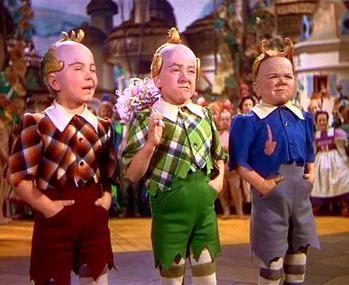
I don't know what you think, but that looks to me like a Sontaran!  The head is more squished down than the elongated head of the Silence.  Also, it's somehow shorter than Clara, which means its either a Sontaran or a member of the lollipop guild.

We represent the creepy thing under your bed!  Under your bed!
In fact, I thought this was about to be given away when, in a later scene, the Doctor jumps awake from a dream saying "Sontarans perverting the course of human history!"  A moment later, the outburst is forgotten, chalked up to the Doctor thinking he was still in a dream.  But it does seem an odd coincidence.  I'm kind of hoping it stays a coincidence, because I don't want to know whether there was a monster or not.  Although the scene with the creature in the blanket did seem to show some sort of alien that might be a Silent or a Sontaran, there's still so much ambiguity in this, and that was clearly meant to be the point.  I'd like that to stay the point.

The Doctor and Clara's chemistry just keeps getting better and better.  I feel like I called that one, that the biggest problem with 11 and Clara was that the plot was set up for them to not be able to trust each other, which is a natural impediment to chemistry.  Capaldi has a much better rapport with her, and I think their first scene interacting together demonstrated that perfectly, where the Doctor rudely barges into Clara's room.  Clara shows her strength again, being able to tell the Doctor to shut up (not something many companions can do), but also being able to be the one who discovers the Doctor's secret fear.

The idea that Clara is the reason the Doctor has the fear of something grabbing him from under the bed in the first place is called a "bootstrap paradox," and I love bootstrap paradoxes because I love to say the phrase "bootstrap paradox."  A bootstrap paradox is when, in time travel fiction, something seems to create itself, or has no clear origin or creator.  The best example I can think of is in Back to the Future, where Marty plays "Johnny Be Good" because he heard Chuck Berry playing it when he was growing up, but somehow Chuck Berry learned it from hearing Marty play, which means that nobody really wrote the song.  Obviously, this would be impossible if time travel were real.  Moffat loves to use bootstrap paradoxes.  The Doctor was essentially rescued from the Pandorica by a bootstrap paradox, and "Blink" is almost entirely one giant bootstrap paradox.  But, while they are seemingly impossible, they're always fun and make for a really exciting reveal in the end.  So no, I'm not faulting Moffat for creating yet another bootstrap paradox.  I really just wrote this paragraph to say the words "bootstrap paradox" over and over again.

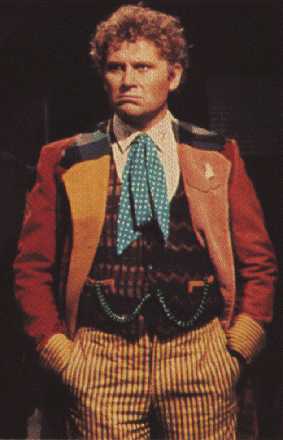
In this episode, we get the third variation on the 12th Doctor's outfit in 4 episodes, basically confirming that there isn't really a "12th Doctor outfit" per-se.  That's fine with me.  Some Doctors have more distinct outfits than others.  Sometimes, trying to be too unique and outside the box in designing a Doctor's outfit can backfire:

Why do you always pick on me in this blog?!
The 12th Doctor's main defining costume piece seems to be a suit jacket, and I'm okay with that.  Peter Capaldi pulls off the casual-dress-with-a-suit-jacket look quite well!  I realize that, for a straight man, I'm abnormally preoccupied with the Doctor's appearance.  I think it's because the Doctor is a character I admire and sort of live vicariously through when I watch the show, and so I want that person to be attractive.  Peter Capaldi, when dressed correctly and given a good haircut that doesn't make him look like a frumpy doofus, is quite attractive.  That being said, I couldn't figure out what was going on with the Doctor's shirt.  Even with a 1080p resolution on my big screen TV, I couldn't figure out if the shirt had a pattern on it, or if the Doctor is just the world's messiest eater and just finished off a powdered donut.  It didn't help that the pattern seemed to change based on the lighting in the room.

Speaking of costumes, why do the Time Lords (who I'm presuming are the Doctor's parents) look like 17th century Puritans?  They're millions of years ahead of us in technology, but their fashion style is all Hester Prynne?  "Pray, Goody Clara, thoust dost need to become more learned in the ways of iPlayer."  (Okay, so I don't know how people talked in the 17th century.)

Another thing I have to address is something a friend of mine brought up on Facebook:  The Doctor, in this episode, seems to be picking on Clara's body a little bit.  There are two times the Doctor makes some jokes about her appearance, basically calling her fat--and at one point, very directly calling her fat.  I don't think it would have noticed this if someone hadn't pointed it out on Facebook before I saw the episode.  But it's a fair point.  I'm not saying it would be appropriate if it were more accurate, but I would like to point out that calling Clara fat is like calling me a dwarf.  I fail to understand why Moffat thought that was a good idea.  Not only was it a little offensive to some of the viewers, it was freaking bizarre and unnecessary.

The overarching plot of this season--The "Promised Land"--didn't appear in this episode, but another "arc" of sorts came back around:  Danny Pink.  Honestly, the one frustration I had in this episode was that Clara never explained to the Doctor why they were landing in Danny's timeline rather than hers.  It seemed a perfectly reasonable thing to bring up.  The scenes with Clara and Orson seemed to want to leave a touch of ambiguity as to whether or not Clara and Orson were related, but they failed because there was no ambiguity whatsoever.  Orson is clearly her great grandson, after she someday marries Danny, and there's no way that the plot is going anywhere else.  End of love story.

Some people have suggested that, like "Blink," this is going to be an episode we're going to be talking about for a very long time.  I think that's true.  Peter Capaldi's 12th Doctor has more vulnerability than the Doctor has had in a long time, but never lets go of that Doctor swagger that David Tennant and Matt Smith's Doctors truly perfected.  Moffat pulled off another classic here, doing what he does best:  scaring the hell out of children, and many of us adults in the process.  But Moffat understands that his job isn't just to invoke fear, but also to keep us from letting that fear overpower and defeat us.  Usually, this means the Doctor defeating the bad guy.  This time, it was in reminding us that "fear is a superpower," an amazingly important lesson to learn.

I wouldn't want to be Stephen Thompson right now, as he wrote next week's episode, "Time Heist," and I don't think any episode will really be able to follow "Listen."

Friday, September 12, 2014

Occupy Nottingham: An Overanalysis of "Robot of Sherwood"


(Sorry, everyone, no excuse for the late blog this week.  I can't blame it on a bad episode.  It was actually a ton of fun and I loved it.  I've just been lazy this week.  I'll try to work on that for next week...)

I was a big fan of Robin Hood growing up.  I remember one year winning the award for best Halloween costume in my Cub Scout pack for my Robin Hood costume, primarily because everyone else had boring costumes like vampires and Frankenstein monsters.  I fell in love with that little toy bow and arrow that I had for the costume, with all the arrows that had the little red suction cups on the front.  At one point, the children's theater group I was a part of put on a performance of Robin Hood and, short on roles for everyone, I played a made up character, the Deputy of Nottingham, and got half of the Sherrif's lines, but I was still very happy to be in a production of that truly brilliant story.  I remember my mother reading me the Great Illustrated Classics version of Robin Hood and fell in love with a story about a hero who displayed the primary values that my parents taught me:  that people are always more important than money.  Robin Hood continues to permeate our culture, and Robin Hood has been depicted in film and television over 60 times between 1908 and today, including a 1953 TV miniseries with the Second Doctor himself, Patrick Troughton, as the title character (an image of Troughton as Robin Hood appears on the space ship's computer screen in this episode).  The Wachowskis are currently in production to create a modern adaptation of Robin Hood, and if the Wachowskis are making it, it's bound to be another huge, blockbuster hit.  The myth seems to be incapable of dying, even in American culture where you would not expect it to be as popular as it is when you consider one simple fact:  When you stop and think about it, Robin Hood is more than a tale of medieval knights and a band of romantic outlaws, it's a deeply anti-capitalist story.  Robin Hood is, in the end, a socialist folk hero, who believes that human life and dignity should always come before petty gain.

Kind of like the Doctor.

We're men!  We're men in tights!

In a revelation that surprised even me, Gatiss managed to write my favorite Doctor Who episode so far this season, although perhaps because he did something that I might have criticized for being too obvious or easy had he not carried it off in such a charming way: drew attention to the striking and obvious similarities between the Doctor and Robin Hood.  He didn't draw the comparison in all the annoyingly obvious ways he could have, but rather showed how two people very similar would become natural competitors and antagonists towards each other.  Tom Riley put in an excellent performance as Robin Hood, whose swagger matches the Doctor's step for step.  Especially now that the Doctor has his swagger down.

With the first two episodes of the season still showing Peter Capaldi's Doctor finding his new identity, "Robot of Sherwood" was the moment when Capaldi's Doctor confidently and powerfully grabbed the reigns of the role and steered it in a wonderfully fun direction.  Seeing the Doctor and Robin Hood challenge each other as two true equals--at least in their virtues, if not in their intellects--we saw Capaldi pull out some of the Doctor's vain and petty nature, which, far from making him unlikable, reminded us of the loveably and deeply flawed nature of this 2,000+ year old character.  Capaldi's Doctor, in the first two episodes, was brilliantly played, but this was the first time I was reminded of the reason that I love Doctor Who:  the pure confidence the Doctor has in his own intellectual abilities.  In this episode, Capaldi showed that confidence in abundance.

Like any Gatiss episode, it had its flaws, but the bulk of the episode was such a fun romp that, for once, I actually found myself able to overlook all of the flaws.  The ending, where they shoot the golden arrow to stop the ship, is absurdly dumb.  The joke about the guard deciding that Clara must be the leader of the group was worth a few chuckles, but I got the punchline long, long before it came.  And the biggest flaw in it is a logical one, as logic is something that Gatiss's episodes often struggle with:  I never understood why, if the Doctor truly believed that Robin Hood was a fictional character, he even bothered to go looking for him, and Clara didn't just take his word for it that Robin Hood isn't real.  It seems that, in the Doctor Who universe, it is confirmed beyond anyone's doubt that Robin Hood is a fictional story.  Even though that turns out to be untrue, I don't understand how any amount of enthusiasm from Clara would convince either of them to go looking for Robin Hood anyway.  Although, part of the reason that this logical flaw annoyed me so much is that there was a very simple way out of it, had Gatiss just acknowledged the reality of the situation:  that it is actually believed that Robin Hood might have been a real person!

According to Wikipedia (I'm not in grad school anymore, I can use Wikipedia as a source) there are actual many historians who think that the legend of Robin Hood is based on a real person.  There has been a great deal of difficulty in trying to track down who exactly he might have been because Robin Hood (or Robyn Hood, or Robyn Hoode, Robyn Hode, and so on) was actually a surprisingly common name in 13th century England.  Because of that, there are a number of people actually named Robin Hood who may have been the basis for the legend, and a few people who were not named Robin Hood, who may have been using the very common name as an alias, kind of like someone going around in modern times using the alias "John Smith."  (Sound familiar?)  It wouldn't have taken much for someone to point this out in the episode.  Clara is, after all, a teacher, and while I don't think anyone has said what subject she teaches on screen, it seems to be implied that its history due to her obsession with Marcus Arelius.  (On a related note, why do all Moffat-created companions have the hots for ancient Romans?)

Now, the main point of my blog really is not to simply write reviews of every episode, but rather to explain an episode's links to past episodes, and analyze the clues that an episode gives about what's to come.  This episode, actually, gave me little to work with on that front, though.  The only tie in we really have is that these robots, like the last ones we saw this season, were making their way towards "The Promised Land."  However, these robots actually seemed to have a better idea of where they were going.  "The Promised Land," to them, seemed to have been a specific planet.  That lends itself to a lot of other questions, now.  Where exactly is Missy?  Is her heaven just another planet?  If so, how did Gretchen and the Clockwork Droid end up there?  My friend Victor's theory that it's a sort of digital heaven could easily explain this, and even makes more sense in light of this week being about another artificial life form looking for it, but it still raises a lot of questions as to how Gretchen ended up there.

The less generous robots end up being serenaded by Dan Castellaneta
With such a charming performance of Tom Riley as Robin Hood, I'm really hoping that Moffat is gearing up to do something like what he did with "The Pandorica Opens" or "A Good Man Goes to War" where a number of the most interesting characters from past episodes will rejoin the Doctor to help him fight a larger battle.  Robin Hood showing up to help the Doctor again would make for a really fun time.  Robin Hood and the Doctor had such a grudging respect for each other that brought me such joy.  I'd love to see them reunited!

Next week is Moffat's second installment this season.  A lot of Moffat's episodes recently have been about introducing or saying goodbye to characters, or episodes that open or close out a larger plotline in the season.  We haven't seen a lot of regular old Moffat episodes lately, where his focus is just to tell a really interesting story, not to introduce a big turning point in the larger plot arc.  Admittedly, he's probably going to be introducing Danny Pink to the Doctor next week, but the preview still makes me think we might have a really interesting Moffat one-off story.  And, as much as I love his overarcing plots, I'd be happy to see a nice "Blink" or "Silence in the Library" style one-off again!

Friday, September 5, 2014

Fantastic Voyage of the Daleks: An Overanalysis of "Into the Dalek"

What goes in after the coyote?
Sorry I'm so late with my overanalysis this week.  The truth is, much like the reason I had trouble keeping up with the blogs I tried to do for Torchwood: Miracle Day, the reason it took me so long to get this blog out was because, frankly, I really didn't like this episode.

Before we get started, I have to get my most Comic Book Guy-esque complaint out of the way.

Worst episode title ever!
Can we get some consistency in our naming of Dalek episodes?  From 1966 to 1988, all Dalek episodes were consistently named "________ of the Daleks" (with the notable exception of 1974's "Death to the Daleks," which is still close enough to be forgiven).  Davies threw out this naming convention (as well as many of the show's other rules) when he revived the show in 2005, with only one episode in the Davies era ("Evolution of the Daleks") maintaining the naming convention.  Moffat, when he took over, gave us the impression that he might permanently return to the convention, as both of the Dalek centric episodes during his tenure used the old title format.  But now we have "Into the Dalek" when there are so many "________ of the Daleks" titles they could have chosen from!  In fact, the phrase "Truth of the Daleks" is uttered a number of times!  Bad form, Moffat.

Okay, are you still with me?  Good, that was a pretty dumb complaint and a pretty good reason to stop reading, I understand, but I'm glad you're still with me.  Okay, moving on.

Why is he shooting a gun at his own ship?  I think he's going to need that.
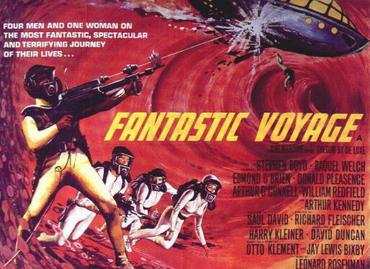
The episode is an obvious homage to the classic 1966 sci-fi film Fantastic Voyage, in which, to save the life of a scientist who could tip the scales of the Cold War, a group of people shrink down to miniature size in a submarine and enter into the scientist's body to try to remove a blood clot from his brain.  I never saw the movie, but in high school (or maybe junior high?) we read the novel by Isaac Asimov.  All these years, I assumed the movie was based on Asimov's novel, but in researching for this blog, I discovered that Asimov's novel was actually that lowest form of all literature:  the novelization of a film.  As distasteful as I find it that the author of the brilliant Foundation series (and the infinitely inferior Robot series) allowed himself to be lowered to the level of creating a film novelization, I was tickled to find that Asimov was very vocal about the gaping scientific inaccuracies int he film, and insisted on correcting them in his novelization.  Due to Asimov being a fast writer, and the film being delayed so much, his novel was actually put out before the movie it was based on.  He wrote a sequel, too, specifically to allow himself to be allowed to take the concept and write something original for it.  So my respect for Asimov remains.

Anyway, again, nerdy aside.  Nevermind.

Fantastic Voyage has been parodied by everything from Futurama, to South Park, to Tiny Toons, and even another Doctor Who story, the 4th Doctor's "The Invisible Enemy" in 1977.  That the show has even done Fantastic Voyage before speaks to what I disliked about this episode:  it's completely well worn territory.  Everything about this episode wants us to believe that it's treading into something that the show has never explored before, and it's not true at all.

The Doctor claims to "learn" in this episode that a good Dalek is possible.  If that's so, he has a very short memory.  The first time Daleks started to develop some sort of positive emotions was in the 1967 Second Doctor story, "The Evil of the Daleks," where the Daleks asked the Doctor to help them develop a "human factor," the set of human characteristics that have been leading to so many Dalek defeats.  He helps them do so, and they begin to question their orders from their Dalek commanders, and begin to be somewhat good, although, being brand new to having emotions causes them to act like children, which I always thought seemed realistic.  And don't forget, the 10th Doctor's "Daleks in Manhattan"/"Evolution of the Daleks" saw Dalek Sec merging with human DNA to become a Dalek with a conscience.  Want an example of a Dalek that didn't merge with human DNA?  How about Dalek Caan in "The Stolen Earth"/"Journey's End" who came to realize the evil of he Daleks and manipulated the timelines to bring their downfall.  Or even the Dalek in "Dalek," who started to realize that, now that he was alone in the universe, there was no reason to cause so much death and destruction.  A good Dalek is hardly a new concept.

I...look...like testicles....
Someone suggested to me that it must have been "devastating" when the Dalek said to the Doctor "You are a good Dalek."  Yes, it must have been devastating, almost as devastating as the last time a Dalek said almost the exact same thing to him in "Dalek":  "You would make a good Dalek."  Davros, in "Journey's End" drew a similar comparison between the Doctor's hatred of the Daleks and the Daleks' hatred of every other living thing in the Universe.  It's a comparison that the Daleks love to make to the Doctor, and it never fails to make the Doctor feel bad because he hates himself enough to believe it's true.  It's something the fans love to buy into, too, because it makes the Doctor sound deep, dark, and twisted.  He's all three of those things, but he's not like a Dalek.

The Daleks are a species that has nothing but blind hatred for every other creature in the Universe, and believe that they are justified in destroying them all.  The Doctor is a man who believes that all life is sacred, and spends all of his lives trying to save every creature he can.  His feelings towards the Daleks are the closest he comes to hate, but only because the Daleks stand in the way of his mission to save all life throughout the Universe.  But even long before this episode, he has always hoped to some day find a way to save the Daleks' souls so that he wouldn't need to destroy them, and always struggles with trying to figure out if his trademark pacifism and commitment to peace makes it justified for him to kill a creature that has no goal in life other than to kill.  It's a profound dilemma for a pacifist, and one he has wavered back and forth on.  When the Fourth Doctor was given the chance to wipe out all of the Daleks before they were even created, he couldn't bring himself to do it, much like the old ethical riddle of whether or not it would be okay to go back in time and kill Hitler when he was a baby.  While the Fourth Doctor couldn't bring himself to do it, the Fifth Doctor says he regrets the decision.  This indecision hardly makes him Dalek-like.  In fact, it makes him the opposite.  If you ask me, the much more devastating thing to say to the Doctor is what Oswin pointed out to the Doctor in "Asylum of the Daleks": that the Daleks have become infinitely stronger in fear of him.

In this episode, we finally get our first few moments with the new companion, Danny Pink.  I noticed that the credits of this episode list it as being co-written by Steven Moffat and Phil Ford, whose only previous Doctor Who credit had been co-writing "The Waters of Mars" with Russell T. Davies.  At first, I thought maybe Moffat didn't trust Ford and helped him write the episode for that reason, but then I noticed that a few other episodes this season are listed as co-written by Steven Moffat.  I have a feeling that, the reason is, Moffat is being a little overprotective about this new character, Danny Pink, and writing some of the more important scenes in Danny's arc by himself, enough that he needs to be given credit in the episodes.  Moffat has a tendency to be very protective of some of his characters.  Only once has River Song ever appeared in an episode not written by Moffat, so he wrote that one scene of "Closing Time" himself, not trusting Gareth Roberts with it.  Only once did he ever let another writer write for the Paternoster Gang, and that's mainly because Moffat seems to have a deep trust in Mark Gatiss that I don't share.

Danny, thus far, doesn't seem like a character I can get to know yet.  We know little about him other than that he's a soldier.  The Doctor's refusal to take the similarly color-themed-named Jordan Blue with him in the TARDIS was an annoyingly heavy handed foreshadowing of the battle the Doctor is going to put up when Danny asks to join the TARDIS crew--a battle, from which, the Doctor will, ultimately, back down.  I assume that Jordan Blue's name being similar is going to lead to some sort of Pond/River style connection, especially since Clara went out of her way to point it out in this episode.

My friend Victor responded to me on Facebook last week with the suggestion that Missy is guarding some sort of digital Heaven, as it would make sense that the Clockwork Droid had died and gone to a digital Heaven.  This, he suggested, could explain the possibility of Missy being River Song, as it's possible that, at a future time, River, now digitally saved in the library, changed her form.  While an excellent idea, I think that Gretchen's appearance in "Heaven" after her very non-digital death seems to question that idea.  Although, since she was essentially killed by robots (the antibodies, not the Daleks, I know the Daleks aren't robots), I suppose her consciousness could have been "uploaded" somehow.

This monkey's gone to heaven!

While we're on the subject, since I assume Missy is a villain, I wonder about Moffat's tendency to associate his villains with religion and religious iconography.  That could be a fun blog some day.

I realize now that there was a major plot thread I forgot to bring up in last week's blog.  In the scene in "Deep Breath" where the Doctor talks with the homeless man (played, in a special cameo, by Brian Miller, widower of the great Doctor Who actress, Elizabeth Sladen) about his new face, he brings up something I brought up before and have been very excited about.

"Do you ever look in the mirror and think 'I've seen that face before?'...Why this one?  Why did I choose this face?  It's like I'm trying to tell myself something.  Like I'm trying to make a point.  But what is so important that I can't just tell myself what I'm thinking?"

I was wondering if Moffat was going to actually follow up on his promise to touch on this.  To explain this exciting new plot idea, I'll use the direct quote from Moffat:

“I remember Russell [T Davies] told me that he had a big old plan as to why there were two Peter Capaldi’s in the Who universe: one in Pompeii and one in Torchwood. When I cast Peter and Russell got in touch to say how pleased he was, I said, ‘Okay, what was your theory and does it still work?' and he said, ‘Yes it does. Here it is…’"

A plot thread thought up by Davies and executed by Moffat promises to be satisfying, and it's something I've always wondered about:  Where do Time Lord's faces come from?

Next week is an episode I'm very excited about, and very worried about.  I make no attempt to hide my...ambivalence about Mark Gatiss.  I don't generally like his episodes, but respect how much he has done for the show, especially in the wilderness years, and feel like we would hardly have a show now if it weren't for people like Gatiss.  I don't hate all of his episodes, but certainly most of them.  Last season was the first season Gatiss submitted two episodes in the same season, and I think he managed to write the first episode of his I truly loved ("Cold War"), and the episode I think might just be the worst episode of the entire revived series ("The Crimson Horror").  Now, he's written the episode about Robin Hood, who was one of my favorite characters when I was growing up.  I'm very excited to see the Doctor meet Robin Hood, and hope that Gatiss pulls more of a "Cold War" on this than a "Crimson Horror."

Thursday, August 28, 2014

The Doctor is Not Your Boyfriend: An Overanalysis of "Deep Breath"

It was much easier last year when each episode had its own unique movie poster.


It's been a long time.  I've been a little lax in the Doctor Who off-season the past few months.  Sorry about that.  But the season's started back up, and much like the Doctor, I'm not quite dead yet.  So let's kick off another season!

First and foremost, I have to bring you my new Doctor Who podcast that I'm a part of.  Ever since the collapse of The 900 Year Diary (RIP), I've been hoping to find a good place to be able to discuss Doctor Who in a group setting with really funny people.  I finally found that place when I got the chance to start a new podcast with members of the Mile High Who Meetup Group in Denver.  Check out the Mile High Who Podcast with my friends Shelly, Scott, and Somer.  "Shit, Trevor, your name doesn't even fit the alliteration scheme!"

Now, onto the blog...

There is only one unwritten, yet highly important, rule when it comes to the first episode for a new Doctor:  this is no time to get fancy.  A debut episode of a new regeneration is not a time to come up with some sort of overly complicated plot.  In the new series, Davies started out by using the Autons to introduce the new Doctor, much the way they were used to introduce the 3rd Doctor (and the first Master, for that matter).  The Autons are always a great villain to use to introduce a new Doctor, because they don't have the most complicated powers or agenda.  Davies's choice to keep the 10th Doctor in bed for most of his premiere episode is still one I strongly disagree with, but the Sycorax were still not that complex of a villain with a fairly simple plan.  And Moffat knew the rule very well with his first episode as show runner, where he had to introduce both a new Doctor and a new companion, and he used a pretty simple plot when the Atraxi simply wanted to blow up the Earth to stop Prisoner Zero.  The reason for this rule is that the first episode is about establishing the character of the new Doctor, not showing off what you can pull with your imaginative, complex science-fiction twists.  This isn't to say that the rule is never broken, simply that you're off to a pretty bad start when you do break it, as was learned with the stillborn relaunch of the series in 1996 in a plot that was somehow dumbed down yet too complicated to allow a proper introduction of the Eighth Doctor to a new generation of fans.

"Deep Breath" isn't the most simple plot that Doctor Who ever produced, but it's simplified somewhat by bringing back an old enemy, albeit one that only appeared once before.  In fact, in both episodes that Moffat wrote to introduce a new Doctor, he seems to have stolen a part of the plot of "The Girl in the Fireplace."  Allowing the episode to rest on a villain that has already been explained six seasons ago gives the script plenty of time to focus on the introduction of a new regeneration of the Doctor--and his relationship with his companion.

While I'm not a Clara hater like many of the fans, I know I've yet to really bond with her and I know that many others have been even more disappointed than me.  A few months ago, my girlfriend pointed me towards an article called We're Losing All Our Strong Female Characters to Trinity Syndrome that she thought I could learn something from.  The article has apparently even caught on enough that I saw it mentioned in the New York Times review of Guardians of the Galaxy so that the author of the article could try to hold up Gamora as an example of a great female character (proving that the author of the review clearly misunderstood the point of the article). The tl;dr of this article is that it's not enough to create a strong female character if she ultimately doesn't do anything to advance the plot (like Trinity in The Matrix) or if her ultimate point in the plot is to be rescued by the male character or to simply make the male character look better as he surpasses her.  There are ways in which the basic structure of Doctor Who unfortunately resists the recommendations this article makes, the same way Doctor Who, by virtue of being about a man traveling around with a woman, can almost never pass the famous Bechdel Test (despite an article of questionable accuracy that recently came out claiming otherwise).  That being said, that doesn't mean that you can't do something to improve the strength of the female characters on Doctor Who, and Clara, while admittedly not following all of the recommendations this article makes, certainly becomes a much stronger character.

When Clara is seemingly abandoned by the Doctor, she's not crazy to despair.  Regeneration is a lottery.  While the core of the Doctor's character is always good, there's no guarantee that every regeneration will come out as kind or as moral as previous regenerations (The Valeyard) or that a newly regenerated Doctor is necessarily to be relied on to protect you (The Sixth Doctor).

You look tense, Peri.  How about a nice throat massage?

This is the first time when Clara really does have reason to despair that the Doctor might not be coming back to save her this time.  And that is when she shines the most!  While the flashback to her first day as a teacher certainly seemed like a bizarre non-sequitor at first blush, it tied into the plot quite nicely, and led her to a tactic that no companion has ever really thought of before:  daring the villain to kill her.  Her logic is sound through and through, and she overcomes a superior physical force with nothing but wits and sheer force of will.  And then the Doctor comes to save her and yadda yadda, but the point is, she kept herself alive long enough for that to happen.  While maybe not a shining moment for feminism, it was certainly a strong moment for Clara.

And Clara's other main role in this episode--the stand-in for all of the shallow fans who have complained about the new Doctor being too old--didn't make me dislike her either, even if it reminded me how much I hate the fans she's representing.  Her flaws in judging the Doctor's new face reminded me that she's not perfect, but never made me feel like she was a bad companion or a bad person.  Just a flawed person, like anyone else.  At first, I wondered why she was so confused as to why the Doctor had changed.  Her insistence that he change back to the Eleventh Doctor seemed bizarre in light of "Time of the Doctor," where she met literally every regeneration of the Doctor.  But it soon became clear that her insistence wasn't based on a misunderstanding, but sheer denial.  She was always aware that the Doctor had past faces that looked older, but she never cared as long as his current face was young and attractive.  The Doctor, as he reminded her and the fans, is not your boyfriend!

I didn't even mind the Eleventh Doctor's not-so-surprise cameo to remind her to stand by the Twelfth Doctor.  Like it or not it was just the kick int he pants that Clara--and the fair-weather fans--needed.  My favorite moment was when Clara accused the Twelfth Doctor of listening in on her phone call, and he had to remind her that he wasn't listening in...he made the call himself!

As for the Doctor himself?  While Peter Capaldi was brilliant in this episode, I still feel like I've yet to meet the new Doctor.  The first episode of a regeneration is always incomplete.  The Doctor is confused and still developing his new personality.  It's usually not until his second episode that he's truly stable mentally, and even then he's still figuring his new personality out a bit.  Ten and Eleven showed this instability a little bit, but not as much as some of the classic series Doctors.  The Fifth, Seventh, and Eighth Doctors each suffered a severe case of amnesia, while the Sixth Doctor attempted to strangle his own companion.

I'm sorry, I just have to post this again because I think it's ridiculous that this ever happened.

By comparison, spending a whole episode in bed is pretty mild.  Twelve really showed the most serious regeneration confusion of the revived series, which is part of why so many fans were confused by Capaldi's first moments at the end of "Time of the Doctor" when he seemed to forget how to fly the TARDIS.  Capaldi played this regeneration effect with true brilliance, particularly his first scene where he seemed confused by basic things like trying to tell people apart by color, gender, or even species.

Yet, the defining moment of the episode for Twelve seems to be when he threw the clockwork droid out of the hot air balloon, killing him.  The Doctor said that killing went against his "programming," and his retreat on that statement may look like the Doctor is going into much darker territory.  The Doctor has always been a strong pacifist...to a point.  True, the Doctor's famous pacifism has developed over time, and has moments of lapsing.  I don't only refer to the Time War--although that was perhaps the most significant lapse--but the Sixth and Seventh Doctors both had their violent streaks.  The Sixth Doctor had moments where he seemingly abandoned pacifism altogether, even shooting a gun at Cybermen, something that would seem to go against his "programming."

Also, this!

Seven was known for being the master manipulator and, while he did not like to kill people, he seemed to find a moral loophole in that he was fine with tricking others into taking their own lives.  Even Nine, Ten, and Eleven, who are supposed to be the true pacifists of the Doctor's regenerations, have lost their tempers against such villains as Cassandra, The Family of Blood, and Solomon the Trader, respectively.

Yet, at the same time, we have to remember that the person he killed was not a person...entirely.  While the clockwork droids had adopted a lot of human parts, they weren't really human.  They weren't really humanoid for that matter.  Whether they constituted true "life" is a question up for debate, and they had reached a point where their death could almost be considered a mercy.  Still, that doesn't seem to negate the fact that the act of killing the clockwork droid was...dark.  The look Peter Capaldi shot directly into the camera right afterwards was proof enough of that.  The Doctor is venturing into darker territory, but don't imagine yet that he's that far removed from his past incarnations.  Yes, it was hinting at a potentially darker Doctor--something Moffat has made very clear that we should be ready for--but we haven't really seen him stray too far from his "programming" yet.

I watched this episode with my friends from the Mile High Who group, and one of the members told me he read that this season wouldn't be as "arc-y" as the last few seasons; this season was to be a return to the one-off style of the Davies era episodes.  While he was delighted by this news, it disappointed me.  Everyone who knows me knows that I love a good, long plot arc.  But thankfully, the episode itself proved that either my friend there misunderstood what he read, or Moffat was simply being Moffat again.  Rule 1.  If there was any question as to whether or not this was going to be an arc-y season, that was answered swiftly at the end of this episode.  And that gives me plenty to theorize about.

First, there's the mystery woman, who IMDB seems to refer to as "Missy."  Her insistence that the Doctor was her boyfriend rang of River Song, but there are too many problems with that--the sheer lack of a place for her in River's timeline, not to mention the fact that this woman seems to be evil.  Another friend of mine suggested she may be the Rani, a classic series villain that many fans have been clamoring to see return, despite the fact that she only ever appeared in two serials of the classic series.  While this is an interesting theory that I refuse to rule out, this barely seems to fit the Rani's modus operandi.  The Rani was, first and foremost, a scientist (a neurochemist to be exact) and, in her first appearance, she showed no signs of wanting to conquer or kill other creatures, but simply to perform experiments, with no regard whatsoever for the intelligent humanoid test subjects she tortured and killed to carry on her experiments.  It wasn't until her second appearance that she took on the normal universe-dominating attitude of a Doctor Who villain.  Furthermore, I can't see why the Rani would refer to the Doctor as her boyfriend.

The Rani attempted to take over the Universe by creating a giant brain,
and it still wasn't the silliest plot of the 7th Doctor era.
I realize there's a good chance that she's a completely original villain, and there's good reason to believe that as Moffat usually prefers to create his own villains rather than pull them from the classic series.  That being said, he has been more warm to the idea of reusing classic series as of last season, where he not only wrote a Dalek episode, but used an obscure 2nd Doctor villain as the season's primary villain.  So I submit my own theory:  with all the rumors that the Master is returning this season, I submit the possibility that Missy is the first on-screen example of a Time Lord regenerating between genders.  I think she could be a female incarnation of the Master.  While this may seem strange considering how seemingly hostile Moffat has been to the idea of a female Doctor, remember Rule 1.  His seeming hostility could be a mislead, and let's not forget that Moffat, for all his professed resistance to the idea of a female Doctor, is actually the first person to really lay the groundwork for the possibility of Time Lord's regenerating between genders.  In the Eleventh Doctor's first scene--which Moffat wrote without accepting a credit in the episode--he fears that he has regenerated into a woman, suggesting that it is possible.

Only on a family show would someone check their Adam's Apple first
when trying to determine if they've changed genders.
Neil Gaiman may have written "The Doctor's Wife," in which the Doctor talks about an old friend of his who regenerated between genders, but it was written on Moffat's watch.  And, most importantly, "The Night of the Doctor" establishes without a doubt that, at least with artificial technology, Time Lords can regenerate between genders.  Also, let's not forget that Moffat's 1999 official Doctor Who parody sketch, "Curse of the Fatal Death," actually shows the Doctor regenerating into a woman.  Is it possible that the Master has taken The Sisterhood of Karn's potion that could have allowed the Doctor to regenerate into a woman?  If so, Moffat is treading on shaky ground.  After all the accusations of sexism, he's not likely to win a lot of fans for creating a female Master before creating a female Doctor...even if he handles it very carefully.

The last question we have before us concerns who is trying to keep the Doctor and Clara together.  At the end of the episode, the Doctor references that--between the woman who gave Clara the TARDIS number in "The Bells of Saint John" and the person who placed the newspaper ad in this episode that brought the Doctor and Clara back together--someone clearly wants to keep them together.  I always operated under the assumption that the woman who gave Clara the phone number was either River Song (God I hope she comes back) or a future version of Clara, or a less likely possibility of it being a surprisingly well disguised Madam Vastra.  We now also face the possibility of it being "Missy."  The interesting thing is that, whoever it is, both allowed Clara to enter the Doctor's life, allowing her to save him from The Great Intelligence, but also led them to the restaurant that was the headquarters of the clockwork droids.  This leaves us in an unusual situation of not only not knowing who is trying to keep them together, but also not even knowing for certain if this mysterious party is friend or foe!

The performance of Peter Capaldi in his first outing as the Doctor, like I said, is truly brilliant, but also doesn't feel like the definitive Twelfth Doctor yet.  In the coming weeks, I hope to learn more about who the Twelfth Doctor is, and what sets him apart from his predecessors.  But one thing is for sure:  despite all the memes and jokes about Peter Capaldi's playing the Doctor like his most iconic role of Malcolm Tucker in In the Loop, Capaldi didn't feel like he was playing Malcolm Tucker.  He felt like he was playing a new regeneration of the Doctor, one that is very different but still tethered to the basic tenets of the Doctor's character and philosophy, and one that I'm looking forward to getting to know better!

SCOTTISH EYEBROWS!