Showing posts with label The Order of Rassilon. Show all posts

Thursday, June 6, 2013

The Order of Rassilon #1: Matt Smith, The Ancient Amateur

Hair, nose, chin.  I guess that everything on Matt is abnormally large...
When I started writing this list about 10 days ago, I had no idea that, when I got to number 1 on the list, that very Doctor would have already announced his retirement, leaving me to write an obituary for my favorite Doctor in the franchise.  When I first saw a picture of Matt Smith, I thought "This is going to be the ugliest Doctor of all time."  I was very wrong about that, as his pure charm and attractiveness shine through when he's moving around.  Matt Smith's Doctor was a truly excitable child with the wisdom of an ancient soul.  Something old, something new...

If you want to talk about big shoes to fill, Smith had his work cut out for him just as much as Peter Davison did, if not moreso.  Smith not only had to replace the most popular Doctor of his time, he had to replace Doctor Who's first real male sex icon, a man whose screaming fangirls could contend with the Beatles' concert at Shea Stadium.  But Steven Moffat said that, while he expected it to take about a season and a half for the audience to accept Matt Smith, he really felt that everyone fell in love with him the second he popped out of that TARDIS and said "Hello, I'm the Doctor."  His first landing on the ground showed his new trademark Doctor stance. The way that Matt Smith moves is simply unique.  The way he stands.  The way he moves his hands.  The way he jerks around exaggeratedly with his head flopping all around.  It just gives this lovably manic quality to him that is both endearing and exciting at the same time.
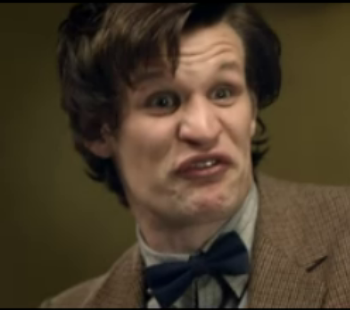
"My anger at the Daleks has turned me into a ferret!"

Where Tennant's Doctor was cool as a cucumber, Smith's was a little different.  He had an unshakable confidence when staring down a Dalek battle fleet, but fell into a bumbling mess when trying to talk to women.  His first kiss with River is hilariously awkward.  I feel like that's the appeal of the Eleventh Doctor to really awkward nerds:  It gives us this hope that, even though we're terrified of everyday social situations, if the chips were really down, we could be just as brave as the Eleventh Doctor.  All the Doctors have shown a striking confidence in themselves to be a primary trait (the Second Doctor appeared to be very terrified and/or stressed, but still knew that he was strong enough to handle the situation), but none have combined it with awkwardness the way Matt Smith did.  That's the brilliance of his performance:  he's awkward and confident, childish and ancient, silly and serious, handsome and gawky, sometimes all at the same time.

Smith was lucky, as well, as he was surrounded with some truly amazing people.  Karen Gillan and Arthur Darvill were the first multi-companion pair since the 5th Doctor's outings with Tegan and Turlough, which was also the last time we saw a full-time male companion.  The "no hanky-panky in the TARDIS" rule that had been instituted in the classic series by Jonathan-Nathan Turner was violated once or twice with Amy, but for the most part hers was a love story that was going on inside the TARDIS, with the Doctor merely as a chaperone.  Traditionally, companions left the Doctor when it was time for them to get married.  Jo Grant, Leela, Peri, and even the Doctor's granddaughter, Susan, all left the Doctor because they fell in love a man they met during their adventure with the Doctor.  The Amy and Rory storyline taught us that that wasn't a coincidence.  The Doctor doesn't want to become too attached to someone.  "He hates endings" River tells us.  The Doctor ducked out on his companions that wanted to get married because he didn't want to see them grow old and die, or become too involved in their new life to stay with them.  Remember the end of the second Whinnie the Pooh book where Pooh just turned back into a stuffed animal because Christopher Robbin grew out of him?  The Doctor didn't want to turn back into the little, stuffed, raggedy Doctor puppet.  He got out first.

Amy was the first and only companion to convince him to stick around and bring her husband with her, allowing their relationship to grow and develop over a decade of their lives (and 300 years of the Doctor's).  It went into a deeper Doctor/Companion relationship than ever before, and not in a simple romance way like the Tenth Doctor/Rose relationship.  Colin Baker at Denver Comic Con last weekend said that he thought the Doctor and his companion should not even notice that they are of different genders, and that it should be a strictly paternal relationship.  The Doctor's relationship with Amy, despite her early on misinterpreting it as sexual, was actually extremely paternal.  Rory was, in some strange ways, a son-in-law to the Doctor, which made them both friends and, in some cases, rivals.

The Eleventh Doctor's awkwardness with women made you wonder how the First Doctor could possibly have had a granddaughter.  Thus, it only makes sense that the woman to win his heart would have to be someone assertive enough to be the pursuer.  Thankfully, Moffat had just such a character lying around ready to be used from an earlier episode he wrote in the David Tennant era:  the aggressive, and sexually aggressive, River Song, played brilliantly by Alex Kingston.  Moffat claims to have not had a plan for River when he wrote "Silence in the Library" (I'm not sure if I believe him), but it seems funny that a character who was created before the Eleventh Doctor had been cast actually turned out to be a better match for the Eleventh Doctor than for the Doctor she originally appeared with.  River became an important part of the Eleventh Doctor era.  The entire era is defined by the characters of Amy, Rory, and River.  Jenny, Vastra, Strax, and Clara, who are the primary supporting characters at the moment, really seem to be more of an entourage that's been made in preparation for the 12th Doctor.  The Pond family was the real focus of the entire effort:  Amy (mother), Rory (father), River (daughter), Doctor (son-in-law).  Yet, while these may have been the biological and legal labels for how they relate to each other, in a brilliant irony, the way they act towards each other completely flips these relationships around.  The daughter and the son-in-law end up actually being the experts, becoming parent figures for their own parents/in-laws.

This should be hanging over the fireplace in the TARDIS.
Alex Kingston and Matt Smith were a match made in heaven.  She was sexy and fiercely independent.  He was horrified of her sexually, and she was almost his equal intellectually.  While they may have disagreed about the neccesity of violence in battling evil, the Doctor always respected River's ability to get things done.  Moffat once said that he had an endgame planned for Amy, Rory, AND River.  I can't imagine how there could be an endgame for River, as her first appearance was her death.  It would be a tough way to write her out of the show at this point.  Hopefully, she'll stick around to annoy the 12th Doctor.

Most importantly, Matt Smith was backed up by the greatest writer in Doctor Who history:  Steven Moffat.  Those people who say that Moffat ruined Doctor Who and want Russel T. Davies back must be the kind of people who would wait in line for an opening night screening of Fast and Furious 6 and call The Godfather boring.  Moffat's writing is light years ahead of even the best of Davies's episodes.  He created fascinating stories that didn't just lean back on the classic villains for excitement.  With the exception of the Great Intelligence, most of the season-arcs were focused more on a new villain that Moffat invented, most notably The Silence.  Not seen until "The Impossible Astronaut," The Silence are implied to have also been secretly involved in the explosion of the TARDIS, meaning that they were the primary villain of the entire era, despite appearing in only 3 episodes.  In all of Moffat's season finales, classic series villains and races show up, but they are always side characters, added for flavor, who serve as extra menaces in an episode about something else.  A Dalek attacks the Doctor in a library, but while trying to repair the universe from a Silence plot.  Another Dalek gives the Doctor the information about trying to find the Silence.  A Silurian and a Sontaran appear in "The Name of the Doctor" but, unlike the classic series, they are exclusively protagonists of the stories.  Moffat took his own original, imaginative stories and sprinkled them with a little bit of familiar Doctor Who flavor by placing these iconic characters in the background.  It's distinctly Doctor Who, and distinctly Moffat.

Moffat's most unique talent is actually steeped in a Freudian concept called "the uncanny."*  While this isn't something Moffat has ever cited as an inspiration for his writing, the definition of "uncanny" sounds strikingly Moffatian:  "The uncanny is a Freudian concept of an instance where something can be familiar, yet foreign at the same time, resulting in a feeling of it being uncomfortably strange or uncomfortably familiar" (from the Wikipedia page).  Moffat says he does just that:  he tries to make something strikingly unfamiliar, grotesque, and horrifying out of something that is commonplace and familiar.  He's done this with gas masks, clockwork toys, statues, dust in sunbeams, "the smilers," whispers in the darkness, and, most recently, wi-fi.

"Are you my mummy?"
The truly terrifying concepts behind Moffat's best episodes are emphasized perfectly by Matt Smith, whose Doctor is so optimistic and brave that the darkest moments of the Eleventh Doctor's era become less scary when you realize exactly who is standing in the way of these monsters:  A man who, unarmed, can taunt an entire fleet of ships, telling them to come and get him.  Matt Smith's Doctor is the man who stands firmly in the way of everything terrifying in the Universe.  He is what monsters have nightmares about.

Now, as he departs, he will leave behind a legacy of being in the shadow of what many will continue to call the greatest Doctor in the new series, or possibly in the whole franchise.  Few will give Smith the credit he deserves for being his own, unique, and brilliant version of this 50 year old character.

The age of the David Tennant vs. Tom Baker debate is over.  Long live the age of the Matt Smith vs. David Tennant debate!


It's a tie, guys!  You're both pretty!
*I owe this concept of linking Moffat to "the uncanny" to someone I saw at the Popular Culture Association conference.  I don't remember her name, but can look it up upon request.

Wednesday, June 5, 2013

The Order of Rassilon #2: David Tennant, The Phoenix

Seriously, you try to go through Google Image search and decide from thousands of different pictures of David Tennant looking handsome.
Just as Patrick Troughton had to sell the whole idea of regeneration for the very first time, David Tennant had to sell the idea for a whole new generation who had just been introduced to this new version of Doctor Who and knew nothing about the classic series.  In the long run, it was probably for the best that Christopher Eccleston left after one season, as it allowed the show to reintroduce the concept of regeneration before the audience got really attached to a new Doctor.  But it certainly helped that the salesman for this concept truly believed in his product, because not a single Doctor in the history of the show has ever, ever loved Doctor Who as much as David Tennant, the man who is most responsible for raising Doctor Who from the ashes.

Tennant was an obsessive Doctor Who fan growing up and was said to be able to quote "chapter and verse" from the classic series.  If it looks like the Tenth Doctor is having a really fun time running around and being brilliant, it's because David Tennant really is having a fun time.  I don't think anyone had as much fun as Tennant.  When he left the show, he said it wasn't because he didn't ever want to reach the point where this became just a job.  He wanted to leave it while it was still the most amazing thing in his life and didn't want to spoil that memory by keeping at it until it stopped being fun.

Colin Baker, at this past weekend's Comic Con in Denver, said that he noticed that there were never many female Doctor Who fans in America before David Tennant.  He said there had been plenty in England, and there always had been, but David brought in the female audience from America for the first time because of his sex appeal.

"Oh my God, the way he makes his hair look ruffled, but in a careful way that clearly took a great deal of effort, makes him look so laid back and casual!  It's so sexy!
The only thing that really holds Tennant back from the #1 spot on this list is this man:

"What a sad little episode.  I know, I'll put a Dalek in it!  Did you care about this episode before?  I didn't.  Now there's a Dalek.  It's exterminating!  It's mean!"*

Russel T. Davies, as I've said before, was a fantastic show runner, but not a very good writer of individual episodes.  Davies engineered a perfect comeback for the series.  It really looks like he watched Philip Segal's failed attempt to pilot a revived Doctor Who series in 1996 with the made-for-TV movie.  However Davies had an annoying tendency to come up with good plots that he was unable to resolve with a satisfying ending.  His season finales lazily leaned on the Daleks way too much.  While sometimes a fun jaunt, there was little substance to Davies's stories, particularly his season finales.  The notable exceptions were Davies's much darker Season 3 3-part finale (the only one without Daleks) "Utopia"/"The Sound of the Drums"/"The Last of the Time Lords," Davies's brilliant, low-budget, last minute written episode, "Midnight," and the surprisingly intelligent "Turn Left."

Tennant might have made it to the top of my list if he hadn't been speaking the words of such a mediocre writer.  Tennant's best episodes were generally written by people other than Davies.  "The Impossible Planet"/"The Satan Pit," "Human Nature"/"The Family of Blood," "School Reunion," and "The Planet of the Ood" were some of the finest examples of the Tenth Doctor era.  But, if you haven't guessed, I'm a pretty big fan of Steven Moffat, and I will obviously put up Moffat's 3 Tennant episodes as the absolute best of the Tenth Doctor era:  "The Girl in the Fireplace," "Blink," and "Silence in the Library"/"Forest of the Dead."  Had Tennant been working with Steven Moffat as show runner and head writer, he'd be on the top of this list as his immense acting skills would be combined with the intelligence of Moffat's scripts.

In fact, it was Moffat's writing that bumped a certain other Doctor up to the #1 spot on my list...


+10 nerd points if you can figure out what non-Who related show I'm parodying with this caption.

Tuesday, June 4, 2013

The Order of Rassilon #3: Tom Baker, The Original Mad Man

COUNTESS: My dear, I don't think he's as stupid as he seems. 

SCARLIONI: My dear, nobody could be as stupid as he seems. 


-"City of Death"

Tom Baker had the most companions of any Doctor who wasn't played by a senile old fool.
For a lot of people, Doctor Who begins and ends with Tom Baker.  He holds the record for lonest running Doctor.  He was the first to have his episodes broadcast in America.  He had the greatest companions of the series, from Sarah Jane, to Leela, to both Romanas, and, of course, K-9.  He made the role more fun than any of his predecessors.  It would take 6 more regenerations before anyone even started talking about someone else as the best Doctor in the franchise.  There wasn't much reason to even take a poll as to who was the most popular Doctor.  His image has become so associated with the franchise that he's been parodied and referenced in The Simpsons, Family Guy, and even Paris Hilton in a Saturday Night Live sketch:

I'm not sure Tom Baker should be proud of this, though.
I had a really hard time writing this one up, because what hasn't already been said about him in 32 years?  You don't explain to someone why Tom Baker was great.  He just...was!  A man lucky enough to become the Doctor while working as a brick hauler (his role as an evil sorcerer in The Golden Voyage of Sinbad may have won him the role, but he still wasn't rich yet) quickly won over the public with his portrayal of the Doctor as a whimsical mad man.  From his first appearance in "Robot," you could see that he was a very different kind of Doctor.  It's an interesting episode because, he seems to have gone off of his rocker in the regeneration, turning into a raving lunatic, but he later turns out to be fully in control of the situation.  That was usually his M.O. for the whole show.  He was a seemingly flighty, crazy person bouncing around the room like a curious child, but Tom Baker's Fourth Doctor was always way more in control of the situation than he let on. He rarely panicked.  He rarely raised his voice.  He didn't need to.  He was playing an elaborate chess game that nobody else knew they were playing with him.  He was, to paraphrase the Eleventh Doctor, the original madman with a box.

This is what it would look like if the Crypt-Keeper was given Buster's hand from Arrested Development
Reports from the set suggest that Tom Baker was a really love-him-or-hate-him kind of guy.  There were those who he truly loved, like Elizabeth Sladen, to the point where the writers left Baker and Sladen to write their own farewell scene together.  He married Lalla Ward, the actress to play his final companion (not counting the ones he really just picked up for the Davison era), making them the first--and, to date, only--Doctor and companion to marry on the show.

Take one look at this woman and realize that this is why Tom Baker is luckier than you've ever been.
Lalla Ward's marriage to Baker, however, lasted only 16 months.  When asked once what her favorite Doctor Who monster was, she answered "Tom Baker."  Whether this was real animosity or just a joke is hard to tell, but if it was true, it would make sense alongside so many other people's complaints about Tom Baker.  Amongst those that Tom Baker did not like were Anthony Ainsley (The Master), Jonathan-Nathan Turner (executive producer from the end of the Tom Baker era through the end of the classic series), Matthew Waterhouse (Adric), and Janet Fielding (Tegan, who, admittedly, has been bitter towards the entire franchise since she left).  Thankfully, Baker got along very well with his co-stars (excluding his two final-days companions mentioned above) accounting for his exceptional chemistry with all of them, but he was known for yelling at the producers about how they wanted him to play the part, and yell at the cast members in ways that made him a sort of proto-Christian Bale.

Tom Baker was lucky in many ways, most notably for one season of the show he was lucky enough to have, at the head of the writer's table, the second best writer in the history of the franchise (after Moffat, of course) the late, great Douglas Adams.  While there, Douglas Adams wrote two and a half brilliant serials for the Fourth Doctor:  "The Pirate Planet," "City of Death," and "Shada."  The third was cut short because of a BBC strike and, for some reason, the BBC chose to punish the strikers by not letting them finish filming "Shada."  Two versions are now available, though.  One is a flash animation that swaps the Fourth Doctor out for the Eighth.  One uses the footage they did shoot from "Shada," and fills in the gaps with still photos as well as narration from a stoned/drunk Tom Baker in the 1990s.

I can see Daleks on the ceiling!

Some rumors also suggest that Adams secretly wrote "Destiny of the Daleks" and put Terry Nation's name on it as a courtesy to the creator of the Daleks (this is helped by the Hitchiker's Guide reference in the serial).  His third Hitchiker novel was actually a Doctor Who story he came up with but never got a chance to write, so he changed the characters.  If you've read the Hitchiker's novels (and if you haven't, stop reading this and start reading them), then you know that Adams is skilled at both humor and high-concept science fiction ideas.  His guidance made some of the best Doctor Who writing of the classic series.  The episodes Adams wrote himself are, without questions, the best of the classic series, and it's because of the dual talents of Tom Baker and Douglas Adams.

While Tom Baker played the role longer than anyone, he has been more reluctant to make return appearances than anyone else, with the notable exception of Eccleston.  He pulled out of "The Five Doctors" at the last minute, forcing them to use archival footage to replace him.  He refused to take part in any of the Doctor Who audios until 2009, even forcing them to have another actor impersonate him in one of the audio adventures in 2006 because of Tom Baker's refusals to return.  It's easy to understand why he would want to break out of the typecasting of his role.  I certainly get tired of being "The Guy Who Wrote the Hitchcock Poem."  But when you play one of the greatest science-fiction icons of all time for seven years, sooner or later, you have to realize that this is a great thing that you don't need to run from.  He's 79, and hopefully he's realizing that there's no point in spurning his Doctor Who legacy.  Now, if we could just get one guest appearance by him in the new series, many Whovians would be able to die happy.

Monday, June 3, 2013

The Order of Rassilon #4: Colin Baker, The Wrongfully Accused

Haters gonna hate
As I write this right now, it's about one week before I go to the Denver Comic Con to meet Colin Baker himself.  I tried 4 times to ask the Denver Comic Con when Colin Baker would be appearing.  They only responded to me the third time, and that was because I was fucking furious with them.  Finally, I emailed Colin Baker's personal website, and got a response from Baker's webmaster within  hours (which he at least claimed he got from Colin himself) and told me to introduce myself as the guy who emailed him to ask when he would be there.  This exchange confirmed something I already knew deep down:  Colin Baker had to be moved up on my list.  Where Tom Baker was the most popular Doctor of the classic series and now avoids audio productions and conventions like they're the plague, Colin Baker, who has more reason than anyone to feel completely screwed over by the franchise, is more loyal to the show and his fans than almost any Doctor in the history of the show.

You can consult my book report on The Valeyard or the Topless Robot article I cited as one of my main sources to see how much I think Colin Baker got completely fucked over by the BBC.  Colin Baker did an excellent job of portraying the Doctor.  It just happened to be a Doctor that was the exact opposite of what the fans wanted to see.  The writing can't even be blamed, as many of Colin Baker's supporters have tried to claim.  The writing was actually excellent.  Colin Baker's acting was excellent.  What was wrong was the way in which the writers and producers read their own audience.  They went darker with the stories, and made the Doctor meaner, and both turned out to be choices that the audience sternly objected to.  They weren't bad plot choices, but they were a stark contrast from the Davison era.  Virtually no Doctor in the history of the show had to steer such a drastic change in tone, and, had the public been ready for it, he would have been praised for his masterful handling of that change.

Kill it!  Kill it with fire!
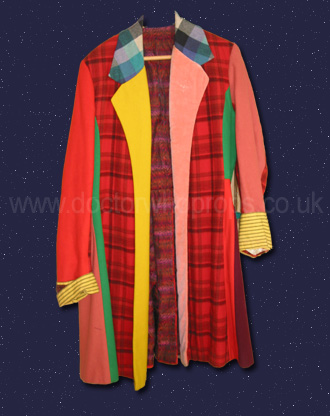
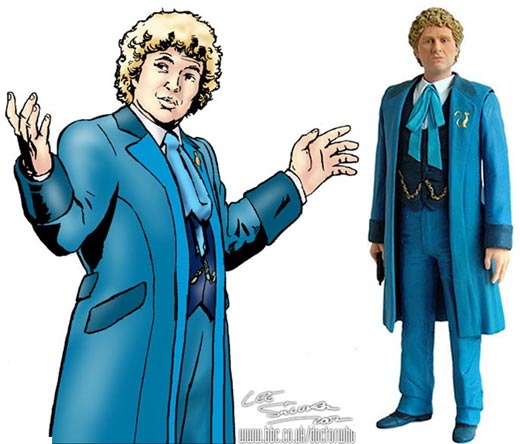
Some of the criticism can also be blamed on Baker's hideous outfit.  However, as has been pointed out repeatedly, Colin Baker himself objected to it.  The Doctor's outfits had become sillier and sillier, starting with Troughton's fur coat, and then getting weirder with Pertwee's dandy outfit (which he put on as a joke that the producers did not get), Tom Baker's ludicrous scarf (an accident on the behalf of the costuming department), and Davison's decorative celery.  For some reason, Jonathan Nathan-Turner (who I honestly think was trying to commit television suicide by sabotaging the show) thought the Doctor's outfit should be wild and crazy to highlight the Doctor's alien nature, and demonstrate how he failed to understand fashion.  Even if you buy that as a logical explanation, you have to wonder why every single person who met the 6th Doctor didn't shout "What the fuck are you wearing?  And why the fuck do you have a cat pin on your lapel?"  Baker wanted to wear black to highlight the fact that he was playing a darker Doctor, but, personally, I can't imagine Colin Baker in any black outfit that wouldn't make him look like the guy on the Quaker Oats box.  In some of the expanded universe media, mercifully, a different outfit was introduced for him called the "Blue Variant."  While it's much better looking, it doesn't change the fact that the Sixth Doctor, in his timeline, must have gone back to his hideous clown suit after the blue variant, because he died in it.  But at least someone said "Hey, the Sixth Doctor deserves better than this quilt from hell" and they gave him this:


Despite its unpopularity, though, the Sixth Doctor's obnoxious costume, probably because of its uniqueness, is one of the most common Doctor costumes at conventions.  It's hard to dress up as the Ninth Doctor because his costume isn't distinctive.  Nobody can say the same of the Sixth Doctor.

Personally, I love it when Doctor Who gets really dark.  The fun of the deep, dark, terrifying moments of the show is the moment when the Doctor stands up and says "No.  Not here.  Not this time.  Not while I'm here."  The darker it gets, the better it is when the Doctor brings the light.

Had Colin Baker been allowed to continue the role as he should have, he would have been playing an arc that would see the Doctor go from a brash and pompous regeneration to a much calmer and kindly version of the Doctor after the death of his companion, Peri.  It would have been a difficult arc to carry off, and a marvelous feat if done correctly, but I think Baker probably could have handled it.  Frankly, once the show was put on 18 month hiatus after the first Colin Baker season, they would probably have been better off just going back to what they were working on with this arc.  Instead, they did "The Trial of a Timelord," which is fascinating as a metaphor for what was happening to the show, but which made very little sense in the end.  The Colin Baker era might have lasted longer had they stuck to their guns.

As it is, we saw a very complex Doctor in the Sixth incarnation.  Even though, during his regeneration crisis in his first serial he attempted to strangle his companion and also cravenly tried to give her up to save his own life, this soon proved to be a temporary problem caused by a very difficult regeneration.  Once he got adjusted again, Colin Baker portrayed a character whose pompousness and brashness didn't completely conceal the Doctor's love for all living creatures and his generous nature and spirit.  Those who see the Sixth Doctor as nothing more than a blowhard are missing the point.  He was a blowhard on the outside, but Colin Baker made sure that, underneath the surface, the Sixth Doctor was still, without a doubt, a Doctor.

Hopefully, by the time this is published, I'll have met the man and be able to tell you about that experience.  Until then, know that The Horror of Fan Blog loves Colin Baker, whether you like it or not.

Sunday, June 2, 2013

The Order of Rassilon #5: Peter Davison, The Young Doctor

No reason was ever given as to why the Fifth Doctor was wearing a cricket uniform.
He only played cricket once. 
When Tom Baker was ready to leave, the producers of the show were scared shitless.  How on Earth do you replace such an iconic actor as Tom Baker?  In addition to completely redefining the role, Tom Baker had been the first Doctor whose episodes had been broadcast in the US, so Americans thought Tom Baker was the Doctor.  So they came up with a pretty brilliant idea:  find someone that the public already knew and loved to play the Doctor.  So they gave a call to Peter Davison, who was already a household name for his role as Tristan Farnon on All Creatures Great and Small.

I tried to find this video from the "Castrovalva" DVD (Davison's first episode) which had this great video featurette called "The Crowded TARDIS" which showed one of Peter Davison's first interviews after being cast as the Doctor and you wouldn't believe how unimpressed he looked at the prospect of being the Doctor.  I couldn't believe it!  How could you not be excited about being the Doctor?


But his performance didn't reflect the same apathy.


The Fifth Doctor era was meant to be more of a back to basics era.  The sonic screwdriver was retired as part of the show's attempt to get away from both horror and humor in favor of more scientifically based stories.


Science and realism.  That's what the 5th Doctor era was really about.
Peter Davison was the youngest Doctor of the classic series era, but he still pulled off the ancient wisdom of the Doctor.  Despite Steven Moffat's insistence that the Doctor should always be an old man, he cites Davison as his favorite Doctor (and also cast the first Doctor younger than Davison, so, Rule 1).  Moffat once pointed out, quite correctly, that Davison set the model for all of the young Doctors we would see in the revived series.  He was dashing, handsome, and charming.  He made the Doctor look young and sexy for the very first time in the history of the series.

"I'm the Doctor, I can save the universe using a kettle and some string, and look at me, I'm wearing a vegetable"
Yet, Davison's Doctor was much more serious than his predecessor.  Tom Baker's Doctor very rarely stopped joking around.  He was always quick with a quip, no matter how seemingly dire the situation.  Davison's Doctor could see the severity of dangerous situations, and could mourn for the first (and, thus far, only) companion to actually die on the Doctor's watch.  It was a truly sad and dark moment that couldn't have been handled with the appropriate weight even by Tom Baker (even though, as you've probably already realized, he's higher on my list than Davison).

In 2007, Moffat wrote the brilliant mini-episode, "Time Crash," which, despite being only a few minutes long, was the first multi-Doctor episode of the revived series, and made Peter Davison into the first (and, it looks like, only) classic series Doctor to appear in the new series.  Let's use the words of Moffat, the master writer himself, to explain why Peter Davison was so utterly awesome:


Saturday, June 1, 2013

The Order of Rassilon #6: Patrick Troughton, The Doctor Who Did The Impossible

Patrick Troughton next to two men in Yeti costumes, demonstrating the ridiculousness of Troughton's fur coat
There are a lot of Doctors who had big shoes to fill, most notably Peter Davison and Matt Smith.  But none had a more impossible task ahead of him than Patrick Troughton.  While the show had already survived a replacement of every single companion, Troughton had to sell the idea of a completely new actor playing the Doctor!  Think of how many television shows you've seen that have had major cast changes after being on the air for years and building up a large fan base.  Now think of how many of those survived.  From Scrubs to The Man Show to That 70's Show to The Profiler to All in the Family to Happy Days, almost no television show can survive a radical change in cast members.

The only franchise I can think of that survived such a radical change is James Bond, and let's face it, they didn't do it as successfully.  Sure, the franchise survived after George Lazenby replaced Sean Connery and is still highly successful to this day, but how many people actually think Lazenby, or any of the other Bonds, surpassed Connery.  In fact, I had to look up on Wikipedia who the second Bond was because, of course, nobody fucking remembers him.

Additionally, it should be remembered that, in the regeneration from the First to Second Doctor absolutely no explanation was given for why the Doctor changed!  None!  The Doctor just laid down really tired, and woke up looking younger.  It was said that the Cybermen, as they left, took the Doctor's energy with them somehow, but no explanation was given as to why he turned into a new guy instead of dying.  Sure, the Doctor's companions at the time, Ben and Polly, certainly thought it was strange, and continued to comment on it throughout the entire episode.  But the word "regeneration" wasn't even used on the show until the Third Doctor regenerated into the Fourth, and the phrase "Time Lord" wasn't used until the Second Doctor's last episode.  So not only did Troughton have to sell this impossible idea, he had to do so without any explanation being provided in the script.

The fact that he pulled this off was a miracle.  Perhaps a good deal of it can be attributed to Troughton's likability.  Troughton was about 180 degrees from Hartnell's Doctor.  While this could have been a reason for the transition to fail, it somehow succeeded beyond their wildest dreams.  Where Hartnell was brash and hostile, not really being very kind to anyone including his own poor granddaughter, Troughton's Doctor had a lust for life and a love for all creatures.  He was whimsical and kind.  His trademark recorder playing made him such a quirky, strange old man that you couldn't resist.  If Hartnell was your mean old grandfather, Troughton was your grandfather on the other side of the family who always had candy in his pocket for you and loved to play "got your nose."

I'm not sure what's happening here, but it looks completely heterosexual.
And if Hartnell's dedication to the show should be praised, Troughton's should be moreso.  The upcoming 50th Anniversary special will officially be the first, full-length multi-Doctor episode to not feature Patrick Troughton, and, if he wasn't dead, he'd be in it in a heartbeat.  Nobody was game to come back for future episodes as much as Troughton.  Few were as proud of their time on Doctor Who as Troughton was.  He became a model for many of the later Doctors, including both Peter Davison and Matt Smith.  It is because of Troughton that future Doctor's were known for their sense of humor, because we know for damn sure that Hartnell's Doctor didn't have one.  Troughton made the TARDIS more fun.

Sadly, when the BBC purged their archives and threw out a lot of the old black and white Doctor Who episodes, they mostly threw out Troughton episodes.  Very few of his serials remain fully in tact.  But of those that do, I highly recommend "The Mind Robber" (which is available on Netflix), "The Tomb of the Cybermen," and his appearance opposite the 6th Doctor in "The Two Doctors."

Friday, May 31, 2013

The Order of Rassilon #7: Jon Pertwee, The Dandy Scientist

Here the Doctor wears something that looks like a cross between a cape and a life jacket.

Most actors to play the Doctor took something from their predecessors.  Where the First Doctor was old and crotchety, and the Second Doctor was full of pure whimsy, the Third Doctor was whimsical and crotchety at the exact same time.  He could be somewhat old fashioned at times, and then, at the same time, he wore a fucking cape!

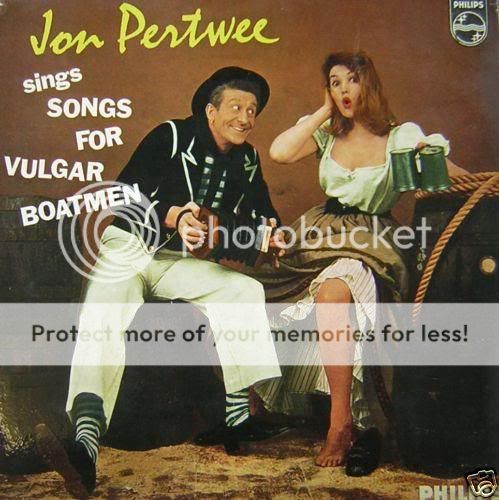
While most actors who play the Doctor have a background in classical theater, Pertwee, in his pre-Doctor career, was actually much more of a comedian than you would have guessed from his stuffy-ish portrayal of the Doctor.  He put out a series of novelty music albums, including one that has one of the greatest album covers I've ever seen, Jon Pertwee Sings Songs for Vulgar Boatmen:

Jesus, Pertwee looks creepy!
The Pertwee era is really interesting in that it was the first time a major change was made in the format of the show:  The Doctor was exiled to Earth as a punishment by his own people, the Time Lords, his TARDIS was disabled, and the knowledge of how to fix it was erased from the Doctor's brain.  It made a formula for a very, very different type of show.  Sure, by the end of the Pertwee era, the TARDIS was usable again, but Perwee carried the show as it moved almost exclusively to Earth in the present.  It was a wonderful experiment and, while not one that could or should have been carried on beyond a few years, it was still a great idea for a short term change up in the plot of the show.

Pertwee played a Doctor who was irritated with his situation, but also looking to make the most of it.  Trapped in 20th Century Earth, he teamed up with alien-hunting military organization, U.N.I.T., and the irreplacable Brigadier Alistair Gordon Lethbridge-Stewart.  Pertwee did an excellent job of portraying the Doctor's pacifism as it came into inevitable conflict with the military nature of the Brigadier and his organization.  Yet, he could still seem to see the good that U.N.I.T. was doing.  Pertwee and Nicolas Courtney (who played the Brigadier) had a perfect chemistry as two friends who are frustrated by each other, and yet still appreciate each other immensely.

Pertwee's era was marked by the unfortunate death of Roger Delgado, the original actor to play the Master.  (Maybe I should do a ranking of Masters?)  Pertwee and Delgado had a perfect chemistry as well, as two old enemies who still seemed to have a respect for each other's intelligence buried beneath their animosity.  The scene in "The Sea Devils" where the Doctor visits the Master in jail and feels sorry for him for a moment, telling his companion how they used to be friends in school, is a touching moment.  When Delgado was killed in a freak car accident, Pertwee had a lot of trouble going on.  He had created such a good friendship off camera with Delgado, that he eventually cited it as one of the reasons he left.

Ultimately, Pertwee did a lot for the series, including showing how flexible the basic premise of the show was.  The only real downside of the Pertwee era was their attempt to portray the hippie movement (like all television, they were about one decade behind the times) through Jo Grant, who was more of an insult to the 60's counterculture than anything, as she was portrayed by Manning as a blithering idiot.


Also, this ridiculous shit happened.
Thankfully, she was replaced with Sara Jane Smith, who showed that feminists aren't all dumb rich college girls.  Seriously, Jo Grant was an idiot.

Thursday, May 30, 2013

The Order of Rassilon #8: Paul McGann, The Forgotten Doctor

Paul McGann in the expanded universe outfit that doesn't make him look like a pansy from the 1800s
Paul McGann had the unfortunate dishonor of only appearing on screen as the Doctor in one made-for-TV movie.  And he didn't even get to be in the full 90 minutes of the movie.  Sylvester McCoy spent about the first third of the movie as the Doctor before regenerating into Paul McGann's 8th Doctor.  On top of that, he was stuck in one of the worst stories of the entire color era.  Possibly the worst in the history of the franchise.  Even the most boring episode of the Hartnell era at least has an interesting science-fiction concept that was trying to be intelligent.  They never did anything as stupid as "The Master wants to blow up the Earth using the Doctor's TARDIS and then steal the Doctor's body."  Vin Diesel films have more complex plots than that.  Add in the most horrible line ever uttered in Doctor Who--"I'm half human, on my mother's side" (the expanded Universe material, thankfully, retconned this)--and you have one stinker of a movie.  It was an attempt to restart the series, making the made-for-TV movie a sort of backdoor pilot.  I could write an entire blog post about why this failed, but for now, just take my word that it was shockingly misguided.

None of that was McGann's fault, though.  When offered the chance to restart the most iconic science-fiction franchise in the history of your country, you'd take it, wouldn't you?  And you'd probably be willing to suffer through a pretty shitty pilot if you thought there was a chance at a much better show to come, wouldn't you?

What redeemed McGann in the eyes of Whovians, though were the Big Finish Audio Adventures.  Big Finish in the early 90's started doing a series of individual, one off adventures, randomly cycling between Peter Davidson, Colin Baker, and Sylvester McCoy, as they were the only ones who were up for it and not dead (because if Patrick Troughton could have done it from his grave, he'd jump at the chance).  Then McGann jumped on board, and people were so excited to hear more stories from the Eighth Doctor, that McGann got his own spin-off series of audio stories called "The New Eighth Doctor Adventures."  The stories are a lot of fun because, where the television show has to be able to appeal to casual viewers who are just flipping through the channels, if you've gone through the trouble of digging out a New Eighth Doctor Adventure, you're not a casual fan.  So that opens up the opportunity to bring in really obscure villains like Zygons, Eight Legs, and Ice Warriors.  It also works it into a long, interesting plot arc that's as strong as anything Steven Moffat has written.  Strong story arc + Super fanboy references = One of the most exciting stories in the franchise.  And it all hinges on the excellent performances of Paul McGann and his spectacular chemistry with Sheridan Smith, who plays his companion Lucie Miller.

After the departure of Lucie, a sort-of 5th season of the series began called Dark Eyes, which introduced a much less interesting story and companion.  But the four seasons of The New Eighth Doctor Adventures definitively prove that, had there been a revived series of Doctor Who in the mid-90s, and if it had been given strong writers, it could have been extraordinary!

Wednesday, May 29, 2013

The Order of Rassilon #9: Sylvester McCoy, The Master Manipulator

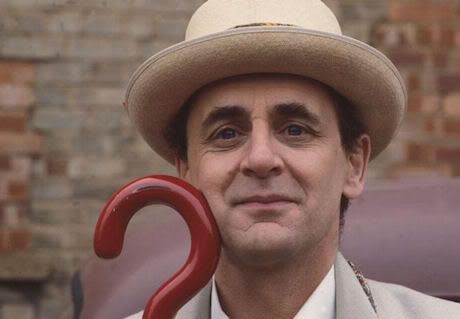
For those of you who may have been wondering, it's not a fedora, it's a pork pie.

Here, we start really getting into the category of my least favorites, rather than the ones I actually dislike.  Sylvester McCoy was brilliant, there are just a lot of brilliant men ahead of him on my list.  McCoy had one of the hardest acts to follow. Unlike Matt Smith and Peter Davidson who had to follow in the footsteps of the most popular Doctors of their eras, or Patrick Troughton who had to follow the original Doctor, Sylvester McCoy had to follow up the most unpopular Doctor in the history of the franchise.  Colin Baker's era (not Colin Baker himself, the era, I need to stress that) nearly killed the series.  The three years that they got with Sylvester McCoy seemed more like a courtesy granted by the BBC simply because the show was so iconic.  The show lasted 26 seasons, but really, it was cancelled in season 22.  McCoy was brought in as a very last ditch effort to save a franchise that was already doomed.

I've said it before and I'll say it again:  Doctor Who is written on drugs.  I don't know what their plan was to save the series after the Colin Baker era debacle, but it seemed to involve much harder drugs, because the 7th Doctor's episodes got fucking bizarre.  On a Doctor Who message board, I once challenged anyone to try to explain to me the plot of the 7th Doctor episode, "Ghost Light."  Surprisingly, several of them could explain it, although at least one of them admitted to be on drugs himself when watching the episode.  But it's known that all of the actors in the episode were confused as fuck as to what was going on.

There also seemed to be a little bit of a "fuck you" to the critics of the 6th Doctor era during the 7th Doctor era.  Because, while the show was trying to rebound from accusations of it being gruesome, dark, and starring a pretentious Doctor, they only fixed two of these three things.  Sylvester McCoy was more likable, the stories got less visibly violent...but the Doctor got crueler.  What Sylvester McCoy's Doctor is known for is for being a master manipulator.  I truly believe that, when the 10th Doctor, in "The End of Time," talked about getting so good at killing that he could trick people into killing themselves, he was talking about the 7th Doctor.  7 was so jovial, like an eccentric (young) grandfather.  But just beneath the surface was a boiling anger.  And he didn't need to unleash that fury in a fiery rage.  He would slowly manipulate his enemies into creating their own destruction for him.  He didn't get mad.  He got even.  Few people complained about the violence in this era, because it wasn't as blatant.  The Doctor didn't try to strangle his companion or throw someone in an acid bath, but he did destroy Skaro by simply leading the Daleks into thinking they wanted a certain object, a weapon, without telling them that it would actually destroy the planet.  The extent to which the Doctor's pacifism applies to Daleks varies wildly, as it is certainly an interesting ethical conundrum for a pacifist to decide whether or not it's wrong to kill a living, sentient being whose only purpose in life is to kill.  But in "Remembrance of the Daleks," the Doctor's speech to Davros as he and his planet burn together is bloodcurdlingly cold.  Nothing Colin Baker's Doctor did was nearly as...devilish.

DAVROS: You have tricked me!
DOCTOR: No, Davros. You tricked yourself.
DALEK 2: Omega device returning.
DALEK: Impact minus twenty five.
DOCTOR: Do you think I would let you have control of the Hand of Omega?
DAVROS: Do not do this, I beg of you.
DOCTOR: Nothing can stop it now.
DAVROS: Have pity on me.
DOCTOR: I have pity for you.
DALEK: Fifteen.
DOCTOR: Goodbye, Davros. It hasn't been pleasant.

Tuesday, May 28, 2013

The Order of Rassilon #10: Christopher Eccleston, The Non-Doctor

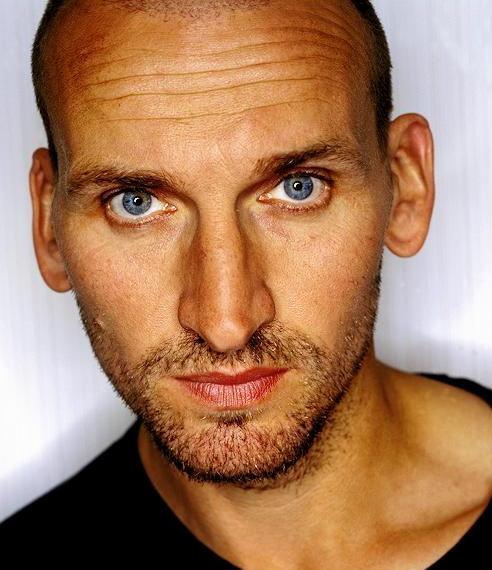
"I’m constantly told I’m not funny and I’m not charming, and they were some of the demands in the role" - Christopher Eccleston, being very correct

When asked why he wouldn't wear a flamboyant costume like the other Doctors, Eccleston literally said that it was because his Doctor wasn't going to be a "tosser."
Keeping with the "first is worst" theme, the first Doctor of the classic series comes in last place, with the first Doctor of the new series in first to last.  His place on this list is going to piss off a lot of people, but I stand firmly by it.

I'll confess, as much as I seem to know about Doctor Who, I'm actually a very, very recent convert.  I just fell so in love with it that I went back and watched every episode, started digging out obscure Doctor Who comics and audio adventures, and two different sonic screwdrivers (a 9/10 one and an 11 one).  I actually began my love of Doctor Who watching the new series from the beginning when they were already well into the David Tennant era.  So, they say that your first Doctor will always be your favorite, but Eccleston was my first, really, and he's just one spot up from the bottom on my list.

Let me be clear:  it isn't that Eccleston wasn't a good actor.  He just wasn't a Doctor.  The three new series Doctors each had a very different position that they started from.  Tennant was already a die hard fan of the show who was said to be able to quote the classic series "chapter and verse."  Matt Smith was not a fan when he became the Doctor, but made damn sure he did his research before taking on the role, which caused him to fall in love with the 2nd Doctor.

Christopher Eccleston had never seen an episode of Doctor Who, and made a conscious effort not to.  I doubt he's seen one since.  He never seemed to fully understand what he had gotten himself into with Doctor Who.  We all complain about his refusal to return for new episodes or audio books, but I think that part of the reason for that is that he doesn't fully understand that it's expected of one of the Doctors. He said that he chose to take the role because he was interested in working with Russel T. Davies, not because he was interested in Doctor Who (which makes me seriously doubt his intelligence and sanity).

Christopher Eccleston has no muscles or fat in his body whatsoever.  Only bones.
The idea of one man with 12 different faces is an idea so bizarre and so wonderful that it seems to blow my mind, only for it to be repaired so it can blow again.  It's a concept that seems brilliant and impossible at exactly the same time.  Part of the fun is trying to imagine these very disparate people as being the same man, and both believing it and not believing it at the same time.  When you watch the Doctor's in order, there's a mostly gradual progression that can allow you to believe that William Hartnell and Matt Smith are the same person in a way that you couldn't really believe if you just watched their episodes in isolation.  But each regeneration strays from his predecessor just slightly so that the combined effect is more believable (with the exception of a few large leaps in personality, most notably the jump from the 5th to 6th Doctors).

But 9 is the oddball out, as putting him up against pretty much any other Doctor in the franchise will still look strange.  He doesn't act like any other Doctors in the history of the franchise.  He has little sense of humor.  He lacks the Doctor's whimsy.  He's never happy.  He's not flamboyant.  He can fade into the background in a crowd of people.  He doesn't really seem to like most people.  He's not the Doctor.

The one thing that 9 now has going for him is True 9, and that's something he can thank Moffat for.  True 9, as we get to know him, might help us get bridge the monumental gap between 8 and 9.

Monday, May 27, 2013

The Order of Rassilon #11: William Hartnell, The Crotchety Old Fool

Every Doctor Who blog should include a ranking of the Doctors. Who is best and Who is worst in Who? So, with the series now on hiatus, I thought it might be a little fun to count down the Doctors, from worst to first. I call it "The Order of Rassilon."

I look forward to hearing who agrees with me, and who vehemently disagrees with me. So we're going to start it out with the worst in the history of the franchise, the First Doctor, William Hartnell.


I wear a weird ugly hat now.  Weird ugly hats are cool.

Yes, he started the franchise.  Yes, the original show couldn't have survived without Hartnell's unbridled enthusiasm for the show, keeping everybody's spirits up during filming.  Good for him.  Punk wouldn't have gone anywhere without the Sex Pistols, but they still sounded like a special ed class playing guitars.  Honestly, I don't know what it is about Hartnell that made the show so popular that it could survive a replacement of every single cast member (several times over).


Famously, film was so expensive during the black and white era and they had to keep shooting even when things went horribly wrong.


If this was the stuff that was deemed suitable for air, I want to see what exactly a Hartnell blooper reel would look like.  What's the stuff that he fucked up so badly that they couldn't salvage it for television? I'm sure it has to exist.  He'd have to have, like, wet himself or something.

As old and feeble as he looked, would you believe that Hartnell actually played the role from ages 55 through 58?  My dad is 79 and he looks about 20 years younger than Hartnell did in his Doctor Who years.  He must have done some really hard living in his younger years.  I imagine him waking up every morning and drinking a big glass of paint thinner and smoking about a carton of cigarettes.  When they brought him back for the 10 year anniversary episode (keep in mind, 68 years old), he was so feeble that they had to write the script in such a way that Hartnell could perform the entire episode sitting down.


He could have shot this on the can and nobody would have been the wiser.
So yes, when it comes to Doctor Who, first is worst.  But then again, the whole point of the series is that it's supposed to be constantly renewing itself, and constantly getting better.  For all we know, Hartnell might have been very proud of the fact that every Doctor that followed him surpassed him.

Probably not, though.