"Now that we have a black person, we're officially a Benetton ad!"
Once upon a time, in the Russel T. Davies era, Season 4, there was a plan for a Cops-style episode, where the Doctor goes on a reality show like Cops and solves a mystery while Donna watches the episode from home. Davies, however, scrapped the episode because he felt like it was too similar in tone to "The Unicorn and the Wasp," even though the two episodes would have taken place approximately 82 years apart. Instead, he quickly wrote "Midnight," his best episode, and put that in its place. I tell you this story because I don't understand how Davies could see the similar tones in what sound like very dissimilar stories, and Steven Moffat (admittedly, one of my heroes) couldn't see that within three weeks he had two episodes with similar monsters with the exact same way of killing people. In "Knock Knock," the monsters are tiny creatures that make up the very structure but can come loose to form a swarm that eats people. Where have I heard of that before?
The two robots represent the old man
This was a pretty mediocre episode, with a lot of plot holes. Why does he need to let the bugs eat people in order for them to keep his mother alive? Those seem like pretty unrelated things. As Shelley pointed out, why does the mother only restore this particular group of young people and not the hundreds of others that he's done this to? Why do the bugs kill everyone else but for the mother they keep her alive? Why did everyone accept the Doctor as Bill's grandfather without asking the inevitable racist question, which is easily answered by anyone with half a brain, but still would inevitably be asked in that situation?
This was an interesting to see, though, in the week before I move in with some new roommates. Oh, and it was the week before Mother's Day. Ew.
Is it my imagination or, when Bill claims to be the Doctor's granddaughter, it's on a day where her clothes and hair look rather Susan-ish? They've been trying to remind us a lot of Susan this year. Could they finally be hinting at some sort of return?
After this episode, I'm more certain than ever that the Master is in that vault, and it's probably Missy. I mean, could that have been a more obvious hint? It's someone whose company the Doctor enjoys who delights in the suffering of others. That's Missy. I know that John Simm is coming back to play the Saxon Master at some point this season, but I can't imagine Simm's Master playfully communicating with the Doctor through piano music. I'm thinking that Simm is just back to film a flashback scene where we see his Master regenerate into Missy. I don't want to see him steal Missy's spotlight. He was a great Master, but his Master was very much designed to play against David Tennant's Doctor, and Missy was just made for Peter Capaldi's 12th Doctor.
That's going to have to be it for now. I've got packing to do for my move this weekend. Next week we have an episode from Jamie Mathieson, so that looks promising. Until next time:
RASSILON: We will initiate the Final Sanction. The end of time will come at my hand. The rupture will continue until it rips the Time Vortex apart.
MASTER: That's suicide. RASSILON: We will ascend to become creatures of consciousness alone. Free of these bodies, free of time, and cause and effect, while creation itself ceases to be. DOCTOR: You see now? That's what they were planning in the final days of the War. I had to stop them. ("The End of Time Part 2")
This weekend, the BBC released another full trailer for the 50th Anniversary Special, "The Day of the Doctor," as well as a short clip from the episode, both of which are above. If you remember, I already gave my analysis of the first trailer they put out a few months back. Then the BBC put out this teaser trailer that everyone but me felt the need to dissect and analyze. Personally, I think trying to learn anything from a trailer that has literally no footage from the episode is fruitless. It's a cool looking trailer, but it tells us nothing we didn't already know. But this trailer is an actual trailer that gives us some new information, so it's time to dive in.
If you ask me, it seems pretty clear that this episode is, first and foremost, the sequel to "The End of Time." "The End of Time" told us how The Time War ended, and this episode is going to show us in greater detail. I'm not surprised that fans speculated that this episode would be titled "The Time War." I think we're finally going to see what really happened. Perhaps, we're going to see the very moment when the Time Lords and the Daleks were destroyed.
The 10th Doctor, the 11th Doctor, and True 9 are somehow brought together for this episode. But the 10th Doctor says in the trailer "Why are we all together? Why are we all here?" That means that they didn't just stumble upon each other, or seek each other out by choice. Something forced them together, a direct violation of the Time Lords' First Law of Time (which they broke when they felt like it). Furthermore, there's something that never dawned on me before: If they can meet True 9, then the time lock is broken.
In "Journey's End," we learn that the entire Time War is "time locked," meaning nobody and nothing should be able to get in or out of the time period in which the war happened. However, Dalek Caan found a way to break through, yet it cost him his sanity (not that Daleks are really sane to begin with). Then, in "The End of Time," Rassilon found a way out, but it was not easy to pull off. True 9, as far as we know, only existed in the Time War, and his regeneration almost certainly happened in that war. This means that either the 10th and 11th Doctors, along with Rose and Clara, are going to be breaking into the time lock, or True 9 is breaking out. My money is on the former.
It's never been known when and exactly how the Doctor regenerated into the 9th Doctor. Up until "The Name of the Doctor," it was assumed that Paul McGann's Doctor regenerated into Christopher Eccleston's, but now we know that's not true. That leaves us with 2 regenerations we've never seen on the show, and a lot of wiggle room as to when things happened. However, there's one important clue: In the beginning of the episode "Rose," the 9th Doctor checks himself out in the mirror, and it looks like it's for the first time. "Ah, could've been worse. Look at the ears. " So True 9 presumably regenerated into 9 moments before the events of "Rose." I think it's fairly safe to assume that his regeneration occurred because of the event that caused him to end the Time War.
It's been said that Eccleston was approached to come back for this special, but that he turned them down. I've been wondering about this: was True 9 supposed to be in the script, or was he added into the script because Eccleston turned down the special. Is True 9 playing the role that Eccleston's 9 was going to play? This would have required Moffat to completely ignore the mirror scene I mentioned earlier, but perhaps the special was supposed to be about how Eccleston's 9 ended the Time War. Regardless, it's going to be very difficult to do this story without Eccleston, if this is the story I think it's going to be. How do you not show True 9's regeneration into 9 if Eccleston refused to come back? Maybe Eccleston is lying, but I doubt it. He does seem like he's too much of a dick to come back for the fans. But maybe he's going to surprise me.
The other little clip they released, referred to as "But That's Not Possible!" Other than introducing a character in the background, who's supposedly going to be named Osgood (I don't feel like unraveling that little puzzle) and who seems to be wearing the 4th Doctor's scarf. The whole clip seems pretty pointless to me. It tells us very little. UNIT (it sounds like Kate Stewart) is showing the Doctor a painting, and Clara sees something that she thinks is "not possible" (a phrase that is used often on Doctor Who and is almost always proven wrong). I couldn't understand what Clara was shocked by the painting. My girlfriend said "She saw herself in the painting." That would be interesting, as the painting is clearly of Gallifrey burning to the ground. But I'm afraid we're looking at a much more commonplace and tired plot device: Clara saw the same image in a dream that's in the painting.
Next Saturday, the minisode "The Night of the Doctor" will be released. The description they've given out says:
"The 50th Anniversary features Matt Smith, David Tennant and a mysterious incarnation played by John Hurt. Only one appears in this mini episode, 'The Night of the Doctor.' But which?"
I'm thinking of the phrasing of this. "Only one appears in this mini episode." One of those three? Or one Doctor? Moffat said that no other past Doctors will appear in the special. He said nothing about these minisodes that he's so fond of making. Furthermore, Paul McGann, the 8th Doctor, seems to have potentially let something slip on Twitter. Back in October, Paul McGann said on Twitter:
"Spent forty minutes this pm having to imitate Matt Smith’s dramatic delivery in VO. You have been warned….”
After fans got crazy excited, he followed it up by saying:
“I should explain. It was by way of an aural experiment to find out how similar we might sound. We didn’t. And he’s better looking too.”
What the fuck does that mean? What kind of aural experiment? For what? What could that possibly mean? It sounds like a weird, fumbled excuse that he came up with when he realized he had just said way too much. Even if Moffat is telling the truth about none of the past Doctors coming back for the special, that doesn't mean that none of them can come back for the minisode. Plus, he's one of the easiest Doctors to bring back because we know so little about him. He could have stayed in that regeneration long enough to really, truly age within that regeneration, which would explain the 20 year age difference since the last time we saw him. You can't really say that about any other Doctor.
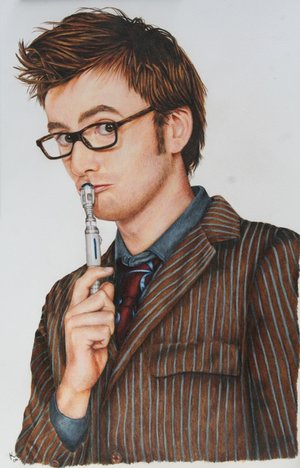
Seriously, you try to go through Google Image search and decide from thousands of different pictures of David Tennant looking handsome.
Just as Patrick Troughton had to sell the whole idea of regeneration for the very first time, David Tennant had to sell the idea for a whole new generation who had just been introduced to this new version of Doctor Who and knew nothing about the classic series. In the long run, it was probably for the best that Christopher Eccleston left after one season, as it allowed the show to reintroduce the concept of regeneration before the audience got really attached to a new Doctor. But it certainly helped that the salesman for this concept truly believed in his product, because not a single Doctor in the history of the show has ever, ever loved Doctor Who as much as David Tennant, the man who is most responsible for raising Doctor Who from the ashes.
Tennant was an obsessive Doctor Who fan growing up and was said to be able to quote "chapter and verse" from the classic series. If it looks like the Tenth Doctor is having a really fun time running around and being brilliant, it's because David Tennant really is having a fun time. I don't think anyone had as much fun as Tennant. When he left the show, he said it wasn't because he didn't ever want to reach the point where this became just a job. He wanted to leave it while it was still the most amazing thing in his life and didn't want to spoil that memory by keeping at it until it stopped being fun.
Colin Baker, at this past weekend's Comic Con in Denver, said that he noticed that there were never many female Doctor Who fans in America before David Tennant. He said there had been plenty in England, and there always had been, but David brought in the female audience from America for the first time because of his sex appeal.
"Oh my God, the way he makes his hair look ruffled, but in a careful way that clearly took a great deal of effort, makes him look so laid back and casual! It's so sexy!
The only thing that really holds Tennant back from the #1 spot on this list is this man:
"What a sad little episode. I know, I'll put a Dalek in it! Did you care about this episode before? I didn't. Now there's a Dalek. It's exterminating! It's mean!"*
Russel T. Davies, as I've said before, was a fantastic show runner, but not a very good writer of individual episodes. Davies engineered a perfect comeback for the series. It really looks like he watched Philip Segal's failed attempt to pilot a revived Doctor Who series in 1996 with the made-for-TV movie. However Davies had an annoying tendency to come up with good plots that he was unable to resolve with a satisfying ending. His season finales lazily leaned on the Daleks way too much. While sometimes a fun jaunt, there was little substance to Davies's stories, particularly his season finales. The notable exceptions were Davies's much darker Season 3 3-part finale (the only one without Daleks) "Utopia"/"The Sound of the Drums"/"The Last of the Time Lords," Davies's brilliant, low-budget, last minute written episode, "Midnight," and the surprisingly intelligent "Turn Left."
Tennant might have made it to the top of my list if he hadn't been speaking the words of such a mediocre writer. Tennant's best episodes were generally written by people other than Davies. "The Impossible Planet"/"The Satan Pit," "Human Nature"/"The Family of Blood," "School Reunion," and "The Planet of the Ood" were some of the finest examples of the Tenth Doctor era. But, if you haven't guessed, I'm a pretty big fan of Steven Moffat, and I will obviously put up Moffat's 3 Tennant episodes as the absolute best of the Tenth Doctor era: "The Girl in the Fireplace," "Blink," and "Silence in the Library"/"Forest of the Dead." Had Tennant been working with Steven Moffat as show runner and head writer, he'd be on the top of this list as his immense acting skills would be combined with the intelligence of Moffat's scripts.
In fact, it was Moffat's writing that bumped a certain other Doctor up to the #1 spot on my list...
+10 nerd points if you can figure out what non-Who related show I'm parodying with this caption.