Showing posts with label Tivoli. Show all posts

Saturday, October 17, 2015

Words and Guitar: An Overanalysis of "Before the Flood"

"I drink your milkshake!"
I've taken a lot of time to explain bootstrap paradoxes on this blog.  Mostly it's because I love the phrase bootstrap paradox.  It's my username on a couple websites, most notably, one of the larger Doctor Who message boards on the Internet, Gallifrey Base: 

I hope a lot of people tried to register with this name on Saturday!

So I was very happy to see the phrase show up in the beginning of "Before the Flood."  It's hardly the first bootstrap paradox we've seen in the show.  The Moffat era is riddled with them.  The Doctor getting himself out of the Pandorica is a bootstrap paradox.  The Doctor finding Craig's apartment in "The Lodger" was entirely thanks to a bootstrap paradox.  "Blink" is literally a bootstrap paradox from beginning to end.  So I'm glad someone finally gave an explanation of what it is so I don't have to explain it over again to every person I try to talk to about Doctor Who.

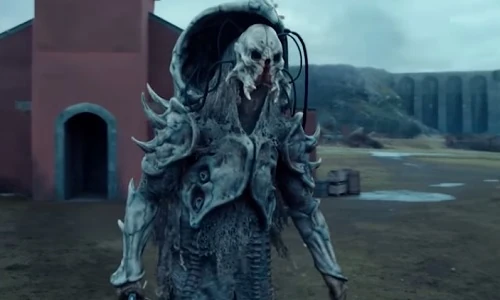
Part one of this story was a lot more exciting than part two, because part one was about building a very intricate mystery, and part two was about bringing that all back down to Earth and explaining everything.  But "Before the Flood," much like "Under the Lake," benefited from some really great work from multiple different departments.  Doctor Who doesn't particularly scare me much (with the delightful exception of The Silence) and almost nothing scares me in broad daylight, but this particular shot takes the cake for the only thing I've ever seen in any media that was still fucking terrifying despite being shot in broad daylight (or, well, cloudlight as the case may be):
MAKE IT GO AWAY!
Wow, the Fisher King was one of the most terrifying Doctor Who creatures I've ever seen.  This is not cheap prosthetics, this is a very well thought out and detailed construction of someone's worst fucking nightmare.

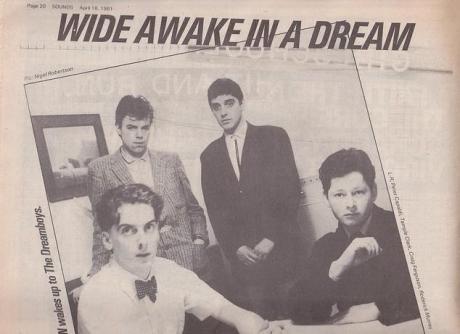
The Doctor's electric guitar is, thankfully, becoming a recurring part of the 12th Doctor's persona, with clips from next week's episode, "The Girl Who Died," showing brief flashes of it as well.  The 2nd Doctor was known for playing a recorder sometimes when he was trying to think, while the 12th seems to absently strum at an electric guitar with his special sonic sunglasses for much the same reason.  Regardless of how much cooler the guitar and sunglasses may seem to us than the recorder, its all ancient artifacts to the Doctor.  Yet, somehow it seems so appropriate that the man who is tied for the oldest actor to ever play the role would adopt such a "cool" look to him.  And why not, if it's Peter Capaldi.  He's a total punk rocker.  He was in that band in a punk band when he was younger with Craig Ferguson.

What's even more freaky is that the guy on the right is Geoff Peterson.
Peter Capaldi can pull it off because we know that that's who he is.  Have you ever known someone who had been a big punk rocker in their teens once they got older?  Because I know quite a few of them, and they all remind me of Peter Capaldi.  I'm glad he's building a persona for this particular Doctor, and I'm glad that it seems to reflect quite a bit of Capaldi's real personality.
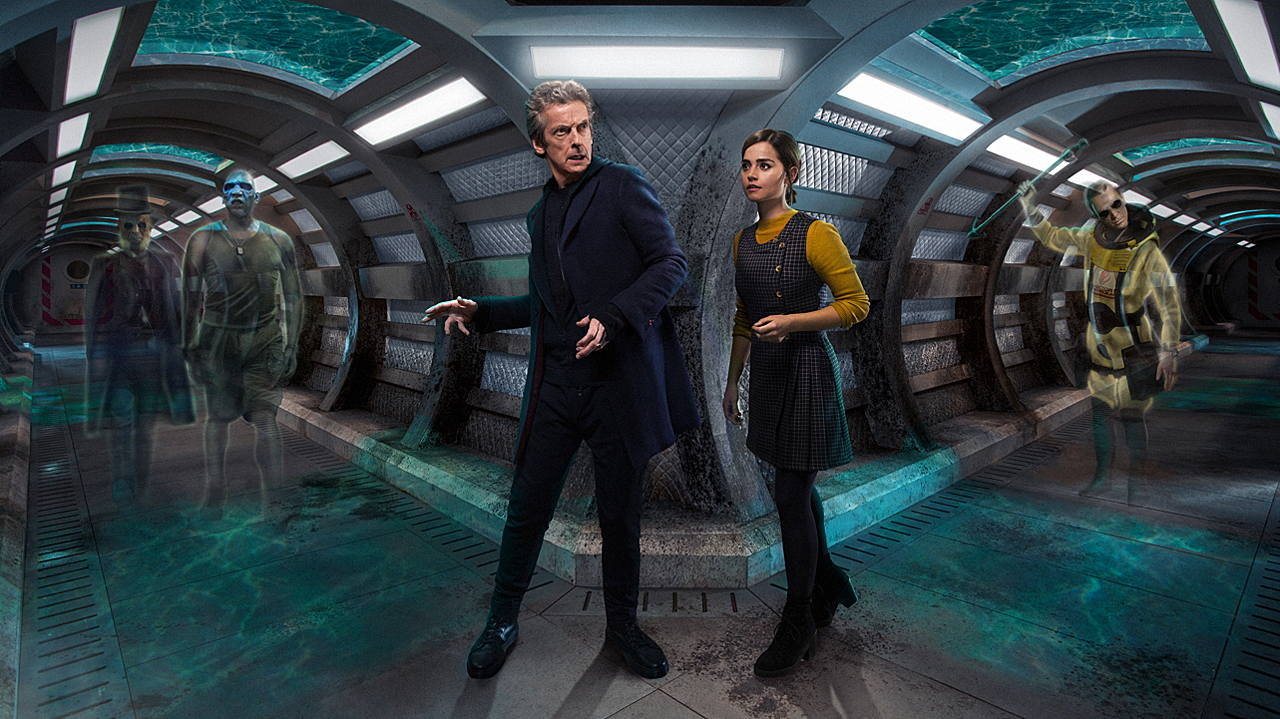
Last week I was left confused as to why the ghosts had no interest whatsoever in Lunn.  This week, when Clara figured out it was because he was the only one who hadn't seen the writing yet, I literally had to smack myself in the head for never having figured that out.  I guess you are a smart one, Clara.  I felt an equal smack to my head at the reveal that the Doctor's ghost was a hologram, after we had already established that the Drum can create holograms.  Wow, I feel like a doofus now.  I had already figured out that the Doctor was in the stasis chamber, but admittedly only because I had seen someone else guess it on Facebook and said "Oh, yeah, of course, that's who's in there."  It was an interesting take on the concept of fixed points in time.  It's not the first time that the Doctor has found a way to change the future by simply tweaking and modifying events he knows are going to happen but creating a scenario in which he doesn't have to die.  He essentially found the same loophole out of his death at Lake Silencio.  History said that the Doctor had to be there on that beach, and that someone looking like the Doctor had been killed, but that was it.  As long as he found a way to keep all of that true, nothing negative happens if he still walks away from it.  I liked that trick in "The Wedding of River Song" (regardless of what anybody else thought about it), so I liked it again now.

I keep trying to figure out if there's any larger plotline that this episode is setting up for farther down the road.  Frankly, there isn't a very clear indication that there is an overarching plot.  I'm presuming that Missy staying behind on Skaro in "The Witch's Familiar" was probably part of a set-up for the season finale.  I'm also guessing that the prophesy of the hybrid from that same episode is part of a set-up as well.  But other than that, I've seen nothing else in this season that is very clearly constructing a mystery or a plot arc that is leading us towards something specific.  I haven't seen this from Moffat since his largely disappointing series 7, which I found to be his weakest season-long plot arc if for no other reason than very little was done to advance the larger plot arc as the season moved along.  Yet, this series, so far, has me mesmerized.  So I'm hoping that we're moving towards something a little larger, a little arc-ier.  Is that a thing?  No, it's probably not.

And the next episode will likely grant my wish.  As I write this, it has technically already finished airing in the UK (sorry, I'm late again), but I'd heard reports before that "The Girl Who Died" would finally explain to us the big mystery of why Peter Capaldi's face appears three different times in the Doctor Who universe.  I've just rewatched "The Fires of Pompeii" because I understand that "The Girl Who Died" is going to call back to it somehow.  How, I do not yet know, but I'm thrilled to see what it is!  An idea thought up by Russell T. Davies, executed by Moffat, with the assistance of my first choice to follow Moffat when he finally does leave, Jamie Mathieson.  All with Maisie Williams as a guest star.  I can't wait to see where we're going with this.


Saturday, October 10, 2015

The World's a Mess; It's in My Kiss: An Overanalysis of "Under the Lake"

Day Mode.  Whoa-oh.  Fighter of the Night Mode.
Every time I try to think about why I love "Under the Lake," words and specifics fail me. I can't really give a good reason why it's special, why it's anything more than a middling, filler episode. There's not a huge, glaring reason to point to why this episode is significantly better than some of the other "Who cares?" boring episodes like "Curse of the Black Spot," or "Rings of Aka-Something or Other"--or, to pull from the same writer as this episode, an episode like "Vampires of Venice." And yet, every time I go back to rewatch "Under the Lake," I fall in love all over again. I don't know what it was I loved about this episode. Perhaps it's that the show's brilliant music producer, Murray Gold, has outdone himself yet again with this episode. Perhaps first-time Doctor Who director Daniel O'Hara is just the best director the show has ever seen and we've just never seen him before. Perhaps it's the stellar performances all around, including the most dignified characterization and portrayal of a deaf person I have ever seen seen in media (admittedly, I've never seen Children of a Lesser God). Perhaps it's that Toby Whithouse is a pretty amazing writer, albeit with a few duds here and there. Or maybe it's a combination of all of those things that results in an episode that fires on all cylinders.

It was so exciting that, at the point of the episode where the Doctor looks at the ghosts and says "What are you?" I caught myself literally saying the same thing as the Doctor at the exact same time. He owes me a coke.
I only accept Mexican Coke, Doctor.  Fuck corn syrup.
Toby Whithouse has been rumored more than once to be the successor to Steven Moffat for when he's ready to leave the show.  Moffat has not really given any indication that he's quitting anytime soon, but Whithouse has been thought of as a natural successor.  As I've been mostly saying I just want #anyonebutgatiss, I'd be happy to see Whithouse take over.  If we think back on his few episodes he's written, there are some pretty good ones.  He brought us the fun romp of "School Reunion" where he triumphantly brought back the most popular companion(s) of the classic series.  "The God Complex" is one of the smartest episodes of its or any other season.  The worst episodes he's written, "Vampires in Venice" and "A Town Called Mercy" are really only guilty of being dull, never of being silly or stupid.  Perhaps "Vampires in Venice" was always as riveting as "Under the Lake" in Whithouse's head, and the director and cast could never fully pull off his vision.  Whithouse is, of course, also responsible for the show "Being Human," which I still need to go back and finish, but which I do highly recommend (what I've seen of it, anyway) and I've even heard positive comments about the American adaptation of it.  So, overall, I wouldn't hate it if he took over for Moffat eventually.  Him or Jamie Mathieson.  Or Neil Gaiman, but that's a pipe dream and we all know it.

Whithouse is already building his own trademarks, though, as this episode actually sees the return of a species he created for one of his previous episodes.  Remember the Tivolian from "The God Complex"?  The most invaded race in the galaxy?  The one who surrenders so easily that their planet's anthem is called "Glory to <Insert Name Here>"?  


It's like having an entire planet full of Adrics!
Yeah, in case you didn't catch it because he was speaking so fast, the Doctor did identify the first ghost in this episode as another Tivolian, and points out how odd it is for them to become violent like that, because they're known for surrendering so easily.  The Tivolian is named "Prentis," something we only know so far from press releases and credits, because he didn't speak a single time in this episode, but he's clearly meant to be a much larger character in the next episode.  Creating your own recurring species?  That sounds like someone is setting up the Doctor Who universe for some plans he has down the road when he becomes showrunner.  However, where Steven Moffat did that in the Davies era with some of his creepier monsters like the Weeping Angles, Whithouse's creation of the Tivolians seems less terrifying, and more Terry Pratchett-esque in nature.  (The girl I'm dating has me reading the Night Watch books.  I'm hooked.)

I keep trying to think up some way that this episode is going to link into larger plot arcs in the greater series, and I keep coming up with nothing.  I get the feeling this two parter is probably going to be self-contained, but then again, you never know.  Remember how much "The Rebel Flesh"/"The Almost People" felt like a self contained episode until about 30 seconds before the ending?  I keep wanting the coordinates that the ghosts are shouting out to be the coordinates to Gallifrey, but try as I might, I can't quite get that scenario to make sense in my head, and I don't think we're going there in the next episode.


In the next episode, the Doctor blindly follows the coordinates like an idiot following a GPS.
Also, I have to take a moment to acknowledge the brilliance of the Doctor's cards.  Not just a great one-off joke, but also something that really taps into who the Doctor is right now as a character.  Plus, one of them, if you freeze frame the episode, is a joke about the Fourth Doctor dropping Sarah Jane Smith off in the wrong town, something that Toby Whithouse also referenced when he brought Sarah Jane back in "School Reunion."

I also have to give Whithouse some real credit for his diversity of characters.  In "The God Complex," I was very impressed not only that he included a Muslim woman as a character, but that in an episode about religion, Islam was the only major, real-life religion actually referenced.  Whithouse gave a lot of dignity to a religious and ethnic minority that is often maligned in media, and I thought it was very refreshing.  He does that again, this time for the hearing impaired, as Cass is not only a strong and capable deaf woman, but one that the Doctor refers to as the smartest person in the room.  She's a powerful leader, and a loyal one to her people, too.  I think Whithouse should be applauded for that characterization.

I'm really curious to see what these ghosts are.  They aren't just going to be ghosts.  As the Doctor already figured out, these are not a naturally occurring phenomenon.  Someone has created this situation, and trapped these souls somehow to be used as communication tools.  The Doctor is tremendously curious right now, and his curiosity is infectious.  But, in the end, they're not going to be significantly different than other types of "ghosts" we've seen in Doctor Who, from the digitally saved consciousnesses in "Silence in the Library"/"Forest of the Dead" or even in "Dark Water"/"Death in Heaven," to the psychic impressions left behind in Amy's house in "The Pandorica Opens," to the woman trapped in time in "Hide."  The Doctor is thrilled about finally having found real "ghosts, but ultimately, these souls are somehow trapped in something that's specifically linked to this ship, and that's going to turn out to be very technological, not otherworldly.  In Doctor Who, the explanations are almost always scientific and never otherworldly (with the ambiguous exception of "The Impossible Planet"/"The Satan Pit"), although, as we were reminded back in "The Shakespeare Code," there's a thin line between science and fantasy in the Doctor Who universe.

A theme that Whithouse is playing with here, and one that I don't think is seized on enough, is the idea of the Doctor as an adrenaline junkie.  Clara's catching it, too, and it's starting to scare the Doctor, as witnessed by his little speech in the TARDIS.  But clearly, there's a sense that the Doctor is too invested in his own thrill seeking right now, and the ghost of his future self that appears at the very end of the episode suggests a Doctor that inevitably lets his addiction to adventure take him down a dark and dangerous path.  In a way, he lost his last set of companions, and I don't think he's going to take it very well if he and Clara are separated, not by choice, but by force.  The Doctor might be learning by the end of part two that he needs to slow down a little.  But while he may have to, the pace of this two-part episode doesn't have to slow down at all, and I'm excited to see where it goes from here.

When I first heard the "I want to kiss it to death" line in the trailer, it really bugged me, but I like it in context.  So in honor, here's a little X!: