Maybe if I stand in the most effeminate position possible, they won't see me...
I guess I have some apologies to make. I've got some catching up to do, which is partially due to some slight ambivalence about this blog, but also partially due to being somewhat busy with a new relationship starting up. And I've been trying to get her caught up on Doctor Who as well so we can watch it together but, ironically, she kept falling asleep during "Last Christmas." I spend the whole of my weekends with her, so I won't really be able to watch the new episodes on the day they come out until she's caught up, which she will be soon. Until then, I'm going to play a little catch-up. So sorry that this blog is about a week late. I'll work on that. For now, on with the show:
The Daleks have always been a moral quandary for the Doctor. The Doctor is the ultimate pacifist, at least in his philosophy if not always in his actions. His goal is always to prevent as many deaths as possible, including the deaths of his enemies. The Daleks have shown up to throw a wrench in this philosophy more than once, because if your enemy serves absolutely no purpose in the Universe other than destruction, should your pacifism extend to them? He's been fighting the Daleks for almost 2,000 years now, and he has still failed to come up with a definitive answer to this moral dilemma. Each regeneration seems to attack the problem again and each regeneration comes up with a slightly different answer. That can be expected, as there isn't an easy solution to the quandary that the Doctor faces. But when the option comes up in the shape of the opportunity to murder a young boy who hasn't done anything yet, the Doctor finds the question even more troubling than usual.
Could you kill baby Hitler!? Look at him! He's adorable!
My new go-to question whenever I have the honor of meeting one of the actors that has played the Doctor is to ask them what they think is consistent across all the very, very different incarnations. I didn't think of this question until after meeting Colin Baker, so I never got to ask him, and when I asked Peter Davidson and Sylvester McCoy the question McCoy copped out and avoided the question with a "Well, that's the writers' job." (You do Shakespeare, McCoy, I know you give more thought than that to your characters!) However, Davidson gave a very interesting and insightful answer about the Doctor's recklessness. If you ask me, the two traits that are consistent to all of the Doctors are curiosity and compassion. That second one is big, even with regenerations like 6, 9, and now 12 who are notorious for how rude and pompous they can be to other people. Their compassion may not be the first thing you notice about them, and they may not be the kind of person to stick around and put a blanket around you after they've saved you, but it's still very important to them to rescue all living creatures and ensure their survival. Even when the Doctor's not particularly nice, he's still full of love and compassion, even for someone as terrible as Davros.
I've said before that I think the 12th Doctor is embarking on the redemptive arc that the writers originally planned for the 6th Doctor, the one that was never carried out due to Colin Baker's era nearly getting the show cancelled. The low ratings, combined with the fact that the average fans were starting to agree with the conservative fanatics who thought Doctor Who was too dark and violent, led the production team to quickly cancel their plans and scramble to find solutions to save the show. Their first solution was the bizarrely nonsensical "Trial of a Timelord" story arc, which only made things worse. The abrupt firing of Colin Baker and hiring of Sylvester McCoy bought the show a few years of mercy from the BBC, but not much, and the show only lasted a few more years. In the meantime, the long redemptive arc that was planned for the 6th Doctor never got carried out. At the same time, though, I wonder if Jonathan Nathan-Turner and Eric Saward had the talent to carry off such a delicate arc. Steven Moffat, on the other hand, does, and "The Witch's Familiar" is the episode that really makes it clear that we've set off on that path. The Doctor is really trying to figure himself out, what his morals are now, if he is a good man, and if he's stronger than the darkness in his heart. Never is that put to the test quite as much as it is in this 2-parter, and thankfully, the Doctor passes with flying colors.
Missy is having a big ball of fun in this episode, and we finally get to see how she managed to survive the end of "Death in Heaven." Considering her quick return, I can only assume that Steven Moffat has been planning this for quite a long time. The only real complaint that anybody (anybody with taste, anyway) had about Missy in "Dark Water"/"Death in Heaven" is that there wasn't nearly enough of her, especially considering that we got a chance to get to know John Simm's Saxon Master over a 3-part episode. Granted, he only showed up at the very end of the first part of that episode, but it still means we got much more of him, as the reveal that Missy was the Master didn't even come until the end of the first part of her two-part introduction. Finally, "The Magician's Apprentice"/"The Witch's Familiar" gives us some time to get to know Missy.
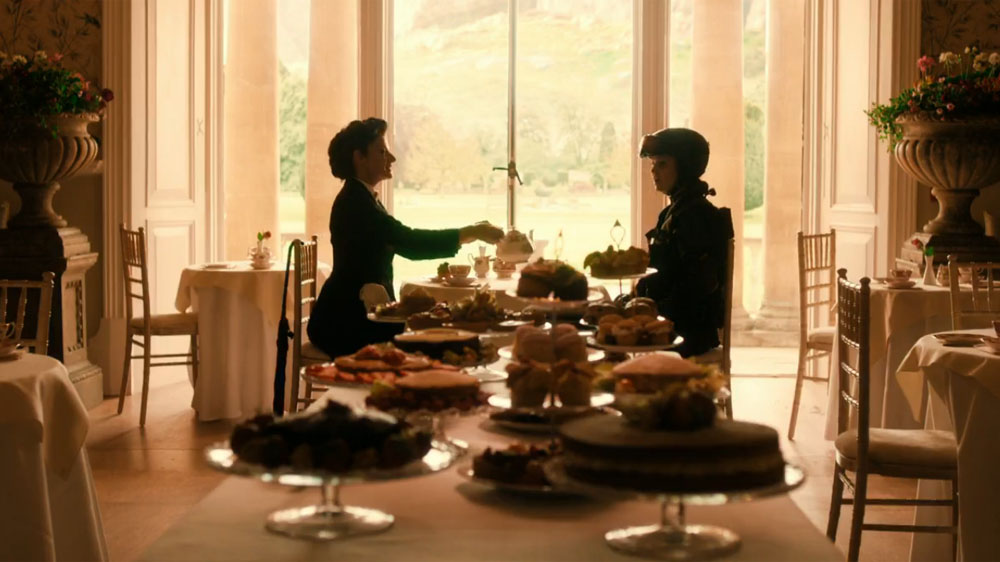
Doesn't she just look so inviting? Don't you want to get to know her better?
As delightfully warped as Michelle Gomez's performance of Missy is, she also proves herself to be incredibly intelligent. She has a very different moral compass from the Doctor, but that's about the only difference between them, as Missy demonstrates that she has as much intelligence and ingenuity as the Doctor. Clara, in this episode, serves more as a companion to Missy than the Doctor, hence the title of the episode, making it the first time since the 1996 movie that the Master has truly had his own companion. Missy's explanations of the Dalek homeworld and how it functions sound quite like the Doctor's explanations, but with the added danger of being willing to murder anyone without a moment's hesitation.
Michelle Gomez brings out a very interesting aspect of the Master that we've never really seen before. We've known since back in the 3rd Doctor serial, "The Sea Devils," that the Doctor and the Master had been friends once at school, and we've seen glimmers of that friendship before. There's been a begrudging respect between them, and a few temporary truces so that the two former friends can put their heads together to defeat a common foe, but Missy is the first version of the Master to make it absolutely clear how much the Doctor means to her, and is adamant that her multiple attempts to murder him over the years do not change how she feels about him. Perhaps it's that her last regeneration (presumably) met his end trying to protect the Doctor (a long lost 3rd Doctor era plotline that Davies finally brought to fulfillment), but Missy genuinely cares about the Doctor. In "The Magician's Apprentice" she expresses her friendship with the Doctor and explains why it isn't a contradiction to two people as ancient as herself and the Doctor, but it's only in "The Witch's Familiar" that she puts her money where her mouth is and mounts a rescue mission to save the Doctor. In a way, she almost becomes a second companion in this episode, which is extremely refreshing.
Now, some people may have had a moment of hesitation that the Doctor is surprised at Clara's ability to get the Dalek tank to say the word "mercy." Most notably because of this famous scene, which was also written by Steven Moffat:
This made me do a double take as well, because clearly, River gets the Dalek to say the word "mercy" a long time ago. However, it occurred to me, the Doctor wasn't present for this scene, as he was busy wiring his vortex manipulator into the Pandorica. (That might be the nerdiest sentence I've ever written.) River is a brilliant woman, who knows a lot about the Universe, and certainly more than the average companion, but in many ways she is still a companion. It makes sense that she wouldn't know as much about Daleks as the Doctor does, and that she would not notice that it was strange for a Dalek to know this word. There's a good chance that she never got around to telling the Doctor about the time she made a Dalek beg for mercy, as whether or not he approves of this will largely depend on what mood he's in. Even if she did tell him, it seems likely that he wouldn't have believed her.
The bigger discrepancy is this, which is also Steven Moffat's writing:
We don't actually see a shot of the Dalek from the outside saying the name "Oswin Oswald," but we do get it saying "I am not a Dalek" and a few other things which it seems, from Missy's demonstration, would be impossible. Similarly, "Into the Dalek" features a Dalek saying a lot of things that "The Witch's Familiar" implies would be impossible for a Dalek casing to be able to interpret. It's worth noting that Moffat is also credited as a co-writer on "Into the Dalek," although I do believe that's largely because Moffat gave himself partial credit for every episode in Series 8 where he threw in a little bit of story for the overall plot arc.
So yes, Moffat has created a bit of a plot hole here. There are ways to rationalize this away. We could say that this is a trait particular to the newly revived Daleks from after "Victory of the Daleks," but more likely than not it's just because Moffat decided that it was convenient to the plot, so fuck all those scripts he wrote in the past. Personally, I think Moffat and Davies together have patched up almost every major plot hole leftover from the classic series, including the bizarre prophecy that the Valeyard would appear between the Doctor's "12th and final incarnations," and because of that I think Moffat can be forgiven for leaving a few very small holes of his own.
I got the distinct feeling that this episode was setting up the season-long plot arc for Series 9. It would be very unlike Moffat to leave the series without a larger, overarching plot, and the stuff about the prophecy of the "Hybrid" sounded far too foreboding and interesting to leave it where it stands right now, especially considering that Missy continued to reference the prophecy after the Doctor had already defeated Davros. At first, I thought the prophecy sounded too mystical for as scientific a race as the Time Lords, much like their "Visionary" from "The End of Time," but I decided that a time travelling race could have many non-magical or mystical ways to predict the future and see a "prophecy." The fact that Missy said that she had just come up with a very clever idea once she was cornered by the Daleks seemed like it was also pretty clearly Moffat setting up a larger plot arc, with a return for a Dalek attack led by Missy later this season. Remember, the Master has teamed up with the Daleks before, and last time the plotline was cut short due to the untimely death of the actor, Roger Delgado, so we never really got to see what comes of a Master/Dalek team-up. Perhaps this is another lost plotline that Moffat intends to finally bring to fruition.
I've decided to do a little thing that's fun for me. This series, I'm naming every Overanalysis after a punk song I like (that I think is appropriate) then putting the song at the end. So, enjoy!
Sorry I'm so late with my overanalysis this week. The truth is, much like the reason I had trouble keeping up with the blogs I tried to do for Torchwood: Miracle Day, the reason it took me so long to get this blog out was because, frankly, I really didn't like this episode.
Before we get started, I have to get my most Comic Book Guy-esque complaint out of the way.
Worst episode title ever!
Can we get some consistency in our naming of Dalek episodes? From 1966 to 1988, all Dalek episodes were consistently named "________ of the Daleks" (with the notable exception of 1974's "Death to the Daleks," which is still close enough to be forgiven). Davies threw out this naming convention (as well as many of the show's other rules) when he revived the show in 2005, with only one episode in the Davies era ("Evolution of the Daleks") maintaining the naming convention. Moffat, when he took over, gave us the impression that he might permanently return to the convention, as both of the Dalek centric episodes during his tenure used the old title format. But now we have "Into the Dalek" when there are so many "________ of the Daleks" titles they could have chosen from! In fact, the phrase "Truth of the Daleks" is uttered a number of times! Bad form, Moffat.
Okay, are you still with me? Good, that was a pretty dumb complaint and a pretty good reason to stop reading, I understand, but I'm glad you're still with me. Okay, moving on.
Why is he shooting a gun at his own ship? I think he's going to need that.
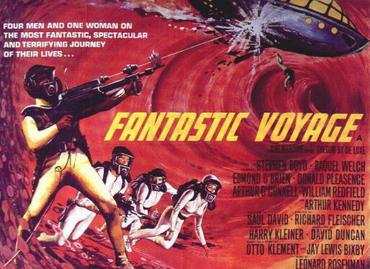
The episode is an obvious homage to the classic 1966 sci-fi film Fantastic Voyage, in which, to save the life of a scientist who could tip the scales of the Cold War, a group of people shrink down to miniature size in a submarine and enter into the scientist's body to try to remove a blood clot from his brain. I never saw the movie, but in high school (or maybe junior high?) we read the novel by Isaac Asimov. All these years, I assumed the movie was based on Asimov's novel, but in researching for this blog, I discovered that Asimov's novel was actually that lowest form of all literature: the novelization of a film. As distasteful as I find it that the author of the brilliant Foundation series (and the infinitely inferior Robot series) allowed himself to be lowered to the level of creating a film novelization, I was tickled to find that Asimov was very vocal about the gaping scientific inaccuracies int he film, and insisted on correcting them in his novelization. Due to Asimov being a fast writer, and the film being delayed so much, his novel was actually put out before the movie it was based on. He wrote a sequel, too, specifically to allow himself to be allowed to take the concept and write something original for it. So my respect for Asimov remains.
Anyway, again, nerdy aside. Nevermind.
Fantastic Voyage has been parodied by everything from Futurama, to South Park, to Tiny Toons, and even another Doctor Who story, the 4th Doctor's "The Invisible Enemy" in 1977. That the show has even done Fantastic Voyage before speaks to what I disliked about this episode: it's completely well worn territory. Everything about this episode wants us to believe that it's treading into something that the show has never explored before, and it's not true at all.
The Doctor claims to "learn" in this episode that a good Dalek is possible. If that's so, he has a very short memory. The first time Daleks started to develop some sort of positive emotions was in the 1967 Second Doctor story, "The Evil of the Daleks," where the Daleks asked the Doctor to help them develop a "human factor," the set of human characteristics that have been leading to so many Dalek defeats. He helps them do so, and they begin to question their orders from their Dalek commanders, and begin to be somewhat good, although, being brand new to having emotions causes them to act like children, which I always thought seemed realistic. And don't forget, the 10th Doctor's "Daleks in Manhattan"/"Evolution of the Daleks" saw Dalek Sec merging with human DNA to become a Dalek with a conscience. Want an example of a Dalek that didn't merge with human DNA? How about Dalek Caan in "The Stolen Earth"/"Journey's End" who came to realize the evil of he Daleks and manipulated the timelines to bring their downfall. Or even the Dalek in "Dalek," who started to realize that, now that he was alone in the universe, there was no reason to cause so much death and destruction. A good Dalek is hardly a new concept.
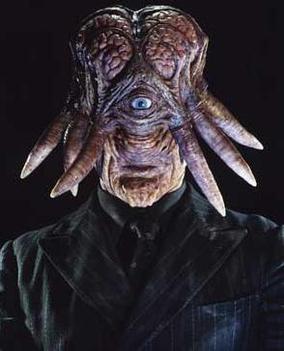
I...look...like testicles....
Someone suggested to me that it must have been "devastating" when the Dalek said to the Doctor "You are a good Dalek." Yes, it must have been devastating, almost as devastating as the last time a Dalek said almost the exact same thing to him in "Dalek": "You would make a good Dalek." Davros, in "Journey's End" drew a similar comparison between the Doctor's hatred of the Daleks and the Daleks' hatred of every other living thing in the Universe. It's a comparison that the Daleks love to make to the Doctor, and it never fails to make the Doctor feel bad because he hates himself enough to believe it's true. It's something the fans love to buy into, too, because it makes the Doctor sound deep, dark, and twisted. He's all three of those things, but he's not like a Dalek.
The Daleks are a species that has nothing but blind hatred for every other creature in the Universe, and believe that they are justified in destroying them all. The Doctor is a man who believes that all life is sacred, and spends all of his lives trying to save every creature he can. His feelings towards the Daleks are the closest he comes to hate, but only because the Daleks stand in the way of his mission to save all life throughout the Universe. But even long before this episode, he has always hoped to some day find a way to save the Daleks' souls so that he wouldn't need to destroy them, and always struggles with trying to figure out if his trademark pacifism and commitment to peace makes it justified for him to kill a creature that has no goal in life other than to kill. It's a profound dilemma for a pacifist, and one he has wavered back and forth on. When the Fourth Doctor was given the chance to wipe out all of the Daleks before they were even created, he couldn't bring himself to do it, much like the old ethical riddle of whether or not it would be okay to go back in time and kill Hitler when he was a baby. While the Fourth Doctor couldn't bring himself to do it, the Fifth Doctor says he regrets the decision. This indecision hardly makes him Dalek-like. In fact, it makes him the opposite. If you ask me, the much more devastating thing to say to the Doctor is what Oswin pointed out to the Doctor in "Asylum of the Daleks": that the Daleks have become infinitely stronger in fear of him.
In this episode, we finally get our first few moments with the new companion, Danny Pink. I noticed that the credits of this episode list it as being co-written by Steven Moffat and Phil Ford, whose only previous Doctor Who credit had been co-writing "The Waters of Mars" with Russell T. Davies. At first, I thought maybe Moffat didn't trust Ford and helped him write the episode for that reason, but then I noticed that a few other episodes this season are listed as co-written by Steven Moffat. I have a feeling that, the reason is, Moffat is being a little overprotective about this new character, Danny Pink, and writing some of the more important scenes in Danny's arc by himself, enough that he needs to be given credit in the episodes. Moffat has a tendency to be very protective of some of his characters. Only once has River Song ever appeared in an episode not written by Moffat, so he wrote that one scene of "Closing Time" himself, not trusting Gareth Roberts with it. Only once did he ever let another writer write for the Paternoster Gang, and that's mainly because Moffat seems to have a deep trust in Mark Gatiss that I don't share.
Danny, thus far, doesn't seem like a character I can get to know yet. We know little about him other than that he's a soldier. The Doctor's refusal to take the similarly color-themed-named Jordan Blue with him in the TARDIS was an annoyingly heavy handed foreshadowing of the battle the Doctor is going to put up when Danny asks to join the TARDIS crew--a battle, from which, the Doctor will, ultimately, back down. I assume that Jordan Blue's name being similar is going to lead to some sort of Pond/River style connection, especially since Clara went out of her way to point it out in this episode.
My friend Victor responded to me on Facebook last week with the suggestion that Missy is guarding some sort of digital Heaven, as it would make sense that the Clockwork Droid had died and gone to a digital Heaven. This, he suggested, could explain the possibility of Missy being River Song, as it's possible that, at a future time, River, now digitally saved in the library, changed her form. While an excellent idea, I think that Gretchen's appearance in "Heaven" after her very non-digital death seems to question that idea. Although, since she was essentially killed by robots (the antibodies, not the Daleks, I know the Daleks aren't robots), I suppose her consciousness could have been "uploaded" somehow.
This monkey's gone to heaven!
While we're on the subject, since I assume Missy is a villain, I wonder about Moffat's tendency to associate his villains with religion and religious iconography. That could be a fun blog some day.
I realize now that there was a major plot thread I forgot to bring up in last week's blog. In the scene in "Deep Breath" where the Doctor talks with the homeless man (played, in a special cameo, by Brian Miller, widower of the great Doctor Who actress, Elizabeth Sladen) about his new face, he brings up something I brought up before and have been very excited about.
"Do you ever look in the mirror and think 'I've seen that face before?'...Why this one? Why did I choose this face? It's like I'm trying to tell myself something. Like I'm trying to make a point. But what is so important that I can't just tell myself what I'm thinking?"
I was wondering if Moffat was going to actually follow up on his promise to touch on this. To explain this exciting new plot idea, I'll use the direct quote from Moffat:
“I remember Russell [T Davies] told me that he had a big old plan as to why there were two Peter Capaldi’s in the Who universe: one in Pompeii and one in Torchwood. When I cast Peter and Russell got in touch to say how pleased he was, I said, ‘Okay, what was your theory and does it still work?' and he said, ‘Yes it does. Here it is…’"
A plot thread thought up by Davies and executed by Moffat promises to be satisfying, and it's something I've always wondered about: Where do Time Lord's faces come from?
Next week is an episode I'm very excited about, and very worried about. I make no attempt to hide my...ambivalence about Mark Gatiss. I don't generally like his episodes, but respect how much he has done for the show, especially in the wilderness years, and feel like we would hardly have a show now if it weren't for people like Gatiss. I don't hate all of his episodes, but certainly most of them. Last season was the first season Gatiss submitted two episodes in the same season, and I think he managed to write the first episode of his I truly loved ("Cold War"), and the episode I think might just be the worst episode of the entire revived series ("The Crimson Horror"). Now, he's written the episode about Robin Hood, who was one of my favorite characters when I was growing up. I'm very excited to see the Doctor meet Robin Hood, and hope that Gatiss pulls more of a "Cold War" on this than a "Crimson Horror."