Showing posts with label Peter Capaldi. Show all posts

Monday, January 1, 2018

Steven's Last Night in Town: An Overanalysis of Twice Upon a Time


Senioritis:  A condition peculiar to high school seniors, hence the subword "senior" in senoritis. Symptons include a general apathy towards classes, homework, future i.e. college applications, restlessness and a "cannot do" attitude to surmountable school load. - Urban Dictionary

Despite all the hullabulloo about "Twice Upon a Time" being Peter Capaldi's last episode, we're forgetting another goodbye here.  It's also Steven Moffat's last episode writing for Doctor Who.  Moffat always kept an open invitation extended to Russell T. Davies to come back and write a one-off episode, but Davies never took him up on it.  All signs point to Chibnall holding out the same invitation to Moffat, but Moffat has indicated he doesn't intend to take advantage of the invitation either.  After six seasons as showrunner, 47 episodes, four minisodes, and one licensed parody, Steven Moffat is finally done (so he says) with the Doctor Who franchise.  (Of course, Rule 1.)  And for the conclusion off all that work, the greatest writer Doctor Who has ever known (fuck the haters) caps off his run on the show with possibly his biggest limp dick of an episode.

"Twice Upon a Time" can't really be called a "story" in the traditional sense.  The elements of a story are considered to be character, setting, plot, conflict, and resolution . "Twice Upon a Time" lacks conflict.  Hell, I'd argue it barely has a plot.  The episode even goes so far as to point out its own biggest flaw when the Doctor shouts out "It's not an evil plan!"  More or less, the Doctor happens upon a perfectly innocent science project, mistakes it for something evil, realizes it isn't, and moves along on his way.  That's distinctly not a story.

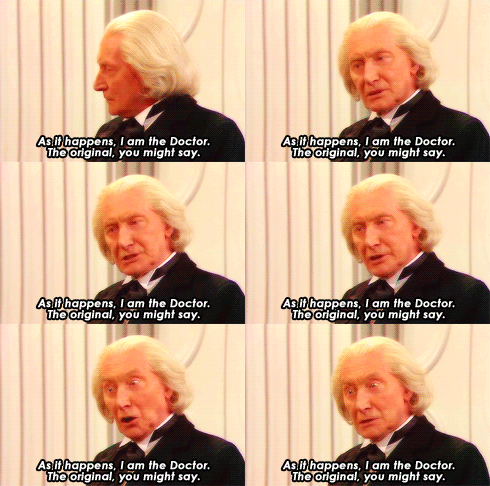
But the episode is an excuse to have some interesting conversations between the 12th Doctor, the 1st Doctor, Mark Gatiss for some reason, and Bill.  Here's the thing, I hate William Hartnell's 1st Doctor.  He played the character as a pompous ass, and Hartnell couldn't remember his lines to save his life, which was especially difficult when they couldn't afford to reshoot anything. Steven Moffat has talked about how, looking at David Bradley's version of the 1st Doctor is like looking through a time machine and seeing William Hartnell's Doctor in the flesh.

The fuck is he talking about?

Bradley's voice is distinctly deeper than Hartnell's, for starters.  His face looks nothing like Hartnell's, as the 12th Doctor comments on.  He doesn't act like the 1st Doctor at all.  While the 1st Doctor had a general air of superiority about him, that was always directed towards men and women equally.  He never showed himself to be the rampant misogynist that he appears to be in the "Twice Upon a Time."  Either Moffat hasn't watched the black and white episodes in a minute, or else he wanted to show everyone who accused him of sexism what sexism actually looks like.  Also, bragging about sexual exploits?  No Doctor does that.  The first Doctor had presumably one partner that we've never met, since he has a granddaughter, and he had a brief romance with an Aztec woman that probably amounted to nothing.  Either way, he's never been one to kiss and tell.  Remember that just because the 1st Doctor lived in the 1960s and his era aired in the 60's doesn't mean that he's a man from the 60's.  Any regeneration, and the Doctor is still an alien who has travelled all of time and space and is millennia ahead of simple human prejudices.

There are only a few things that "Twice Upon a Time" gets right about the 1st Doctor. One is that he always holds his damn lapels whatever he's doing.  The other is that the 1st Doctor is not truly a hero.  He's surprised by the notion of the 12th Doctor declaring the Earth to be "protected," because the 1st Doctor didn't see himself as a protector of the Earth.  He was just an explorer bumbling about, much like 12's speech at the end of "Death in Heaven."  I did love the 1st Doctor's explanation of what he was running to, though, that he was trying to realize why good so often triumphs when everything suggests that it shouldn't.  He went out in search of the source of that balance in the Universe, and accidentally became the balance he was looking for.

If I let go of my lapels, my neck will fall off.

I loved the line "To be fair, they cut out all the jokes" and it is my nw go-to response for everything now:

Why are the DCEU movies so boring?
Why wasn’t Two and a Half Men ever funny?
Why was Sarah Huckabee Sanders’s press conference so weird?
Why didn’t Kevin Spacey’s apology speech go over better?

Honestly, some of the banter between the two Doctors was amusing, but the fact that the 1st Doctor wasn't the 1st Doctor spoiled it for me.  Although I did like that 12 could steer 1's TARDIS which confirms something I've always suspected:  The 1st Doctor's TARDIS didn't have a broken navigation system, the 1st Doctor just never had any fucking clue how to steer the damned thing.

While Rusty the Good Dalek is a great name for a Saturday morning cartoon show (RIP), I don't understand why Rusty is so intent on killing the Doctor.  They seemed to part on good terms, they have similar goals, what do they have to hate each other over?  It seemed like Moffat didn't go back and watch his own episode before writing this one.


I did like the moment of the Christmas Armistice, which is a fascinating point in history, and I don't know how I didn't see that one coming.  That being said, it annoyed me that that was the only part of the episode that had anything to do with Christmas!  Moffat once said he hated Christmas specials that didn't actually have anything to do with Christmas.  Well, he's written two back to back (this and "Mysterio") that only feature one scene on Christmas.  I was sad to see his last one lacked any real Christmas to it.

Christmas bells, those Christmas bells, ringing through the land...

The Doctor's regeneration scene, however, was better than the rest of the episode combined.  The goodbyes from Bill and Nardole felt hollow since we knew they weren't really them.  Admittedly the same could be said of Clara's goodbye, but I think the main point of that moment was to give the Doctor back his memories of her, not for her to say a real goodbye to her.  The speech he gives his future self is some of Peter Capaldi's finest work, and a reminder of why he will always be one of the finest actors to ever play the role.

Speaking of actors, hello Jodie Whittaker, who I'm so excited to see taking on this role.  The Girl Who Was Hated.  I honestly expected they wold make a joke about her noticing she's not ginger before she realized she was a woman now.  The revived series has this annoying pattern where, every time the Doctor is about to regenerate, he punches in coordinates and starts the engines right when he is about to regenerate.  Think about it, it's happened every time:  War to 9, 9 to 10, 10 to 11, 11 to 12, and now in this episode we can not only say the same about 12 to 13, but also about 1 to 2.  Smartest man in the universe and he can't figure out that it's a bad idea to start up the most powerful vessel in the universe right before he's about to come down with massive amnesia and confusion.  "I'm about to go blind, now's a good time to go for a drive."  This time it ended more disastrously than ever before, as the 13th Doctor pressed one button, catapulted herself out the door, at which time the TARDIS dematerialized, leaving her both plummeting towards the ground and stranded without her TARDIS.  (The first person I hear make a joke about women drivers, I will detach something valuable from you.) . She'll probably survive the fall because she's technically still regenerating and therefore can heal her injuries, but I'm really excited to see Series 11 start off with a Doctor in a new gender, confused, lost, stranded, with no companions.  It's likely to be her most desperate situation upon starting a new regeneration, and I can't wait to see it.  Sadly, rumor has it we won't see the next series until September or so.  I can't wait.

While we're waiting, I might post in here once or twice.  I have been watching all of Jodie Whittaker's other roles and intend to make a post about that at some point.  Maybe I'll make another post or two in the meantime.  So, until then, fuck you, get pumped, the Doctor is a woman and this is gonna rock!


Monday, July 10, 2017

Original Me: An Overanalysis of "The Doctor Falls"

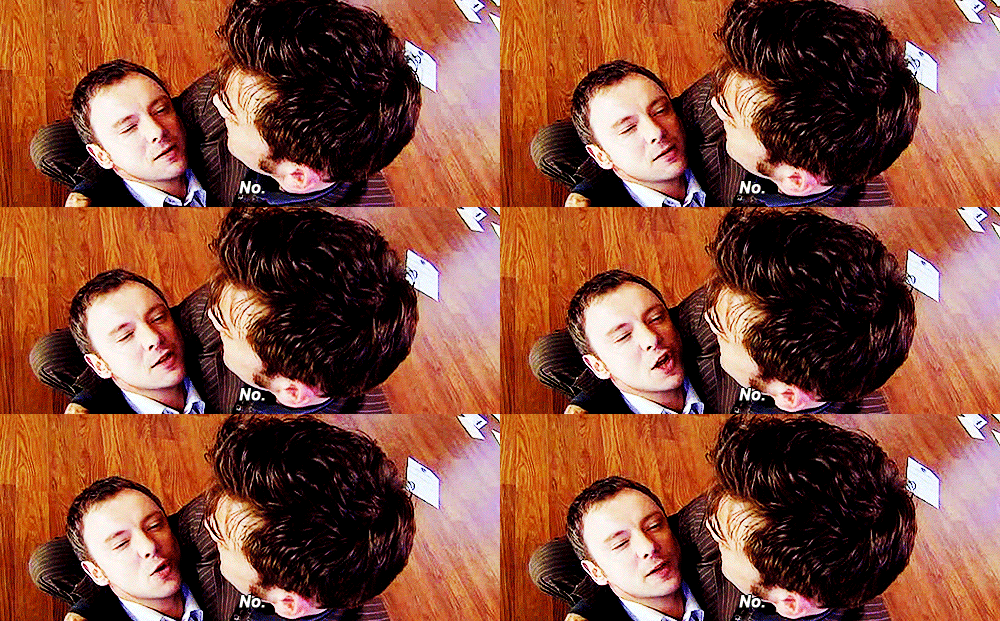
If you met yourself, as a different gender, would you not spend all your time fucking?
I know I'm in the minority in saying this but, despite thinking this was a good season (albeit not as good as Capaldi's other two seasons), I thought the two part finale was just so-so.  I mean, it's got some great moments, and the first two-Master episode is a certainly a prospect that I was excited to see, but "The Doctor Falls" set up a lot of expectations that it didn't deliver on.  The two Masters together were woefully underused, and I think there could have been a lot more fun interactions with those two.  Also, I expected this episode to explain the Master's motivation for turning Bill into a Cyberman, and the answer in the end seems to just be "to be a dick."  Frankly, I would rank this as the weakest Moffat finale, as even Moffat's disastrously weak 7th Season still ended strongly (even though I said it didn't at the time).

They keep calling this the origin of the Cybermen, which makes little sense because it's been well established that Mondasian Cybermen come from...well, Mondas, not a Mondasian colony ship.  Even if this isn't explicitly stated in their debut episode, "The Tenth Planet," it is in what is generally considered the best of the Doctor Who audio stories (which, remember, are canon) Spare Parts, in which the 5th Doctor visits Mondas just before the creation of the Cybermen to see their real origin.  Moffat tries to fix this in the dialogue by saying that the Cybermen start a lot of places, here, Mondas, Telos, Earth.  Okay, not only does that not explain the fact that these Mondasian Cybermen are identical to the ones in "The Tenth Planet."  Also, the Cybermen never started on Telos.  Telos is the planet that the Mondasian Cybermen moved to, displacing (or killing, I don't remember) the residents because their home planet of Mondas had been destroyed by their own stupidity.

And what does the Doctor accomplish with this episode, anyway?  He manages to leave Nardole behind to continue to help protect the people from the Cybermen for eternity.  Good luck with that Nardole, you useless lump.  But there's really no climactic scene in this episode.  There's a big, muddled scene of the Doctor battling the Cybermen (and the sonic screwdriver is used as a weapon, which is breaking a rule of Doctor Who) and the Doctor is basically killed and then he spits out a 1st Doctor quote that's based on a 4th Doctor quote, but nothing really feels like a climactic moment of the episode, and I think that's what I disliked about this episode the most.


I also didn't feel satisfied with the interactions between The Master and Missy interactions.  In "Day of the Doctor," I felt like Moffat hit all the right notes of everything I wanted 10 and 11 to say to each other.  I didn't get that from the Master and Missy.  I did love the Doctor's speech to them to stand with him, and that, at the end, Missy tries to but the two Masters kill each other.  But I didn't get why the Master was so opposed to standing with the Doctor.  The last we saw the Saxon Master, he was standing with the Doctor against Rassilon.  And then he got sucked into the time lock and cured of being Skeletor (which seems unlikely, but okay) and this is him after the events of "The End of Time."  So why has his tune changed so much?  Missy's right in "The Magician's Apprentice," the Doctor and the Master have always been as much friends as enemies, and the Saxon Master is no exception.  There were plenty of moments where he and the 10th Doctor had a mutual respect and admiration for each other.  Where'd all that go?


I thought it was a shame that the Doctor never explained the concept of regeneration to Bill (even though he demonstrated it to her) so she just leaves him not knowing she could stick around and wait for him to regenerate.  Although, she does repeat the Doctor's line about it being a big universe and hoping she'll run into him again.  And I've been having the same argument about this episode that I had about "Time of the Doctor":  Heather showing up is not a deus ex machina.  Something that was set up previously cannot, by definition, be a deus ex machina.  It's just another one of Moffat's methods for killing off a character but not really killing them off (but really killing them off).

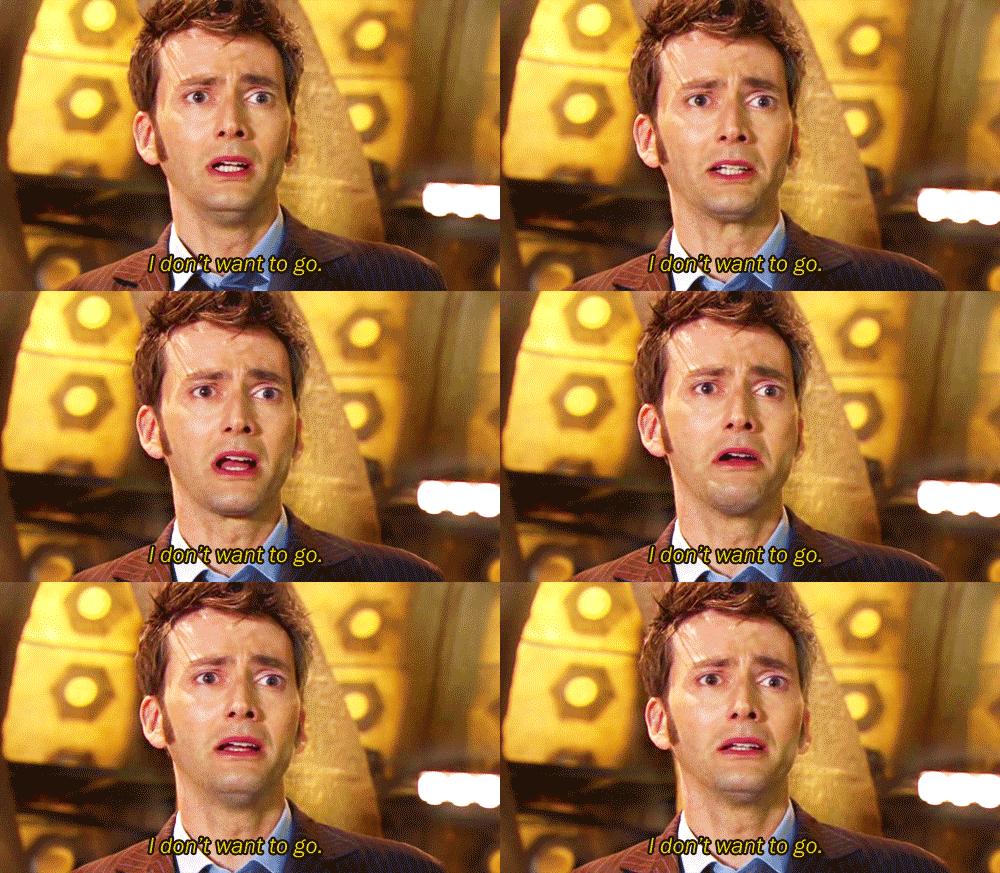
The Doctor then wakes up and starts babbling phrases from other Doctors before him, and people are already complaining about this Doctor not wanting to regenerate and it being like 10's big whiny speech about not wanting to go at the end of "The End of Time."  But that's not a fair comparison.  My problem with 10's speech was that a man was about to die if the Doctor didn't spend a regeneration.  That's not happening this time.  Very.  Big.  Difference.

Me every morning before work.

And then the 12th Doctor runs into the 1st Doctor (played by a new actor, of course, because Billy Hearts is long dead) and the 1st Doctor repeats the same 1st Doctor line that the 12th Doctor said earlier.  Moffat couldn't leave us without lying one more time, because he said like 6 months ago that there would be no more multi-Doctor episodes, and he's clearly just set us up for a 12th Doctor/1st Doctor Christmas Special.  It looks like a lot of fun.  But I have to say, what right does the 1st Doctor have to be criticizing the 12th Doctor about not wanting to regenerate.  He's the 1st Doctor.  He hasn't regenerated yet.  As old as he may look, he's a child compared to 12.  He should shut the hell up.

Well, that's it.  My last blog entry for Moffat's final season.  I put together Julie's Punk Rock Doctor Who Playlist Season 10 of songs that represent season 10 for me, partially based on my blog titles, partially based on what I would have titled the blogs I skipped, and a little editing to make sure no band gets used twice.  I can't throw up a link to it like last season because I'm on Apple Music, not Spotify, now and I don't know how to do that, so I'll just write it out.  Feel free to put it together on your device and play along with me:

1.  The Pilot - Drown With the Monster by White Lung
2.  Smile - Smile Smile Smile by The Dollyrots
3.  Thin Ice - The Unseen Tears of the Albacore by The Vandals
4.  Knock Knock - Safe European Homes by The Clash
5.  Oxygen - For Your Lungs Only by Alkaline Trio
6.  Extremis - Bad Catholics by The Menzingers
7.  The Pyramid at the End of the World - Pyramid Scheme by Mad Caddies
8.  Lie of the Land - Die for Your Government by Anti-Flag
9.  The Empress of Mars - God Save the Queen by the Sex Pistols
10. Eaters of Light - All My Best Friends Are Metalheads by Less Than Jake
11. World Enough and Time - Hospital for Heroes by Direct Hit!
12. The Doctor Falls - Original Me by ALL

That's it until Christmas, where I'm going to be really sad because we're not just saying goodbye to a great Doctor, we're saying goodbye to the best showrunner Doctor Who has ever had.  Fuck the haters.  Until next time:


Saturday, May 27, 2017

For Your Lungs Only: An Overanalysis of "Oxygen"

Kill the fat one in the middle!

Okay, I have a few apologies to make.  First of all, I promised myself I wouldn't use two song titles from the same band in the same season, because I think of it like a playlist.  But Alkaline Trio's "For Your Lungs Only" is too perfect of a title for this episode.  The second apology is that I'm monumentally late with this blog.  Another episode has already aired since this episode aired, and another one airs today.  I was moving into a new apartment and my life became chaotic for a few weeks there and I didn't have time to blog.  Believe me, it was not out of disinterest in the episode, "Oxygen," because honestly, "Oxygen" may be my new favorite episode of the Capaldi era.

We haven't had an episode as dark as "Oxygen" since at least "Dark Water," if not longer.  Actually, the only episode I can think of that's as grizzly, dark, and horrific as "Oxygen" isn't even a new series episode.  We have to go all the way back to the 6th Doctor serial, "Vengence on Varos."  "Vengence on Varos," a disturbing dystopian nightmare about a reality where people are tortured on live television and politicians put their proposals up to a reality show style vote and if they lose the vote, they could be killed.  "Vengence on Varos" was so violent that it became the first time fans of the show started to agree with parents' groups that called the show inappropriate for children.  The show survived a few years after "Varos," but I believe that the slow death it suffered began with viewer outrage over "Vengence on Varos."  Now, Jamie Mathieson, Steven Moffat's only true peer on the Doctor Who writing staff right now, gives us an episode that leaves the viewer deeply disturbed, and with a haunting political message to go with it.

Can you imagine if an American television show had an episode where a character said "And that was it for Capitalism"?  Yes, Star Trek basically lives in a socialist utopia and does talk about how unfair conditions for the poor put an end to Capitalism, but they go out of their way to avoid using words like "Capitalism" and "Socialism" and somehow people fail to notice that that's what happened in the Star Trek universe.  Jamie Mathieson's script said the word "Capitalism" multiple times.  And before you go thinking that it's absolute absurdity for a company to sell us the air we breathe, is it really any different than charging for food, water, shelter, and clothing?  This is why I work in the non-profit sector.

And how about "Oxygen"'s cold open? Have we ever cut to the opening credits on a darker, more violent note?  A woman trying to tell her husband she wants to have a baby is attacked and murdered and turned into a zombie that, along with other zombies, tries to kill her husband.  Jesus Christ, you couldn't just make her eight months pregnant to really make it horrifying.  I like when I get scared by an episode's setup because I know it's just going to make me even happier when the Doctor stops the bad guys.  This time, the real bad guys were a big corporation off screen, but those are the bad guys in real life so it was still satisfying.

The fluid link hasn't been mentioned on the show since the Second Doctor era, but in every mention of in in canon, it has always been essential to the function of the TARDIS.  The 1st Doctor met the daleks when he lied to his companions that fluid link K7 (as opposed to fluid link K57 that Nardole steals, because the naming conventions on these things are completely random) had run out of mercury and needed to be refilled as a ruse to get them to go out and explore the planet of Skaro.  It's hard to believe, because of the history of fluid links, that they aren't all essential to the function of the TARDIS.  It's more likely that, when the Doctor says that he lied about the link being essential to the TARDIS taking off, I'd guess that what he really means is that he lied about the thing Nardole took out being a fluid link.

Speaking of Nardole, I still hate him, but thankfully so do the writers and the Doctor himself.  Nardole's entire function in the show seems to be to be a stick in the mud and to try to stop the plot of the show from happening.  "Oxygen" has more of Nardole than any episode so far in the regular season, and I still love it in spite of that.  When Nardole isn't trying to ruin everything, he's giving explanations that the Doctor could have easily given if he wasn't in the episode, or making really weird jokes about an ex-girlfriend that don't really pay off.

The only thing I didn't like about this episode was the hyperbolic, overacted, soap-opera-style overdramatic way that the Doctor announces he's still blind at the end of the episode.  I don't know who directed the great Peter Capaldi into that terrible performance, but they need to be fined for that stupidity.  I'm sure the blindness is a setup for something big in the overall plot, but I can't for the life of me guess what it's going to be.  It's interesting that it happened because of how long the Doctor was exposed to the void of space, because a Fifth Doctor episode that I can't remember the name of right now established that the Doctor can survive in the void of space longer than humans can.  But perhaps that's why that other character said that he should have died; it's almost as if he isn't human.

But the blindness will be discussed in the next overdue blog.  So until then...


Friday, May 12, 2017

Safe European Home: An Overanalysis of "Knock Knock"

"Now that we have a black person, we're officially a Benetton ad!"
Once upon a time, in the Russel T. Davies era, Season 4, there was a plan for a Cops-style episode, where the Doctor goes on a reality show like Cops and solves a mystery while Donna watches the episode from home.  Davies, however, scrapped the episode because he felt like it was too similar in tone to "The Unicorn and the Wasp," even though the two episodes would have taken place approximately 82 years apart.  Instead, he quickly wrote "Midnight," his best episode, and put that in its place.  I tell you this story because I don't understand how Davies could see the similar tones in what sound like very dissimilar stories, and Steven Moffat (admittedly, one of my heroes) couldn't see that within three weeks he had two episodes with similar monsters with the exact same way of killing people.  In "Knock Knock," the monsters are tiny creatures that make up the very structure but can come loose to form a swarm that eats people.  Where have I heard of that before?

The two robots represent the old man

This was a pretty mediocre episode, with a lot of plot holes.  Why does he need to let the bugs eat people in order for them to keep his mother alive?  Those seem like pretty unrelated things.  As Shelley pointed out, why does the mother only restore this particular group of young people and not the hundreds of others that he's done this to?  Why do the bugs kill everyone else but for the mother they keep her alive?  Why did everyone accept the Doctor as Bill's grandfather without asking the inevitable racist question, which is easily answered by anyone with half a brain, but still would inevitably be asked in that situation?

This was an interesting to see, though, in the week before I move in with some new roommates.  Oh, and it was the week before Mother's Day.  Ew.

Is it my imagination or, when Bill claims to be the Doctor's granddaughter, it's on a day where her clothes and hair look rather Susan-ish?  They've been trying to remind us a lot of Susan this year.  Could they finally be hinting at some sort of return?

After this episode, I'm more certain than ever that the Master is in that vault, and it's probably Missy.  I mean, could that have been a more obvious hint?  It's someone whose company the Doctor enjoys who delights in the suffering of others.  That's Missy.  I know that John Simm is coming back to play the Saxon Master at some point this season, but I can't imagine Simm's Master playfully communicating with the Doctor through piano music.  I'm thinking that Simm is just back to film a flashback scene where we see his Master regenerate into Missy.  I don't want to see him steal Missy's spotlight.  He was a great Master, but his Master was very much designed to play against David Tennant's Doctor, and Missy was just made for Peter Capaldi's 12th Doctor.

That's going to have to be it for now.  I've got packing to do for my move this weekend.  Next week we have an episode from Jamie Mathieson, so that looks promising.  Until next time:


Saturday, May 6, 2017

The Unseen Tears of the Albacore: An Overanalysis of Thin Ice

"Trust me, nice clothes cover up racism"
Sorry I'm late this week.  I'm packing to move next Saturday (13th) and I was a little behind on my reviews over at Punknews. (Go check out my reviews of Conor Oberst, Kendrick Lamar, and Cayetana from this week, because I'm weirdly eclectic.)  Also, there's this show on Netflix called Girlboss that I'm already on my fourth time through watching, so I've had things to do.  So I'll probably get this out after the new episode airs in England, but before it airs in the US.  So here we go!

I liked this episode a lot, even though others thought it was was a knock off of "The Beast Below."  I admit that there are similarities.  Most notably that you could just as easily call this episode "The Beast Below" is the name wasn't already taken.  Of course, the beast in "The Beast Below" didn't eat the children.  But the biggest similarity between "Thin Ice" and "The Beast Below" is that the monster is almost a B-story to the more important story of the Doctor bonding with his new companion.  Bill had to deal head on with the darker realities of traveling with the Doctor.  It's something everyone eventually realizes about the Doctor.  But as Bill is likely to be a one-season-and-done companion, she needs to learn it faster than  the others.

I'm glad they addressed the fact of Bill's race.  They did it a little bit with  Martha's first trip into the past with "The Shakespeare Code," but the 10th Doctor seemed oblivious to her concerns.  The notoriously oblivious 12th Doctor understood it a lot better.  I know some people who found it too preachy, but I loved the moment when Bill pointed out there were more black people there than in the  history books, and the Doctor said "History, it's a whitewash."  My hope is that when they finally hire the first black Doctor they address these sorts of things.  I'm really hoping that happens next season and that despite the rumors it's not this guy:

I'm bringing fugly back.
But this guy:

Have you tried turning the Dalek off and on again?
Last week, I had a theory after I published the blog that what was in the vault was Gallifrey, since the creatures trying to destroy it in "Time of the Doctor" presumably don't know it's back yet and that confrontation is yet to happen.  But "Thin Ice" seemed to imply from the interaction with Nardole (who was thankfully in this episode very little, and only to be the big fuddy-duddy) and whatever's in the vault, that there's a single creature in that vault.  My new theory is that one of the versions of the Master we're promised to see this year, was sentenced to death by the Time Lords and the Doctor negotiated with them to put him/her under his custody.

Next week's episode (which isn't really next week because it's airing in the UK as I type this) is by a brand new writer, so who knows what it'll be like.  So until next time:


Sunday, April 23, 2017

Calling All Skeletons: An Overanalysis of "Smile"

It's basically an early predecessor to the sonic screwdriver, yet the Doctor always looks at a smart phone with such contempt.
I made myself a rule last year that I was going to make the rest of my overanalyses in Peter Capaldi's tenure from that point on were going to be named after punk songs, in honor of the 12th Doctor's guitar playing and Peter Capaldi's actual punk band he had with Craig Ferguson.  (Except I already know what I'm going to call the overanalysis of this year's Christman special, and it's alternative, not punk, but I have to use it because it's so perfect.)  Hey, guess what?  Do you know how many punk songs have the word "smile" or "happy" in the title?  Very, very few.

But this episode was goddamn amazing, especially considering it comes from the writer of "In the Forest of the Night"!  This is good, old fashioned sci-fi.  Machines coming after humans, entirely because of a lack of understanding of human emotions.  This is like something pulled out of I, Robot, only with more action.  There's an old classic series serial called "The Happiness Patrol" about a society that policed happiness and punished sadness severely, and I was worried that this episode would turn out too much like that.  But, where "The Happiness Patrol" is about the political suppression of negative emotions, "Smile" was about robots making a mistake that lead to them suppress negative emotion, so it didn't actually feel anything at all like "The Happiness Patrol."

It also didn't have The Candy Man, which is simultaneously the most goofy and most fucked up villain the classic series ever created.

I missed a lot of hints and clues and build ups for the bigger story arc of the season last week and I'm kicking myself for it.  For one thing, I completely ignored all of the Doctor's talk about an oath he swore.  Why did I skip all that?  Because honestly, he said it with so much conviction I actually thought it was something I was supposed to already know about.  Me, the girl that writes a literal "overanalysis" blog, thought she missed a big oath the Doctor swore at some point.  Yeah, that sounds like me.  So, now, we do have an ongoing question of the season:  "Why did he make this oath, and what the fuck is in that vault?"

I loved that Nardole was barely in this episode.  Let's keep it that way.

I love in this episode where the colonists figure out that The Vardy killed their families, so they start grabbing guns.  You're inside an enormous building made out of them, what's a half dozen laser guns going to do?

How long until Think Geek starts selling Bill's rainbow top?

I loved the Doctor pointing out that there was an evacuation of Earth, and that he's run into a few of their ships over the years.  Besides running into one in "The Beast Below," there's also the classic series episode "The Arc in Space," and probably several others I can't think of right now.  But if he even points out that there were multiple ships, that he's been to a few before, why does he literally say that The Vardy are threatening to kill what's left of the human race?  You've already explained in episode why that's not true, Doctor.  Pay attention!

This week, I got a Facebook message from some of the members of my old podcast, The Mile High Who Podcast.  It's been on indefinite haitus for a while, and that will probably be a permanent haitus now that Shelley, the founder of our whole group and the originator of the podcast, moved back home to Kansas City.  But as soon as we finally got a new episode last week, Shelly wished we could still podcast.  So she messaged us all to talk about the new episode, and she pointed out to me something that I missed:


Okay, so my disagreement with Shelley over terminology here is that I, and I think a lot of other people too, use "Mondasian Cybermen" to differentiate from Russel T. Davies's idiotic invention, the "Cybus Cybermen," or "Pete's World Cybermen."  It's been implied that "Nightmare in Silver" was a return to (what I call) Mondasian Cybermen instead of Cybus Cybermen, primarily because the former are the only ones ever shown to have a weakness to gold.  But other people, like Shelley, and apparently all the press that's come out about this season, us "Mondasian Cybermen" to refer only to Cybermen from the era before Mondas was destroyed.  That encompasses only one serial of the classic series, The First Doctor's final serial, "The Tenth Planet," and one Big Finish Audio story called "Spare Parts."  My argument is that they're still Mondasian when they're homeless, and they're still Mondasian when they forcibly take over the planet Telos and make that their new home, in the same way that I'm Irish even though I don't live in Ireland.  So a lot of reports have come out lately about "The Mondasian Cybermen," but I'm going to refer to those, in this blog, "Tenth Planet Cybermen."

Yes, the reports have confirmed that the Tenth Planet Cybermen are coming back this season, and boy am I excited to see them.  And with the clue that Shelley showed me, it implies that they're going to be the main villain of the season.  The original, Tenth Planet Cybermen had a much campier design than the sleeker, modern Cybermen, and they were much easier to defeat, but there was something really retro cool about their look.  I also really loved their bizarre speech patterns, but if the voices coming from the puddle in "The Pilot" were any indication, they won't have those speech patterns.


But what are they up to?  The Mondasian Cybermen come from Mondas, which is a twin planet to Earth that drifted away from the sun and needed to augment their people to continue to survive.  But when that proved to not be enough anymore, they came to Earth for...some reason.  Invasion?  Spare parts?  I don't rewatch First Doctor serials very often.  But it resulted in Mondas being destroyed.  This is why I prefer Mondasian Cybermen, because they actually have a very sympathetic back story.  Everything they did, they did to try to survive.   They were just willing to kill innocents to do that, something the Doctor will never abide.  If they've jumped forward 11 Doctors to come for the Doctor's 12th incarnation, I'm guessing their goals are back to what they were in their first few appearances after "The Tenth Planet":  changing the timeline to bring back Mondas.  But why did they need a pilot who was made of water and not metal?  She's definitely coming back.

The ending, where the Doctor landed in the wrong place and time and that leads us into the next episode, is a very Classic Series style ending.  The first two Doctors didn't have the ability to steer the TARDIS, and once the third Doctor figured out how to do it, he and his successive regenerations were still not great at it, and the accidental landings often set up for the next episode.  Next week's episode is written by Sarah Dollard, who gave us the beautiful first part of last season's three-part finale, "Face the Raven," so I trust it will be pretty good.  Until next time!


Sunday, April 16, 2017

Drown With the Monster - An Overanalysis of "The Pilot"

These are actually all companions, including the Dalek
Last time we were starting a new season, things were very different.  I was deeply in love with a girl named Tanya who loved me back.  Tanya doesn't speak to me anymore.  Last time I was a man named Trevor, and now I'm a woman and prefer you call me Julie.  Last time the President of the United States of America was Barack Obama, and now we're all going to die.  The year 2016 fell into utter and unadulterated chaos from which we may never recover, and coincidentally, who wasn't here to save us?  The Doctor!

But now it's two years later and we finally get a new season, as we say prepare to say goodbye to both Peter Capaldi and Steven Moffat, both of which will be missed by anyone who isn't an Internet trolling twatwaffle.  And how appropriate that for Moffat's last season as head writer, exactly like his first season back in 2010, starts on the day before Easter.  It's going to be a sad goodbye to both of them, and I'm going to cry more than usual for this regeneration.  But before that happens, we have a whole season of the 12th Doctor and his new friend, a girl named Bill.  Bill Potts, to be exact.  A Bill P. who's not a Piper.

Bill was announced as the first openly gay companion recently, to the consternation of many people who were obviously watching the show with their eyes closed, with the sound off, or while coked out of their minds, because, much like when we saw Vastra and Jenny's kiss in "Deep Breath," I have to ask "Why the fuck were you surprised?"  Since Russell T. Davies, the motherfucking creator of Queer as Folk, brought the show back in 2005, he and his successor, Steven Moffat, have both gone out of their way to make the show aggressively LGBT friendly.  Jack was pansexual, River was at least bisexual, Clara was implied to be bisexual and Jenna Coleman refused to deny it, there's an interspecies lesbian couple, there are background gay characters in "Midnight" and "The Rule of Three," and you can argue me on this if you want, but both Missy and The General are transgender.  So not only are the people who are complaining about Bill's sexuality ignorant bigots, but they don't know what show they're fucking talking about.

Amy and Rory when the Doctor's not around
Pearl Mackie, who plays Bill (brilliantly), said that Bill's sexuality would be brought up in about her second line of dialogue on the show and that it wouldn't be treated as a big deal.  And she's right, Bill's sexuality isn't treated as if it's unusual, as if it's a big deal that she's not straight, that she's anything but just another companion.  And yet, simultaneously, it was central to the whole story.  It was a small-scale love story (I guess you could call it a "like" story, since Bill and Heather didn't get to know each other very well) that could have just as easily been told with heterosexual characters, but it simply wasn't.  Because it's 2017 and you can do that sort of thing.

I still hate Nardole.

I'm Matt Lucas and I'm a big, racist, human chode.

Am I the only one who thought "Waters of Mars" in this episode?  Heather didn't react exactly like the infected in "Waters of Mars," but there was a definite similarity in the way she dribbled water from the mouth.  And then there's the other episode it reminds me of:  "The Lodger."  It's kind of a really chopped and screwed, highly postmodern version of "The Lodger," with the ship looking for a new pilot, but unlike "The Lodger," this is nothing like a normal ship.

I was curious about the picture on his desk.  Not River, that's understandable, he just lost her.  But there's a picture of Susan on his desk.  He hasn't hardly mentioned Susan since the 1st Doctor era on the show.  There are some (canonical) 8th Doctor audio stories where he meets up with her again, so he has seen her somewhat recently, right before the Time War.  But I still feel like Moffat wants to do something with Susan.  It's still strange, though, because he's been hinting at it his entire run, and this season is somewhat of a "clerical error," to quote the Doctor from last season.  Season 9 was designed to be Moffat's last season because he didn't know he was going to need to make a 10th one to give Chibnal time to finish up Broadchurch.  So everything we're seeing now wasn't planned that far in advance.

For those wondering which Dalek war the Doctor brought them to, it wasn't the Time War.  Those people they were fighting who looked like Milli Vanilli were a robot race called the Movellans from the 4th Doctor episode "Destiny of the Daleks."  They got stuck in a stalemate with the Daleks because each side could predict the others' moves perfectly, and neither had the imagination to come up with something the other side didn't expect.

I read an article that said that the stakes are low for this season because everyone knows that they're going to throw out the Doctor, the head writer, and most likely the companion at the end of the season.  But if there's one thing that "The Pilot" showed, it's that Moffat isn't writing this season like nothing's at stake, or like it's a "clerical error," but he's writing it as brilliantly as he always has.  I was a little worried that this might fall short the was Season 7 did when a lot was changing on set and Moffat was depressed and the writing suffered.  But Moffat seems to be writing from a place of confidence as he heads out the door, and I think we're in for another great season.

I'm continuing my rule this season of naming every blog after a punk song, and so:


Friday, January 1, 2016

Merry Christmas (I Don't Want to Fight Tonight): An Overanalysis of The Husbands of River Song


It could be argued that, since taking over as head writer, Steven Moffat has actually only been writing one very, very long story:  the story of Gallifrey's return.  The first episode Moffat wrote as head writer, "The Eleventh Hour," featured the ominous warning from Prisoner Zero: "The universe is cracked. The Pandorica will open. Silence will fall."  This set off an entire plotline that would span the entirety of the Eleventh Doctor's tenure, as we eventually discover that "Silence will fall" is a religious slogan from a church that is dedicated to ensuring that Gallifrey does not return.  The Twelfth Doctor's tenure, so far, has largely been about the negative consequences of Gallifrey's return to the Universe.  Steven Moffat has stated openly that the reason River Song appeared in this Christmas special was because, when he wrote it, he thought it might be the last episode of Doctor Who he ever wrote and, if so, he wanted to put River in it.  We now know that Moffat will still be heading series 10, largely because he is having difficulty picking a successor, but "The Husbands of River Song" stands as a would-be finale to the Moffat era.  Where "Hell Bent" ties up the Gallifrey plotline in a nice little bow for the next showrunner to follow up on, "The Husbands of River Song" ties up another thread in the Gallifrey return story.  While River may predate Moffat's tenure as head writer, she quickly became inextricably linked to the larger Gallifrey plotline, the deadly product of a cult dedicated to preventing Gallifrey's return by absolutely any means necessary.  A softer, gentler side of the plot, it's a perfect way to put the finishing touches to the story on Christmas day.  While there's certainly some darkness to it, "The Husbands of River Song" is one of the most beautiful, romantic, dynamic episodes the series has ever done.  It might even be my new favorite.

This is pretty clearly the final episode for River Song.  I mean, are there ways they could potentially bring her back?  Sure.  They've brought so many people back from the dead it's pretty hard to believe that death is a real problem in the Doctor Who Universe.  But more than likely, River is being retired with this episode.  It puts a pretty tidy little bow on the whole story that's a bit difficult to unwrap.  Now, if we string all of River Song's episodes together in order, does it all line up perfectly?  No, not at all.  There are plenty of problems with it.  Why is River surprised that she's going to die at the end of "Forest of the Dead" when the Doctor pretty much confirmed to her that she's heading to her death at the end of this episode?  Why is she surprised to find that the Tenth Doctor is the youngest version of the Doctor she's ever met when she apparently has a rolodex full of pictures of all of his first 12 regenerations in order?  Why does she tell the Doctor in "The Time of Angels" "It's so strange when you go all baby face" when we now know that that's the only regeneration of the Doctor she had met at that point?  How does the new Big Finish audio series The Diary of River Song, in which River meets the Eighth Doctor, even work?  (It's already out, but I haven't listened to it yet.)  But of course you can kind of wave all of this away with River's admission at the end of "The Wedding of River Song" that she often lies and pretends to not know things that she does to avoid spoiling anything for the Doctor.  If anyone ever tries to resurrect River again in the future, "River lies" will surely be used as the explanation.

I have been slowly showing my new girlfriend the Steven Moffat era over the past few months, but we skipped over series 4 because I wanted to jump her straight to my favorite Doctor and, also, because fuck Donna Noble.

Pictured above:  Donna Noble

So a few weeks ago, in preparation for this episode, I doubled back and showed her "Silence in the Library"/"Forest of the Dead," and boy am I glad I did, because this episode does not make sense without that particular context.  I had no idea that we'd be going down that road in this episode, particularly because the Series 5 DVD set has a mini-episode that implied that the Eleventh Doctor was the one that took River to the Singing Towers of Darillium, but then that was explained away in this episode by acknowledging that the Doctor keeps making plans to take her to Darillium but keeps cancelling for very obvious reasons.

As soon as I got to my second viewing of this episode, I realized that the episode is telegraphing the twist from very early on.  Most notably, I can't believe that I missed the Doctor saying early on in the episode that he had a new suit and a haircut, just as River had said in "Forest of the Dead."  I have to admit, I always took her comment about a "haircut" to be a euphemism for "new regeneration," and I think, in the end, it both was and wasn't.  But, like I said about the last episode, Moffat likes to make sure that, if he's killing off a character, he finds a way to kind of save them, but not really.  River was already granted a stay of execution in "Forest of the Dead" by being saved to The Library's computer, and she's given another one in this episode when we find out that her last night with the Doctor on Darillium will last 24 years. I loved her speech about how "Happy ever after doesn't mean forever. It just means time. A little time."  I'm 31.  Personally, I feel like 24 years is a pretty nice, long chunk of time to have with the person you love.  Finally, the Doctor and River get to live together, like a real married couple, not running around the Universe and jumping from adventure to adventure, but living for 24 years with the Doctor on this beautiful planet.  And for all of those 24 years, it's Christmas night.  That sounds like a wonderful life.

"Every time a cloister bell rings, a dead companion gets its wings!"
It's a distinctly Moffat-y ending, because Moffat is pretty much the only writer of the television series who figured out that if you have an immortal character in a time travel show, you're actually completely free to do an episode that lasts as many as 4.5 billion years, let alone a mere 24 years.

The only negative things I can say about "The Husbands of River Song" was that Matt Lucas was in it, playing River's idiotic man servant Nardole.  Matt Lucas co-created, co-wrote, and co-starred in a short-lived sitcom called Come Fly with Me with David Williams, who previously appeared as the Tivolian in "The God Complex." I think you can still find Come Fly with Me on Hulu.  An ex-girlfriend recommended it to me, and she didn't even have a glowing recommendation of it, but pretty much just said "It's not good, it's just sort of generally pleasant to have on in the background while you're doing stuff."  So I watched the pilot and what I witnessed was about 30 minutes of the most boring piece of blatant racism that I had seen since The Blind Side.

I don't know about England, but in America, we call that "blackface."
Come Fly with Me is such a horrendous piece of shit that I have a prejudice against anything that Matt Lucas and David William do now, especially Matt Lucas, as he's the more annoying one.  But thankfully the rest of this episode was so good, it cancelled out Matt Lucas's terrible presence.

I think this episode has so many amazing tender moments.  The set design for the restaurant on Darillium was transcendent.  The realization on River's face as she realizes the man next to her is the Doctor is truly a wonderful piece of acting from Alex Kingston.  The episode breaks a lot of the rules, as it has virtually no connection to present day Earth, it's carried entirely by two actors over the age of 50, and it largely only make sense in the context of an episode that aired seven years ago.  It's not in keeping with what Steven Moffat said when he first started as head writer that every episode should be a jumping on point for new viewers, but then Moffat has never taken his own advice on that point anyway.  It's a terrible episode to initiate a casual viewer with.  It is a lovely Christmas present for the dedicated fans.


Also, I created a Spotify playlist out of all the songs that I named my blogs after this year, so you can listen to the whole season as a playlist (okay, technically the Christmas special counts as part of the next season, but who cares).  Click the link above to check it out!

Hybrid Moments: An Overanalysis of "Hell Bent"

If you want to scream, scream with me!
At this point, I'm starting my damn blog post so late that, by the time it's finished and published, we'll be welcoming Rupert Grint as the 16th Doctor (that sounds like a Mark Gatiss casting choice if I've ever heard one), but I guess better late than never, so here we go...

Star Trek:  Deep Space Nine had an amazing episode in the fourth season in which a freak accident causes Captain Sisko to wander lost through time, never able to decide where or how long he will appear, and his son, Jake, spends his entire life trying to figure out how to save him. Executive producer Ira Steven Behr said about the episode: "A love stronger than death. Usually that's romantic love, but for this show, this series, we chose the love between a father and son. And it worked like gangbusters. Everyone could relate to it."  It's true that when people think of great love stories, they think of romantic love.  But for most of us, our significant other isn't the only person we love so much that we're willing to go to any lengths to save them.  For many of us, that's also a parent, a sibling, a child, or even a friend.  "Hell Bent" is the great story of one man's love for a friend.  Not a romantic love--well, there was a little flirting towards the beginning of their relationship--but the slightly paternal, always challenging, strong friendship between two people, and a non-romantic love between them so strong that one was willing to literally break the Universe in half to save the other.  And that makes for a beautiful story.

I watched this episode at a viewing party at a bar with my friends from Mile High Who, with a bunch of new members there to join us, so I was trying my hardest not to start bawling openly during this episode, but at the moment when the Twelfth General told Clara that the Doctor spent 4.5 billion years trapped in the confession dial, I lost it and couldn't stop myself from crying.

Mostly the Doctor was just trying to one-up Rory.

A lot of people, since this episode have aired, have claimed that this revelation now means that the Doctor is even older, clocking in at a whopping 4,500,002,000 years old.  However we need to remember that, while "Heaven Sent" takes place over the course of 4.5 billion years, it only occurred to the Doctor as 3 days.  He may have experienced it over and over again, but he was essentially reborn each time and never retained the memories of his previous times through the confession dial, so from his perspective only added 3 days to his lifetime.  I think we can still say that the Doctor is about 2,000 years old.  He didn't really live and feel the 4.5 billion years, so I don't think that can count as his age.

I predicted that the Doctor's statement at the end of "Heaven Sent" meant that he was the Hybrid because he's half human and half Time Lord according to an often ignored line from the 1996 movie where the Eighth Doctor says that he is "half human on [his] mother's side." My Mile High Who cohost Shelley said that she thought his statement meant that Ashildr was the Hybrid.  As Shelley and I were both in the same room together as we watched this episode, we both shouted "No!" at the screen when Ashildr asked if the Doctor truly was half human.  We were both quite pleased at where Moffat went with that bit of the script, managing to quite deftly avoid a huge civil war within the fandom, or a straight up Han-Shot-First style revolt, by refusing to either confirm or deny the "half human" line.  The Doctor's simple response of "Does it matter?" doesn't force Moffat to do any major rewrites of cannon, but also makes it quite clear that we are not going to explore the possibility, even if it is true, and I'm fine with leaving it there.

The episode never specifically names who exactly the Hybrid is, but I actually like Ashildr's suggestion that the Hybrid doesn't actually refer to a single person, but the combination of two people, who together become the most dangerous creature in the Universe.  I was originally skeptical of the part about the Doctor and Clara playing Russian roulette with a mind eraser, but in hindsight, it makes perfect sense.  It wasn't just because the Doctor wanted to keep Clara safe, but to destroy the Hybrid, one of them had to stop remembering the other, or else the Universe would be at risk of fracturing as the Doctor tried to save Clara.  Many people at the event I went to called this the "Donna Noble thing," but I had to correct them and remind them that, in fact, in the series as a whole, Donna was the third companion to have her memory of the Doctor erased upon departing the TARDIS.  It happened to Jamie and Zoe before her (although, admittedly, that was retconned in a weird combination of fan theories and external Universe material called "Season 6b" that the BBC has inexplicably declared to be cannon).  Still, I feel very bad for the Doctor in losing his best friend.  He'll probably need some cheering up (from River, of course!).

Fear the hybrid!


I had this inkling in the back of my head that I never quite expressed out loud that Steven Moffat might just put some sort of twist on Clara's death.  I find that Moffat, whenever he kills off a character, likes to find a way to allow them to sort of keep living but not really.  River got saved in The Library.  Amy and Rory got to live out the rest of their lives, just not in their own time period.  It only makes sense that he would have found a way to kind of save Clara while still killing her off.  As some of the people around me at the viewing party suggested, a spin-off about Clara and Ashildr traveling through time together in a TARDIS disguised as a 50's themed diner would be pretty amazing.

And I loved Clara's take on her death, because it really put a weirdly positive spin on it.  Her insistence on not having her memory erased spoke so much about who Clara is now and who she has become.  She never asked the Doctor for safety, that's true.  She wanted to live the life she could with the Doctor, regardless of the consequences.  There were episodes this season that hinted that Clara was getting to be too much of a daredevil, a thrill seeker, an adrenaline junkie, that she was starting to act like she was immortal.  Quite the contrary, she simply didn't care because the risk of death was always worth it to experience life with the Doctor in the TARDIS.  It's a different take on being a companion than I've ever seen before, and certainly gave her a dignity in death that the only other dead companion, Adric, never achieved.  The little trick of this episode bringing her back only temporarily, trapped in a moment in time, also gives her the chance to say everything that's important for her to say to the Doctor before she leaves him.  He needed more than just her warning at the end of "Face the Raven" to keep him from turning cruel and hateful from the death of his companion.  He needed a partial memory wipe combined with a big cathartic sense of closure with Clara, followed by a reminder that what made him special to her in the first place was that he was never cruel nor cowardly.  I'm not saying it will erase the pain of losing Clara completely, but it's probably just what he needed to keep him from spinning completely out of control in Clara's absence.

I have to say, from watching "The Day of the Doctor," I somewhat wondered if Moffat had forgotten about the events of "The End of Time."  I know many people are going to respond to that by saying that "I wish I could forget that episode, too," and they're not wrong.  It's not a very good episode, but it has excellent parts to it.  To be more precise, I really think there's a very good 42 minute episode in there that got excruciatingly dragged out into 2 1/2 hours.  The revelation of why the Doctor had to destroy the Time Lords was mind-blowing and perfectly dark, and I really wanted to see that followed up on, yet "The Day of the Doctor" seems to go out of its way to avoid talking about the evils that the Time Lords have committed, namely wanting to destroy the Universe.  Yet Moffat didn't forget about these atrocities, but was perhaps just keeping them out of "The Day of the Doctor" to avoid turning such a celebratory anniversary episode into a humungous bummer.  But "Hell Bent" makes it quite clear that Moffat has forgotten nothing about what happened in "The End of Time," and the Doctor's showdown with Rassilon makes that quite clear.  Rassilon has now regenerated into Donald Sumpter, as Timothy Dalton was busy, but it gave them an opportunity to make him probably the only actor to ever appear alongside both the 3rd and 12th Doctors in an episode.  That the Doctor begins by banishing Rassilon and the High Council from Gallifrey works perfectly and lines up very neatly with cannon, allowing us now to reestablish Gallifrey in the Doctor Who Universe without the complications brought into it from "The End of Time."  Gallifrey will be a rebuilding planet, certainly, and the Doctor is, again, the Lord President for the umpteen millionth time in his life, but I'm pretty sure he handed that duty off to someone else shortly after the events of this episode, most likely The General.

I do have to comment on the brand new Sonic Screwdriver.  I know a lot of crybabies complained about the temporary retirement of the screwdriver at the beginning of this season, but I liked it, as it forced the writers to find some other ways to get around things.  Plus, the Sonic Sunglasses look really good on Peter Capaldi.  Since I'm writing this after "The Husbands of River Song"aired, I know that the Sonic Sunglasses have not been retired now that the Sonic Screwdriver is back, and I'm fine with that.  The Screwdriver got a much deserved short rest.  But I do have to say that the new one, while a nice pretty blue color, is the most phallic design they've ever done for a Sonic.

It looks like a Transformer's robot penis.

One thing I'm not entirely sure about, and this is something that many of the Mile High Whovians also brought up, is where Gallifrey stands now.  Is it back in the Universe?  Or is it still hiding in a corner somewhere, terrified to reestablish its presence.  I guess that's for us to see next season.  But first, it's time to revisit our old friend, River Song, for Christmas!


Saturday, December 5, 2015

Room Without a Window: An Overanalysis of "Heaven Sent"


The Simpsons used to have a rule that every season had to have one episode that pushed the boundaries of what a Simpsons episode should be.  Personally, I think every show should have a rule like this.  Not every episode should be an experiment, but once a season I think every show should push themselves and see if they can go somewhere very different creatively.  "Listen" was probably Steven Moffat's most obvious attempt at an experimental episode, as it really was, in every way, a complete deconstruction of a Doctor Who episode.  It took the most basic concept of a stereotypical Doctor Who plotline, broke it down to its basic components, and reassembled it in a very different way that challenged the very premise of what this show is and what it's about.  Perhaps it was Steven Moffat's confidence after three seasons as showrunner that gave him the confidence to push the boundaries of the show's structure.  I would argue that there are a number of moments when Moffat deconstructed traditional narratives that were not necessarily looked at as "experimental" episodes, such as "A Christmas Carol" and "The Day of the Doctor," but "Listen" is where he really stretched himself.  "Heaven Sent" is the work of a writer at the top of his game, confident in the abilities of his lead actor, sure of the BBC's confidence in him and his show, and confident in his audience's ability to grasp the complexity of the episode.  Sure, a work of genius like this will not silence Moffat's haters, but nothing ever does.  They will talk about how much they love the 11th Doctor, Amy Pond, Rory, River Song, Danny Pink, the 12th Doctor, "Listen," and now, certainly, "Heaven Sent," but will still insist that Moffat is ruining the show.  But while I'm still not entirely sure why Moffat chose to call the episode "Heaven Sent," I do know that it is a work of pure, unadulterated brilliance that will forever be remembered as one of the most important episodes in the show's history.

The show has been dangling out a few mysteries this season hinting at the plot of the finale, and I haven't entirely understood them all, or even cared to understand them all.  I've been more interested in figuring out who the Minister of War is or what Missy's "clever plan" was, but it now seems like those are setting up for farther down the road so let's focus on the mysteries that seem to be setting up for this finale.  The first was The Hybrid.  It's interesting, but incredibly vague, and leaves me with very little to chew on.  But, more importantly, it completely destroys the premise of the show.  We've always known the reason for the Doctor's departure from Gallifrey, and the story of The Hybrid throws that reason out entirely.  To be honest, the original explanation we've had all these years, that the Doctor was simply bored, makes complete sense to me.  It speaks to the true spirit of the character.  Regardless of which generation we're talking about, the Doctor is always insatiably curious.  So why throw out his original motivation when it fits so perfectly with the character?  Unlike Davros, I never once doubted that the Doctor was just bored.

But the revelation at the end of this episode that the Doctor is The Hybrid does give us an explanation that is more in keeping with the Doctor's character.  The Doctor running from a prophecy is silly.  The Doctor doesn't run from enemies, no matter how deadly they are, at least not for very long.  But running from responsibility?  Yeah, the Doctor has done that many times, and that is quite in keeping with his character.  The Doctor has been offered the position of Lord High President of Gallifrey on multiple occasions and turned it down because...well, because damn the man.  The Doctor doesn't want that kind of power over his own people.  But if he needs to set them straight about a few things, which would be necessary even if Clara hadn't been killed in the trap that they set for him, then he's willing to show up and accept his responsibility as the one destined to fix Gallifrey.

Remember that "Day of the Doctor," taken on its own, is a very happy episode, but when you remember the events of "The End of Time," "Day of the Doctor" seems to be glossing over a few things.  Great, the Doctor has saved his own planet, and the Time Lords have been restored to the Universe.  Except that he destroyed them because they were about to destroy the Universe and rise to a higher level of consciousness.  So when the Doctor did finally find Gallifrey, we knew one thing for sure:  The Doctor was going to need to lay a serious smack down on some people.  I'm guessing Timothy Dalton was not available for "Hell Bent," but there are still some people who are going to need to be dealt with.

But how is the Doctor a hybrid?  I was really, really hoping we weren't going to go here, but I think I know what Moffat is referencing, and I'm not the first Doctor Who fan to have noticed it.


There are a lot of things that are wrong with the 1996 movie.  Somehow it manages to be too simplistic and too complex at the same time.  The line about him being half-human on his mother's side was so despised by fans that it has pretty much been rejected.  Expanded universe materials have retconned the line and explained it as an elaborate ruse to fool the Master.  Russel T. Davies pretty much ignored the line when he wrote "The End of Time," and fully admitted that the mysterious Woman was supposed to be The Doctor's mother, but also insists that that shouldn't be considered canon as he never got around to actually putting it into dialogue.  You wouldn't think that Moffat would even want to touch such a controversial line, but I have a bad feeling that that's what it means. 

If this is where Moffat is going with the whole Hybrid plotline, then there are far reaching implications for it.  The Doctor may have been established as half-human almost 20 years ago, but the show has refused to acknowledge it as real, and fans refuse to accept the line.  A half-human Doctor means something very different.  It means the Doctor's tie to this world is not just a fondness for it, but a birth connection.  I always liked the idea that it isn't his planet, but his adopted second home.  I don't know if I like the idea of it being just where his mother was from.

 My co-host from Mile High Who Podcast, Shelley, pointed out the other possibility that he's not saying "Me" as in he himself is the Hybrid, but rather referring to Ashildr by the name that she insists on calling herself, "Me." It's not a terrible theory, but I don't understand why Ashildr would show up on Gallifrey, unless she now feels really bad about what she did to Clara.  I don't think that the Doctor is going to literally "stand in the ruins" of Gallifrey.  To do that to the planet would be to really spit on Clara's legacy.  She saved the Time Lords from him and, even if they're partially responsible for her death, he would never take that legacy away from his good friend.  I think "stand in the ruins" refers to the fact that he's going to completely dismantle their government and institute a new leader, and maybe he's going to decide that Ashildr is just who should do it.  Or maybe one of the Osgoods, another Hybrid the Doctor created.  But he won't do it himself.  The Doctor is the most fit to govern Gallifrey precisely because he doesn't want to do it.

I'm just going to leave this riiiiight here.
I was also surprised about the Confession Dial.  The Doctor kept referring to it as being similar to a human concept of a "Last Will and Testament," but that wasn't true at all.  It was an interrogation chamber to get him to admit his final secret.  There's one thing though:  even if he is the Hybrid, the Doctor went through a lot of trouble to keep from telling the Time Lords something that he knew about the prophecy of the Hybrid, which means that there's still something we don't know yet.  So I'm really excited to see what it is now.  Regardless, I'm really excited for "Hell Bent," but I'm also a little skeptical.  "Heaven Sent" only really stands up if "Hell Bent" answers a lot more of the questions that it brought up.  So here's hoping it does!