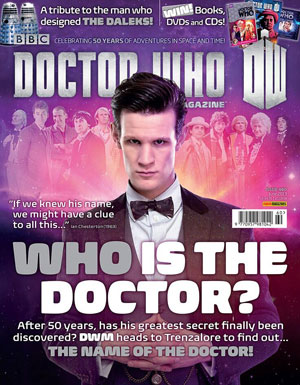
Showing posts with label The Name of the Doctor. Show all posts

Tuesday, May 21, 2013

He Who Must Not Be Mentioned: A Doctor Who Book Report on The Valeyard

I am the Valeyard!  Marvel at my completely impractical faux samaurai outfit!


Some people have been tossing around a theory that the John Hurt Doctor is not the "True 9th Doctor," as I've referred to him.  Some have suggested that he's either a pre-Hartnell Doctor or The Valeyard.  I realize now that dialogue in the episode doesn't specifically declare John Hurt to be an incarnation from between the McGann and Eccleston Doctors.  But him being either pre-Hartnell or The Valeyard seems unlikely.  The Doctor, before the Hartnell Doctor, was "The Other."  This has never been mentioned on TV, but was elaborated in the novel Lungbarrow.  Even though this is an idea that started in the TV writers' room, I don't think it was ever meant to be stated explicitly on screen.  Even if I was a writer for Doctor Who, I wouldn't touch "The Other" with a ten foot pole.  And I love the plotline about The Other.  It's just not something that needs bringing up.  The suggestion that Hurt could be The Other rests on the fact that The Other is someone who didn't bear the name of "The Doctor."  But the 11th Doctor said that the John Hurt Doctor isn't The Doctor because he broke the promise of the name.  When he was The Other, he didn't have that name or that promise yet.

The Valeyard is more plausible, but there are still major problems with that theory.  But, because of this rumor, and also because "The Name of the Doctor" was the first mention of The Valeyard on the show since his final appearance in "The Ultimate Foe," I got some requests to talk more about The Valeyard on here, including my friend Tim Veilleux, who specifically requested a book report.

The 22nd Season of the classic series of Doctor Who was an unmitigated disaster.  Contrary to popular belief, I don't think it was the acting of the new Doctor, Colin Baker (who I'll hopefully meet at the end of this month!).  I don't think it was that the writing was bad.  It was because it was fucking gruesome.  A few years ago, a website called Topless Robot did a great article on why Colin Baker wasn't entirely to blame for the unpopular 6th Doctor era, because he was getting screwed left and right.  The most amazing one to me was the fact that BBC Controller, Michael Grade, who claimed to hate the show because of its poor production values (he controlled their budget), was fucking Colin Baker's ex-wife!  So Colin Baker had a target on his back from day one.

Besides the violence, the other main complaint was that the 6th Doctor was brash, pompous, and insensitive.  As the Topless Robot article points out, this was actually an attempt at an arc.  The 6th Doctor was supposed to regenerate as a dick, lose his companion, and gradually remember why he was the Doctor.  However, the fact that the Doctor got meaner and that the stories got darker made fans so upset that they never got to finish this arc.  Some of the fans started to join in with the chorus of critics who had been calling the show too violent for decades.  The season is solidly disturbing.  In "Vengeance on Varos," the most notorious serial, criminals were tortured on live television for the viewing pleasure of the people of Varos.  Two people fall into an acid bath, and, depending on how you interpret the scene, the Doctor might have pushed one of the guys into the acid bath.  Two different serials during the season were about cannibalism*.  But if you truly watch these episodes and pay attention to them, you'll see some really creative episodes, just not ones that you'd expect on a children's television show.  The sudden shift from Peter Davidson's friendly 5th Doctor and his science-oriented era to Colin Baker's ultra-pompous 6th Doctor with grim and dark morality tales was just too much for the audience to handle.  Michael Grade (I imagine on a phone call while he was literally inside Colin Baker's ex-wife) put the show on an 18 month hiatus.


An attempt was made to soften the change in tone by casting Colin Baker alongside Nicola Bryant's cleavage, high pitched screaming, and horrible fake American accent
When the show came back, executive producer Jonathan Nathan-Turner, and head writer Eric Saward, put together a season long plot line called "The Trial of a Time Lord."  The Doctor was put on trial by the Time Lords for the second time for the same offense:  interfering with the affairs of other species.  If you know the history of what was happening behind the scenes with Doctor Who's near cancellation, you'll notice that the season is a perfect metaphor for the show being "on trial" after Season 22.  The Doctor defends himself against allegations of being violent, and he claims that he only resorts to violence in the direst of emergencies.  However, there was quite a bit of argument between Nathan-Turner and Saward about how dark the story should be.  So some forced rewrites supposedly added to the highly confusing plotline I'm going to attempt to relate to you.  The writers of the show didn't successfully explain the Valeyard in 14 episodes.  I'm going to try to explain him in one blog post.  Here goes nothing:

The Doctor's prosecutor in this trial was known as The Valeyard.  Context suggests that the term "Valeyard" is a Gallifreyan word for "Court Prosecutor."  The Valeyard shows two of the Doctor's adventures as evidence of the Doctor's guilt, allowing two serials ("The Mysterious Planet" and "Mindwarp") to be aired within a larger framework of them being "evidence."  It is explained that every TARDIS has a device in it that records all the events that happen to anyone in the area, including people who the Doctor was not in contact with.  It could literally record the actions of side characters in the story when they weren't near the TARDIS or talking to the Doctor or his companion.

Oh, don't worry, this plot gets fucking weirder.

The Doctor then shows another serial as his defense ("Terror of the Vervoids"), which he claims is from his future.  If it seems ridiculous that the Doctor would find an adventure from his own future, show it, and then not significantly change the course of events when he got to that point in his timeline in the future, that's because it is ridiculous.  What's sillier is that the charge of genocide is added to the Doctor's charges after watching "Terror of the Vervoids" in court, despite the fact that it hadn't happened yet.  Apparently, on Gallifrey, you can be executed for future crimes.  However, it was an awkward but necessary plot device to explain the change of the Doctor's companion mid-season.  (Just trust me on this.  We're getting into such complicated shit here, I'm really worried about my sentences not making any sense.)


"Terror of the Vervoids" is actually a pretty good episode if you can look past the fact that the villains are walking vaginas.
The Valeyard seems to be a particularly harsh prosecutor as he calls several times for the Doctor to be given a death sentence.  The Doctor insists that the evidence being shown at his trial is all altered from what his TARDIS really recorded.  This defense falls on deaf ears, as everyone on Gallifrey insists that, since this information is all recorded in the Time Lords' "Matrix," it can't be altered because the Matrix is tamperproof.  Tamperproof is one of those words like "unsinkable":  It always seems to be a challenge.  In a bizarre twist (in a serial already full of bizarre twists), the Master shows up to prove that the Doctor is right and that there is absolutely a way to tamper with the Matrix by tampering with the Matrix himself.  He then reveals the truth about the Valeyard:

He's a future version of the Doctor.


Well, he's sort of a future version of the Doctor.  The Master describes The Valeyard as such:  "There is some evil in all of us, Doctor, even you. The Valeyard is an amalgamation of the darker sides of your nature, somewhere between your twelfth and final incarnation. And I may say, you do not improve with age."  The phrase "somewhere between your twelfth and final incarnation" is very confusing.  The Doctor is supposed to only have 12 regenerations, meaning there can only be 13 Doctors.  Therefore, I always took it to mean that somehow this creature spins off from the Doctor in the midst of his final regeneration, creating a physical manifestation of the Doctor's darker nature.  However, my friend Patrick pointed out the problem with this sentence of the Master's.  He said that it suggests that there have to be more than 13 Doctors for the Valeyard to have been created between the 12th and the final manifestations because "integers don't work that way."  But that assumes that the Valeyard is a full "Doctor."  I never took him to be as such.  Just a part of the Doctor, not one of his full regenerations.

The Time Lords had somehow screwed up and moved the Earth two light years through space, and renamed it Ravolox.  They made a deal with The Valeyard that he wouldn't rat out the Time Lords if they let him prosecute the Doctor and take his remaining regenerations.  The Valeyard, after being figured out, resorted to trying to blow up the courtroom.  The Doctor defeated the Valeyard in a bizarre, trippy battle inside the Matrix, but, in the final shot, we saw that the Valeyard was still alive, disguising himself as a member of the Time Lord high council--a cliff hanger that was never, ever picked up on.

Not a single moment of this story was written without the assistance of acid
"The Trial of a Time Lord" can be very interesting if you watch it closely and appreciate the subtext about Doctor Who and the BBC.  But the plot makes no sense whatsoever.  How can the Doctor look at future adventures of his own self without breaking laws of time?  How can the Valeyard be trying to kill the Doctor and get his future regenerations?  Shouldn't that kill the Valeyard himself?  How was the Valeyard created?  If the Valeyard survived and infiltrated the high council, what happened afterwards?  Why does the Valeyard wear a hat that makes him look like a penis?


The Valeyard is probably the most written about character in Doctor Who fan fiction, because everyone is still dying to figure out what the fuck he is.  I admit to writing a fan fiction myself that explained his creation in that the Dream Lord found a way to manifest himself in a physical form and then regenerated into the Valeyard.  It's as good of an explanation as any.

In 1991, Virgin launched the Virgin New Adventure Novels, a series of novels that continued the Doctor's adventures, and were often much more adult than the TV show ever was.  According to the Doctor Who Wiki (and we all know how trustworthy wikis are), the following memo was issued to writers of the novels:"Anything featuring the Valeyard is out — he's a continuity nightmare, and a rather dull villain."

The TV writers must have gotten a similar memo, because as soon as "The Trial of a Time Lord" was over, the Valeyard never came back, and neither did the 6th Doctor.  Colin Baker became the only actor to be fired from the role of the Doctor, forcing Sylvester McCoy to shoot the 6th Doctor's regeneration sequence the following season by wearing a blonde wig and never letting us get a good look at his face.  Officially, the 6th Doctor regenerated from hitting his head on the TARDIS console.  This might have been even more offensive to Colin Baker than being ousted by the guy who was fucking his ex-wife.
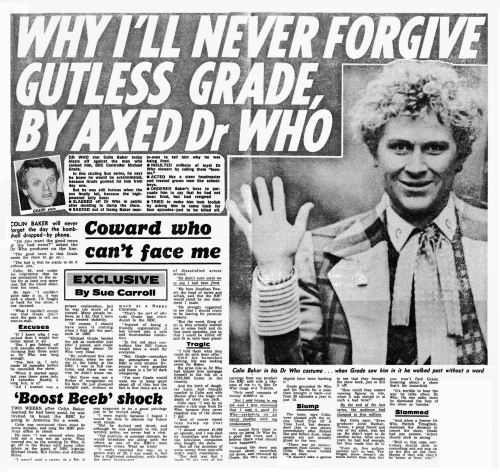

I can't stress enough how ridiculous and hilarious this is.
Baker was fired by the guy who was  fucking his ex-wife!
Thus, the writers seemed always gun shy about attempting to address the Valeyard again after he was such a train wreck.

A few attempts have been made to address the Valeyard in expanded universe media.  My favorite is He Jests at Scars..., a Doctor Who Unbound audio story that imagines an alternate Universe where the Doctor loses his battle against the Valeyard and the Valeyard takes over his regenerations.  It's horrendously depressing, as are all Doctor Who Unbound stories.  My friend Patrick informed me that there's one story where the Valeyard turns out to be Jack the Ripper.  By the transitive property, this means that Vastra ate the Valeyard.  Then again, every evil person in expanded universe media has been accused of being Jack the Ripper.

The timing is all wrong for John Hurt's Doctor to be the Valeyard.  If Hurt is not "True 9," as I believe he is, then when was he created?  The Valeyard is supposed to be created after, or during, the 12th Doctor's regeneration into the 13th Doctor.  Granted, I explained away the discrepancy when I wrote about the Valeyard in my fan fiction, and that could be done in the show just as easily.

The trouble is that nobody's wanted to touch the Valeyard with a Hazmat suit since 1986.  Sifting out the muddled story of the Valeyard would be hard enough if you were doing it with an audience who remembers who the hell the Valeyard is, let alone an audience that probably doesn't remember him.

But what is significant, however, is that the Great Intelligence, in "The Name of the Doctor," explicitly stated that the Doctor will someday take the name of The Valeyard.  I think a lot of people are seeing this as a hint.  But for the Valeyard to be addressed, it would have to be in a very subtle, roundabout way.  It would have to be a plot that fans of the classic series would recognize as being about the Valeyard, but which the new series fans would simply not understand.  It would have to be a plot that is so far in the background that the new series fans wouldn't even notice what was happening.  Even if he could find a way to pull it off, it would probably be career suicide if Moffat tried to address it, and Moffat doesn't like to dip into the past too much anyway.

Thus, I think the reference to The Valeyard was fleeting and not meant to hint at anything.  I think John Hurt is playing True 9, not The Valeyard, or any sort of pre-Hartnell Doctor.  That was the implication that Moffat wanted us to be left with.  Yes, Rule 1, Moffat often lies, and he misled us with the title "The Name of the Doctor."  But, if you remember the secret from "The Impossible Astronaut" as to who it was that shot the Doctor, and it turned out to be River, you'll realize that, sometimes, when we think Moffat is trying to be sneaky, he's actually being blatantly obvious.


*Assuming that you consider any intelligent humanoid eating another intelligent humanoid cannibalism.  If you consider such cross-species consumption to not be cannibalism, then only one serial is about cannibalism.

Sunday, May 19, 2013

War and Peace: An Overanalysis of "The Name of the Doctor"

My Friend (and co-blogger at T9YD) Adam:   I assume you're writing War and Peace right now?
Me: Oh yes! So much to analyze. So much to hate.


Steve:  What I'm saying is, after the John Hurt part--
Susan:  No, no, no, Steve!  Can we just clear this up once and for all:  Alien is not 'really about parenthood.'
Steve:  Well...
Susan:  For just this once, could we manage to discuss childbirth without involving John Hurt.
Steve:  Susan!  No man can do that!
Susan:  Okay.
Steve:  I mean, imagine what it's like for John Hurt.
Susan:  Oh please, can we not!
Steve:  If he was visiting a maternity ward all the guys in obstetrics would be crowding round going "Hey, it's da man!  Cheers, John, you're the one that got me into this racket."
-Coupling, Season 4, Episode 1, "9 1/2 Minutes," written by Steven Moffat

Sometimes, if you sift through episodes of Moffat's brilliant sitcom, Coupling, you can see where some of his motivations in writing Doctor Who really come from.  Here, we see why he cast John Hurt as the estranged 9th-ish Doctor.  If you watch an episode called "Size Matters," I guarantee you that you will never hear the Doctor say "Geronimo" in quite the same way again.

The "John Hurt Moment"
Moffat is a talented writer, and there's so much evidence to support that.  He has bounced between genres freely, succeeding in nearly all of them, from children's programming (Press Gang), to sex comedy (Coupling), to horror (Jekyll), to popular, American animated films (Tintin), to a modern day adaptation of classic literature (Sherlock), to taking the reigns of the greatest science-fiction franchise in British history.  While he's made a few slight missteps (Jekyll, his short lived sitcom Chalk, and some parts of the 4th season of Coupling), he's an excellent writer all around.  He wrote an episode for each of the first four seasons of the revived series, and each one won or was nominated for a major award.  When he took over the show, he had a monumental task ahead of him, recasting the Doctor after the wildly successful David Tennant era whose popularity may never be surpassed.  Rather than try to copy his predecessor, Russel T. Davies, he took the entire show in a different direction, constructing a multi-year long arc that has kept the show extremely popular, despite all of the whiny teenage girls insisting that David Tennant be brought back.  He created some of the most complex and satisfying individual episodes, as well as the greatest overarching stories that this show has ever seen.  He has been, in my opinion, the best writer that the franchise has ever seen, and that's including both Neil Gaiman and Douglas Adams.

It is because of all of these things that I must say the following with a very, very heavy heart:

Steven Moffat has lost his touch.  At least with Doctor Who.

This season has been a disappointment from the beginning.  "Asylum of the Daleks" was fun if you ignored the fact that the very premise of it made no sense whatsoever.  "Dinosaurs on a Spaceship" was fun but idiotic.  "The Angels Take Manhattan" was the first Angels episode without a strong internal logic to it that tied up the loose ends perfectly. Two of the greatest companions in the history of the series were unceremoniously ejected in the midst of a two-part episode that was uncomfortably shoved into 45 minutes like a 300 pound man uncomfortably shoved into a speedo.  "The Snowmen" and "The Bells of Saint John" gave us hope for a better season, only for those hopes to be dashed by the uncompelling "Rings of Something or Other," the disappointing "Hide," the embarassingly horrible "The Crimson Horror," and an episode that is an insult to the very name of Neil Gaiman, "Nightmare in Silver."

GF:  Do you have to pace around the room like there's a war on while you discuss Doctor Who?  Sit down and discuss it with me like a normal person.

I understand a lot of people loved this episode, including my co-bloggers over at The 900 Year Diary, Adam Stone and Kevin Spak.  Normally Spak and I disagree about Doctor Who, but it's normally me loving the episode that he hates, not the other way around.  I have no idea how this episode is becoming so popular.  With the exception of the last 30 seconds, this episode was a convoluted mess?

"The Name of the Doctor" will hopefully go down in Doctor Who history as Moffat's worst episode, as I hope he never produces anything as convoluted and nonsensical as this episode.  After hearing for almost 2 years that the Doctor's name must never be said, it was barely consequential to the episode.  The title, "The Name of the Doctor," in the end, seemed to have nothing to do with the actual "question," but was a trick phrase to refer to something we weren't thinking of.  The prophesy was not fulfilled.  Dorium said that, on the fields of Trenzalore, no living being can fail to speak or answer falsely.  Well, that didn't fucking happen.  The Doctor was asked his name point blank and failed to answer.  River had to answer for him so that the door could be opened.  It's like Moffat changed his mind about what this episode was going to be after "The Wedding of River Song" had already aired.

GF:  The only good thing about this episode so far is that River is in it.

What the fuck, River?  We were told we would be seeing a "post-Library" River, which was true, but it was pulled off in the most disappointing way possible.  Somehow River can be brought into conversation with the Doctor and other people from her home in the computer in the Library?  That's convenient.  A pre-library River would have been much less convoluted.  River was not entirely necessary in this episode, other than the fact that every Moffat season finale seems to have to have River in it as a requirement.  I love River, but she added nothing to this episode.

The fact that the Doctor was forced to go to his grave would have been interesting, if pulled off successfully.  Moffat said, in an interview after "The Impossible Astronaut," how fascinating he found it that, however far the Doctor travelled, he was moving through all of time and space, and somewhere out there is his grave.  He could always stumble upon it.  Fascinating concept, if it weren't for the fact that Dorium told us it was going to be something fundamentally different.

"It's like my mother always said:  The soufflé isn't the soufflé, the soufflé is the recipe."

Shut up, Moffat.  I know you think that's a profound metaphor for Clara scattering herself over the Doctor's timeline, but it's not.  It's a tortured metaphor that doesn't really work.

Clara's splintering across his timeline was a bizarre explanation.  It works for the ways she saved him in "Asylum of the Daleks" and "The Snowmen," but how did she save him from all the other times that the Great Intelligence tried to kill him?  The only explanation is that the reason we've never seen Clara or the Great Intelligence in any of the classic series episodes is because they didn't reflect the altered timeline that the GI changed.  But that doesn't make sense because, if that were true, we'd never have seen Clara in either the Asylum or Victorian London.  Was she always just hiding in the shadows every time the GI covertly tried to kill the Doctor off-screen, battling him and winning for over 900 years?  That seems highly unlikely.

And somehow Clara could jump into the time stream and make those echoes, but since the Doctor went in (went in where?) and saved her, the echoes still exist, but the original Clara doesn't die?  Yeah, that makes a ton of sense.  Was Moffat tripping when he wrote this episode?  And the entire time between writing and production when he could have fixed the episode?

Furthermore, the sacrifice Clara made was a bit ridiculous because she doesn't seem to have enough loyalty to the Doctor yet to justify such an immense sacrifice.  The mystery of Clara drove a huge spike between the Doctor and Clara, and really kept them from developing a strong chemistry.  Now that they know so much about each other, hopefully that chemistry will really develop over the course of the next season.  But so far, I don't buy that she cared about the Doctor enough to sacrifice her life for him. Amy would have.  Rose would have.  Even Martha or Donna would have.  Clara isn't there yet, and it didn't seem plausible.

The brief glimpses at all of the past Doctors was excellent, and it looks like this might be the closest we'll ever get to a 12 Doctors special.  I started yelling out each Doctor's number as they passed by, until my girlfriend asked me to stop.  What I thought was interesting is that, while Clara adjusted her outfit in each era to make it appropriate to the time, some of her outfits looked suspiciously similar to outfits worn by the Doctor's companions.  The one existing in the same time as the 6th Doctor had an outfit that did not match either of 6's companions in any way.  But the one following the 2nd Doctor seemed to have the same outfit as the 2nd Doctor's companion, Victoria.  And the one following the 7th Doctor looks a lot like the 7th Doctor's best companion, Ace.  Even the 1st Doctor Clara looked a little Susan-ish.  I was hoping to find out that Clara was actually Susan, since the expanded universe suggests that Susan might not be his actual granddaughter, just some girl he picked up to travel with him.  I call this the "Amber Alert TARDIS" theory.

GF:  Why is this guy so intent on revenge against the Doctor?  It would be one thing if he was a central villain throughout the season who was responsible for nearly everything in the season.  We didn't see enough for him to have this kind of vendetta against the Doctor.
Me:  Yeah.  He was an old 2nd Doctor villain, but even if you factor that in, this is only the Doctor's fifth time meeting him.

Good point, honey!  While Clara's sacrifice for the Doctor is a bit of a stretch, the GI's strong desire for revenge against the Doctor is just as much of a stretch, if not more of one.  The GI doesn't have enough of a history with the Doctor to be that hellbent on revenge.  There are tons of enemies that Moffat could have used that would have made more sense in that situation, including the most drop dead obvious choice of them all:  The Master.  But Moffat apparently wanted to use a more obscure villain, even though The Master would have made his whole story arc make sense.

GF:  This season sucked.  There wasn't even a good plot arc that led to this.
Me:  Yeah.  As much as I loved Amy and Rory, I have to admit that it was a mistake to keep them on for half a season.  The first half of the season revolved around their departure so much that they didn't even bother to get the real story of the season going until they left.

That's five episodes that could have been used to better set up this episode, and five episodes that were completely wasted in the process.  They couldn't even make the Great Intelligence the villain in some Amy and Rory episodes?  He wouldn't have to be the primary villain, he could just be someone lurking behind the villain, the secret, silent partner to someone.  But instead, we were given two mysteries (the name, and Clara) that were never developed, just reiterated in dialogue.  Actually, Clara's mystery was reiterated in dialogue without developing the plot any further.  The Doctor's name has barely been mentioned since "The Wedding of River Song," which aired nearly two years ago.  Good luck if you didn't remember that episode.

In the mire of stupidity that was "The Name of the Doctor," Moffat nearly redeemed himself with the last 30 seconds, which did exactly what Moffat said the episode would do:  change Doctor Who forever.  Because now there's a whole other Doctor in there that we never knew about it.  It also means we have a whole new Doctor to learn about, and he's going to be a big part of the 50th anniversary special.  John Hurt was announced as a cast member for the 50th Anniversary special months ago, but I never imagined he'd be a Doctor.  It has rocked my world in a way that I never expected.  My mind has been so set in an 11th Doctor world.  I wasn't prepared to meet another Doctor in this episode, let alone a previous Doctor.  The chronology of the Doctor's lives is stored in a large part of my brain, and I've just been told that there a huge and important chunk in the middle of there that I never imagined was there.  It's a matter of cognitive dissonance.  I'm literally going to need until November 23rd, the date of the big Special, to fully accept this radical change in Doctor Who chronology.  Seriously, this is a matter of letting my brain recover.  It really knocked me on my ass.

But even in rocking the entire franchise, Moffat did it in the most ridiculously convoluted way possible.  I'm sorry to have to admit this, but my girlfriend actually had to explain the ending to me.

(The episode ends)
Me:  (Throws a pillow in the direction) What the fuck was that?!
GF:  I got it.
Me:  You did?
GF:  You've never seen what happened in the Time War, right?
Me:  No.  Even the expanded Universe stuff hasn't touched it.
GF:  Yeah.  That's the Doctor during the Time War.
Me:  But that makes the current Doctor the 12th?  How can that be?
GF:  Because he doesn't acknowledge him as the Doctor.  He said he didn't do things in the name of the Doctor, so he isn't a real Doctor.
Me:  So he ignores him in the numbering system, and that's why he calls himself the 11th, even though he's actually the 12th.

So, here's a list of things that have significantly changed due to the ending of "The Name of the Doctor":

-The last 3 Doctors' numbers, even if they don't acknowledge them, are all bumped forward by 1 number.  Eccleston was now the 10th Doctor.  Tennant the 11th.  Smith the 12th.
-The Doctor can only regenerate 12 times, meaning that there can only be 13 Doctors.  This means that, after Matt Smith, the Doctor can only have one more regeneration before they have to at least acknowledge that the Doctor should be out of regenerations (if they don't decide to just ignore it like Davies planned to).
-The 8th and 9th Doctors* probably didn't spend much, if any time, in the Time War.  The 9th Doctor appeared to have just been regenerating in "Rose," acting as if he had just seen himself in the mirror for the first time.  The 10th Doctor said that he had to finally destroy the Time Lords to keep them from becoming God-like creatures, destroying the rest of the Universe so they could exist as the only creatures, in pure consciousness.  I feel like this is probably the true chronology:  The 8th Doctor regenerated early in the Time War into True 9.  True 9 had a change of heart towards the end, and destroyed the Time Lords, forcing him to regenerate into 9 in the process.  Alternately, True 9 might have regenerated into 9 before he destroyed the Time Lords, and his regeneration caused his radical change of heart.
-The 50th Anniversary special will actually have a past Doctor other than 10, it's just not a Doctor we knew about.
-If John Hurt has already been cast for the 50th Anniversary special (we have), then True 9 is going to be a sort of a villain in the special.
-The Doctor is even older than he claims.  The 6th Doctor claimed to be 900 years old, and so did the 11th Doctor at the beginning of his regeneration.  So the Doctor had to be much older than 900 at the beginning of his 11th regeneration.  This might explain the lie better, because there's an entire regeneration he doesn't acknowledge.  How many years did True 9 live?  Because however many years True 9 lived, the Doctor is probably subtracting those years from the age he claims to be.

There's so much to be learned about True 9, and I can't wait to see what happens with him.  The Doctor's hatred of True 9 seems to be a little irrational.  When True 9 said he did everything he did in the name of peace and sanity, the 11th Doctor didn't disagree with him.  He said it wasn't "in the name of the Doctor."  I could understand the 11th Doctor being mad at him if he thought everything True 9 did was wrong.  But it seems like he knows that True 9 had to do what he had to do, he's just pushing him to the back of his mind so he can ignore it.  Some of us don't have the ability to section off our past and leave it behind, Doctor.  You need to deal with True 9.

I'm guessing this is what we can expect from the 50th Anniversary.

Until then, I'll still be updating, just not with episode reviews.  But stay tuned!  Can't wait for Season 8.

*Since the introduction of another Doctor complicates the numbering system so much, I'm going to come up with my only special system.  I'm still going to refer to Eccleston's Doctor as 9, Tennant's as 10, Smith's as 11.  I'm going to call John Hurt's Doctor "True 9."

Saturday, May 18, 2013

I Need A Bigger Head: A Last Minute Addendum to my Preview of "The Name of the Doctor"

I was just rewatching "Silence in the Library"/"Forest of the Dead," and, to quote the 10th Doctor himself:

"Oh! I'm thick! Look at me, I'm old and thick! Head's too full of stuff, I need a bigger head!"

River knows the Doctor's real name in "Silence in the Library."  But in this episode, "The Name of the Doctor," the Doctor's name will be (supposedly) finally revealed.  But, we were promised a post-Library River in this episode.

See what I'm getting at?

This is the episode where The Doctor is supposed to reveal his name for the first time.  Yet River already knows it long before this episode.


How?

This isn't just the culmination of everything that Steven Moffat's been working on since "The Eleventh Hour."  This is everything going back to "Silence in the Library."

Friday, May 17, 2013

The Answer in the Question

Once upon a time there was a magical man known only as "The Doctor" who traveled all around time and space in a magic machine called the TARDIS that looked like a police box on the outside, but was endlessly bigger on the inside.  One night, when he was flying his magic box, he crashed into the backyard of a little girl named Amelia.  Amelia had a large crack in her wall, and she knew there was something wrong with it.  It scared her.  She heard whispers through it.  So she went out into her backyard and asked the magical man if he could help her with the crack in her wall.

The Doctor opened up the crack in her wall, and found something terrifying on the other side.  He found a prison, where a prisoner known as Prisoner Zero had gotten out.  Prisoner Zero could disguise himself as anyone, and he had escaped through Amelia's wall.  But Prisoner Zero's jailers would not let him get away.  They said that if they didn't find Prisoner Zero, they would blow up the whole world to stop him.

The Doctor stopped Prisoner Zero, and returned him to his captors, thus saving the Earth.  But not before Prisoner Zero gave him a terrifying warning:  "The Universe is cracked.  The Pandorica will open.  Silence will fall."

When Amelia was an adult, the Doctor took her and her fiance with him on his adventures.  But someone called the Silence was chasing after him.  The Silence was an evil cult that believed that it was very important to kill the Doctor before he was someday forced to answer the question that must never be answered, a question that they believed was the oldest question of all time, hidden in plain sight.  They believed it was very important that the answer never be spoken.

The Silence developed a plan to blow up the Doctor's TARDIS and kill him, but they didn't realize that they could blow up the whole of time and space if they did that.  The Doctor's enemies, fearing that the TARDIS would destroy the Universe, locked the Doctor in a mythical prison called the Pandorica so that he couldn't pilot the TARDIS.  But the Doctor wasn't piloting the TARDIS, his wife, River Song, was, and so the Silence were able to blow up the TARDIS, thus destroying the whole Universe.

But before the Universe could be destroyed, the Doctor flew the Pandorica and himself into the explosion of his TARDIS, which reset the whole universe and brought it back.  But it erased him from time in the process.  He had never existed, and nobody could remember him.  Except Amelia.  She knew something was missing, but she didn't know what.  On the day of her wedding, she realized who was missing, and tried very hard to remember him.  She wished and wished so hard, and finally, the Doctor showed up, all thanks to Amelie's memory.

The Silence didn't give up, though.  When Amelia and her husband had a baby girl, the Silence stole her and raised her to be an assassin.  Their assassin, River, however, fell in love with the Doctor, and couldn't bring herself to kill the Doctor.  So instead, River helped the Doctor to fake his death, so that the Silence would stop trying to kill him.  So the Doctor ran off to hide from the Silence, but he still had to worry about the prophesy that the Silence believed:  "On the fields of Trenzalore, at the fall of the eleventh, where no man can refuse to answer or speak falsely, a question will be asked that must never be asked:  The first question, the oldest question in the Universe, hidden in plain sight:  Doctor who?"

The Doctor's name must never be said...


If you write it a certain way, Moffat's entire era reads like a fairy tale or an ancient legend.  There's a very good reason why Moffat's style has been referred to as the "dark fairy tale" style.

In Moffat's first episode, "The Eleventh Hour," Prisoner Zero gave us the prophesy that would fuel the overarching plot of the next three seasons.  "The Universe is cracked.  The Pandorica will open.  Silence will fall."  Barring any other twist that raises another question to be answered next season, what we're likely to be looking at tomorrow is the culmination of everything that Moffat has written since he took over the show.  Seasons 16 and 23 of the classic series had season-long arcs.  Season 3 of the classic series featured one story that was made up of 12 half-hour long episodes.  Seasons 1-4 of the current series had very subtle season long arcs.  Never before has Doctor Who told a story steeped in deep mystery that lasted 3 years.  This is quite an accomplishment that finally comes to a head tomorrow night.  We finally understand why the question must never be answered.

Or perhaps we'll learn nothing at all.  Still, it promises to be a hugely momentous episode.  I can't wait!

Wednesday, May 15, 2013

Dead Men Tell No Truths: A Preview of "The Name of the Doctor"


In Season 5, right after watching "Flesh and Stone," I correctly predicted that River would not kill the Doctor (as that was obviously what Moffat wanted us to think, so I knew it had to be untrue) and that she would, instead, help the Doctor fake his death to hide from someone and then take the fall for it by going to prison. I accurately predicted, when watching "The Lodger," that the stranded ship was a Silence ship. I accurately predicted what "The Question" was going to be. The only real thing that I feel like an idiot for missing was that River was Amy and Rory's daughter, which I thought was a crackpot fan theory that could never be true.  I made a vow after that to not reject "crackpot" theories and to make sure that I don't rule something out just because it sounds too "out there."

My point here is not to brag.  Okay, my point totally is to brag.  But my point is, I can get a lot of things. Or, at the very least, I know the right questions to ask.  So let's look at the questions that need to be asked before we head into the big finale of the season.

What did the Cyber Planner's clue mean?

I swear to God, every single time I finish one of my weekly write-ups of an episode, I immediately think of something I completely forgot to mention. This week, it was a big one, and that's the big clue that the Cyber Planner gave the Doctor:

"You know you could be reconstructed by the hole you've left behind."

Sometimes, I think that Moffat needs to set up rules for his own Universe that wouldn't be obvious. He did it in "The Impossible Astronaut" where he, essentially, explained to us the rules of the new mystery, that they couldn't go back in time and stop the incident from happening because it would create a paradox. The Doctor broke more laws of time than that when he rescued himself from the Pandorica, so the only reason this was being brought up in that episode was to explain to us that they can't cheat that way in this season. In this season, that'll be against the rules.

I can't imagine how exactly you could "reconstruct" the Doctor by the "hole he left behind," but the rules in this season say that it's possible, and the Cyber Planner wouldn't bring it up if it wasn't incredibly significant and would affect the plot of "The Name of the Doctor." My guess is that this is how the Great Intelligence is going to find out about the prophesy: "On the fields of Trenzalore, at the fall of the eleventh, when no living creature can speak falsely or fail to answer, a Question will be asked, a question that must never, ever be answered: Doctor who?" We've seen from the preview that the Great Intelligence will be in this episode, and the preview even showed him asking the Doctor his name.

But why does the GI want to know?

I keep thinking of the name "The Great Intelligence." There are some indications that the Great Intelligence's primary goal is to gain intelligence. In the classic series, it wanted to drain the Doctor's brain so that it could absorb his knowledge. Perhaps the Doctor's name is important knowledge, and so the GI wants to know it because it wants to know everything. It's kind of like the Brain Spawn monsters from Futurama.

The Brain Spawn have absorbed so much information that they know that bow ties are cool

Post-Library River?!

This is the most fucking insane clue that we've been given.  River has somehow survived the fucking Library?  This changes everything.  So, how might it have happened?  Here's a few theories:

River Found Her Way Out of the Computer

River's consciousness, at the very least, isn't dead.  The Library is still holding what is presumably the version of her consciousness she had at the moment she died.  She'd just need a body to put her consciousness into.  We never saw in "Silence of the Library" what happened to her actual body.  And whichever future Doctor prepared the screwdriver that saved her probably knew her ultimate fate.  Perhaps it wasn't just a plan to save her consciousness, but a chance to save her life completely.

River Didn't Really Use Up All of Her Regenerations

How exactly did the Doctor and Amy know in "Let's Kill Hitler" that River used up all of her regenerations?  Hell, how did she use up all of her regenerations?  It seems really strange that she would need to use up all of her regenerations to save the Doctor.  If we assume Melody Pond was the first regeneration, Mels was the second, and River was the third (there could be other regenerations in there, but there are strong hints to suggest that there are not) then she could have regenerated up to 10 more times.  That seems like a lot of regenerations to save the Doctor just once.  Again, we didn't see her body after she died.  Perhaps she had to be taken away from the Doctor's sight so she could regenerate in secret.

Everybody knows that everybody dies,
unless you're a recurring Doctor Who character.
Then you can live for-fucking-ever!
Clara is a "Post-Library" Regeneration of River

This would solve two mysteries with one stone, but don't ask me how the fuck it would work.

Which leads us to the next question:

Who the Fuck is Clara?

The problem with this question is that we don't have many clues as to what's happening.  It's an annoying way to handle a big mystery.  So let's sum up the very, very few and very small clues we've gotten about this mystery.*

-Clara was born from two parents who met by complete chance.  She wasn't bred or created.
-Emma, the empath, confirmed that Clara is completely normal.  I doubt that she'd say the same if she met Oswin or Clara Oswin.
-They have all, at some point, used the phrase "Run you clever boy and remember."

That's more or less it.  I still think that the possibility of her being a regeneration of River is perfectly conceivable, but I still can't work out how that would actually explain anything.  I would love it if she turned out to be a regeneration of Susan, but that would make the scene where Clara Oswin kissed the Doctor in "The Snowmen" really gross.  Like Luke kissing Leia in A New Hope.  If she is River, then it's fine.  If she's some random person, that I think River should slap her.  Just because a River/Clara cat fight would be hot.  (I apologize for being a male.)

I also keep thinking of the villain Scaroth, from the classic, Douglas Adams written Fourth Doctor episode "City of Death."  Scaroth had different versions of himself scattered across time, in different centuries, because of his space ship exploding.  The big difference there was that Scaroth's different selves all shared a consciousness and could think as one.  The Claras don't seem to be able to do that.

As opposed to Scaroth, however, the world is richer for having more people who look like Clara.

What is the Doctor's name and why is it dangerous?

I'm still sticking with my the-Doctor-is-a-God theory, which ties into The Cartmel Masterplan.  The much bigger question is going to be how much of this is going to really be revealed in this episode.  I think it's going to cut away very quickly so that, somehow, River will be the only one to hear it.

I'm looking forward to the episode.  There are a lot of mysteries to be solved.  I just hope they all have satisfying conclusions. 


*I’m going to start instituting a new naming system to keep the Clara’s straight, because that’s starting to confuse me. So, from now on:

Dalek Asylum Clara = Oswin
Modern Day Clara = Clara
19th Century Clara = Clara Oswin

Besides being much easier to actually write, it also reminds us that Clara’s three different names are clearly very important. Also, it’s like Moffat made these names specifically for me, as the version of Clara that I have to write about the most is the one with the shortest name. Thank you, Steven. (I can call him Steven now.)

Saturday, May 4, 2013

You Don't Love Me, You Love Magazines: An Operation Blue Harvest Update

Things have been pretty quiet here at The Horror this week.  It's been a very emotionally taxing week in my life.  But a new issue of Doctor Who Magazine just came out, and it gave us some big information about both the season finale and the 50th Anniversary special.  I should probably subscribe to DWM, but for the time being, a Google News alert for "doctor who" seems to be working just fine.

Although I would like to have as many framed pictures of Matt Smith as possible.
In a totally heterosexual way.
Let's start with the season finale...

The Name of the Doctor

I got this all from Blogtor Who.

Like I predicted, Vastra, Strax, and Jenny are all coming back.  When the episode description said that the Doctor's "friends" would be captured and taken to the fields of Trenzalore, I figured it had to be more than just Clara.

Richard E. Grant is coming back in this episode as a "posthumous" Dr. Simeon, which I think we all know means that the Great Intelligence is the main villain of the episode.  This is further confirmed with a quote that has been revealed from the episode.  "How's the intelligence--still great?" - The Doctor.

Clara's true identity will be revealed in this particular episode.  Does this mean her weirdness is linked to the Doctor's real name?  That might explain why the TARDIS showed Clara the Doctor's real name. It might be a clue that she needed to hear.  We've seen the TARDIS give clues about the future before ("The only water in the forest is the river"), and we know that it can predict the future.  There's no doubt that the TARDIS knows who Clara is, hence why it doesn't like her.  Although it seemed to like her enough to save her...

Okay, so most of that is stuff we already knew.  But here's the bombshell:  Not only will River be there...it's going to be a "post-[L]ibrary" River!  It seems that the word "impossible" means very little on this show.  River seemed to be clearly killed in "Silence in the Library"/"Forest of the Dead."  How on Earth has she survived?  One possibility is that she somehow faked her death.  Why that would be necessary is beyond me.  Another possibility is that she hasn't actually given up all of her regenerations after all.  Will we be see a future regeneration of River in this episode?  Or possibly some other time in the future?

Another interesting idea is the fact that, just because the Doctor "saved" River's consciousness in "Forest of the Dead," doesn't necessarily mean she had to die there.  A version of her consciousness could easily have been "saved" even if she wasn't about to die.  Somehow, River found a way to survive, but an echo of her consciousness was still on the sonic screwdriver.  Or maybe her consciousness found a way out of the Library computer.

The magazine also reported that not everyone will make it out of this episode alive.  Hopefully the person to die will be someone relatively inconsequential, like Jenny.  We'll see.  It would be pretty cruel to bring a post-Library River back and then kill her off again immediately afterwards.  But Moffat has said that he has an "endgame" for River.  Who knows what that means.

Now, on to...

The 50th Anniversary Special

Doctor Who Magazine also reported that David Tennant is without a doubt the only Doctor coming back.  I still stand by Rule 1.  It stands proudly as the subtitle of this blog.  It's absolutely possible that Moffat is lying.  Doctor Who Magazine is not opposed to lying on Moffat's behalf.  When "The Impossible Astronaut" was coming out, DWM had 4 collectable covers, each one with a different main character on it:  River, Amy, Rory, and the Doctor.  The headline said that one of them would die, and this time it wasn't a trick.  Clearly, it was a trick.  We all know that the Doctor's escape from the Silence was absolutely a trick.  So maybe they're lying.

However, we have to begin preparing ourselves for the possibility that this isn't a lie.  If that's the case, we all need to remember that David Tennant and Matt Smith paired together in the same episode is an awesome thing!  If we had to choose only one past Doctor to bring back for the special, my number one choice would be David Tennant.  Tennant's cool as a cucumber Doctor will contrast well against Smith's bumbling hipster version of the same character.

However, io9 dug up a brief 19 second video of the filming that clearly shows the crew filming an old fashioned police constable walking past the I.M. Foreman scrap yard at 76 Trotter's Lane.  For those of you who don't know, that's the exact shot that the first episode of the classic series opened with.  It looks like, somehow, we're returning to the beginning.  While Moffat says he wants to move the series forward at all times, the little tidbits that we get from behind the scenes show that that's not entirely true.  The villains are going to be the Zygons, the 10th Doctor will return, and we're going back to Trotter's Lane where it all began.

Even if we don't see the return of any Doctors before Tennant, there's nothing that stops them from bringing back other characters.  Carole Anne Ford, who played the Doctor's granddaughter, Susan, and William Russell, who played Ian Chesterton, remain the only original cast members from 1963 that are still alive.  Either of them would be a perfect addition to this episode, especially if the episode is going back to Trotter's Lane.  Someone else has to come back, even if it isn't a Doctor.

You know what would be a great idea for a special?  "The Five Masters."

While I've been saying that I think Susan will come back soon, and I still think there's a good chance of it, I have one concern.  I've recently started to listen to and read expanded universe material.  In Eighth Doctor adventures, Susan meets her grandfather again.  I used to say that we can't claim that expanded universe is cannon, but since there are actually a lot fewer contradictions between expanded universe and television than I thought, I'm starting to view those stories as all cannon.  This is not to say that a return of Susan can't happen without contradicting the Eighth Doctor adventures, I can't imagine that it wouldn't contradict it.  If you bring back Susan, you have to have the conversation about how the Doctor left her behind.

Tomorrow, my least favorite Doctor Who writer is going to be writing an episode that looks really boring.  Let's hope I'm wrong.

Tuesday, April 23, 2013

Silence Never Falls: An Operation Blue Harvest Update and Clarification

HUGE-ASS FREAKING SPOILERS!


So, I need to make some clarifications about the season finale and the 50th Anniversary special.

For a lot of this blog, I've been talking about the season finale and the 50th Anniversary special as if they were the same thing.  I had a feeling they might not be, but I couldn't be sure.  So I asked around on the Doctor Who message board, Gallifrey Base, and they confirmed for me that the season finale and the 50th Anniversary special are two different things.  So now I believe them when they say they're just shooting it now, because the 50th Anniversary special, it seems, will be held on the exact 50th Anniversary, November 23rd, 2013.

Now, as far as the season finale itself goes, the BBC has finally announced the title of the season finale that they hadn't been announcing.  It turns out that the reason was that the title of the season finale is, in and of itself, a huge spoiler:


There's so much to analyze here just from this poster.  First of all, River's coming back.  Second of all, "his secret is revealed" is a huge clue.  Moffat said the same thing in an interview, that the Doctor's greatest secret would be revealed.  Sometimes Moffat gives us false clues to throw us off the trail.  Sometimes he's straightforward and reading too much into it is unnecessary.  He admitted at the end of Season 6 that he knew people would suspect River Song of being the one who kills the Doctor, and that he didn't care that people guessed it.

So we know what "The Name of the Doctor" is going to be about.  The BBC South Africa website's description said that someone's kidnapping the Doctor's friends to force him to come to the fields of Trenzalore, where he'll be forced to reveal his name.  Obviously, those friends will at least include Clara and River.  My guess is that, if Moffat's going to have some of the Doctor's friends kidnapped, he's going to throw Vastra, Jenny, and Strax in there too.

Now, somebody on Gallifrey Base suggested a possible scenario for this episode that's so perfect...I think it absolutely has to be what's going to happen, and it kind of ruins the ending.  I...I can't imagine it's going to play out in any other way other than this.  So, reading this might kind of ruin the fun of the episode.  So I'm going to make this super extra spoiler protected so you have to highlight it to read it.  I wish I hadn't even read it.

The Great Intelligence (probably, although it could be someone else) will lead the Doctor to the fields of Trenzalore.  There, the Doctor will be asked his name.  He will be forced to answer, but just as he does so, River will materialize the TARDIS around him, so that he blurts out his real name to the person in the universe it will be the most safe with:  River Song.  That's why she'll know his name in "Silence in the Library."

There's no doubt in my mind that the Doctor's real name is "The Other."  It's more or less been confirmed in expanded universe material.  I think it's about time I posted my explanation of the Cartmel Masterplan on this blog to explain what that means.  Regardless, even if that is the Doctor's real name (it is) and even if Moffat is following the Cartmel Masterplan (he is), I doubt the name is going to be said on the show.  Something will happen to allow him to say it without us, the audience, hearing it.  The Doctor IS the Other.  But they can't blatantly say that on the show.  It would ruin too much of the show's mystery.

Now, as for the 50th Anniversary Special itself.

In which we see the return of the cuddliest race in the history of the franchise
I still don't know why the fuck the Zygons are going to be the villain.  They've been in 1 episode!  This is another "Meat Puppets" move from Moffat.  (I'm creating too many inside terms on my own blog here.)

John Barrowman is sending extremely mixed messages.  Here's the timeline of what Barrowman has done:

1.  Announced he was in talks with the producers about returning.
2.  Announced that he was not returning.
3.  Announced that his absence from the special is not due to lack of interest, but because the producers never asked him.

One of these statements has to be bullshit.  I don't know which one.

A post recently on the David Tenant Facebook Fan Page said that Paul McGann's appearance in the special hasn't been ruled out.  Now, for most fans, the fact that a Doctor who appeared on screen for about 60 minutes is not that exciting, but those of us who have listened to the brilliant Eighth Doctor audio adventures know how great Paul McGann can really be.

My friend Gary asked me, what if they aren't lying?  What if it really is just going to be Matt and Dave against the Zygons?  First of all, not lying at all would be completely out of character for Moffat.  But, even if it isn't a trick, and all we're getting is Smith and Tennant...won't that still be awesome!?  Who doesn't want to see 11 meet 10.

It could be the best dialogue in the history of the series.