Showing posts with label Eleventh Doctor. Show all posts

Thursday, December 26, 2013

The Doctor is Dead; Long Live the Doctor: An Overanalysis of "The Time of the Doctor"

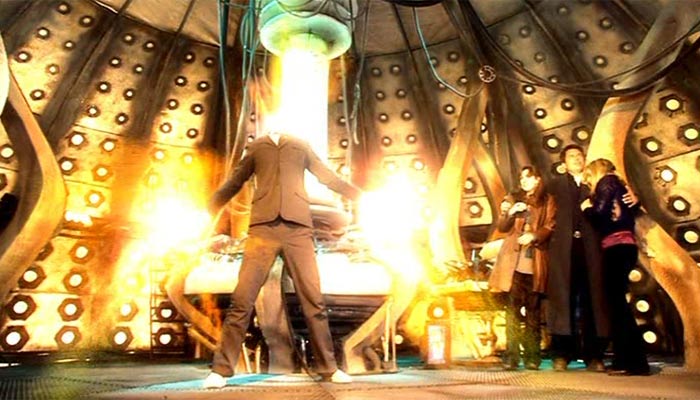
Not what I expected the severed head of a Cyberman to be.
Regeneration episodes are desperate.  The Doctor, more or less, dies.  So it has to be a story that is at least partially about defeat.  The Doctor saves the day, but at the cost of his own life.  The Doctor, therefore, is usually in an extra-desperate situation, because that's the kind of situation where he's likely to die.  It's something you don't get in most shows:  a hero that is, at least partially, defeated every few years.  Superman died once.  Imagine if Superman died every few years!

But Steven Moffat has never been one to follow past patterns, and so he decided to do something that had never been done before.  For the first time in the history of Doctor Who...the Doctor's very death itself was his victory, not his defeat.

I have some friends (from the now defunct 900 Year Diary) who like to criticize a lot of things as "Deus Ex Machinas."  I've heard these same friends of mine use those three words for tons of Doctor Who episodes, as well as other things like Dexter.   They use it so often, I'm starting to think they don't know what those words mean.  So, in the spirit of Inigo Montoya, I'd like to explain that this phrase might not mean what you think it means. From Dictionary.com:
1.   (in ancient Greek and Roman drama) a god introduced into a play to resolve the entanglements of the plot.
2.  any artificial or improbable device resolving the difficulties of a plot.
The key point of a Deus Ex Machina is that it has to be introduced at the time that it resolves the plot.  Otherwise, it's been set up already, and not only is it not a Deus Ex Machina, there's really no reason to even complain about it.  The Doctor-Donna is a Deus Ex Machina.  The Time Lords were not.  The Time Lords were in the episode from the very beginning, and not just because they were necessary to save the day at the end of the episode.  The Time Lords were necessary to the plot of this entire episode.  It couldn't have happened without them.  As for their power to hand out more regenerations, while it may have been rude for Moffat not to re-explain this to those who have never seen the classic series, it doesn't change the fact that the Time Lords' ability to hand out new regeneration cycles was established already in "The Five Doctors."  So nothing about it was a Deus Ex Machina.

Now, were there holes in the plot?  Yes.  The regeneration energy does seem to be a little more destructive than it was before "The End of Time," and I always took the destruction in "The End of Time" to be due to him releasing the radiation he absorbed.  But you could explain that away in a million ways, including it being some sort of help that the Time Lords gave him or the side effect of it being such a long time since the last regeneration, or it being a by-product of it being his first of a new cycle of regenerations.  The thing that would have been a little more satisfying to me is if Clara saved the day by giving the Time Lords the Doctor's true name, which she should know!  I thought that was going to be the solution, and it would have been much neater, and might have shut some people up to boot.  Of course, that would have brought the Time Lords right back into a battle with the Daleks, and then everything that happened in "The Day of the Doctor" would have been for nothing.

It might also seem unsatisfying that Gallifrey wasn't released from the crack in the end.  For a moment, I thought maybe the Doctor had fought this whole war for nothing.  But really, that's not the case.  Had any of the Doctor's enemies gotten to the planet, they could have gone through the crack and destroyed Gallifrey at its most vulnerable.  The Doctor didn't succeed in bringing Gallifrey back in this episode, but he did keep it hidden and protected to be found another day.  That's still a big victory.

But even if you weren't satisfied with how the end of the episode resolved the situation set up in the beginning of the episode, how about the way that this whole episode resolved all of the Matt Smith era?  Because it did that very well.  I was completely wrong about why the Doctor's name was dangerous to say.  I never imagined that it would be a situation in which the Doctor would want to say his own name.  It proved that Moffat had taken the 50th Anniversary special into account when he started writing "The Eleventh Hour."  Everything has been planned for the past 4 years, and that became glaringly obvious.

Except for the fucking cot!  Moffat promised to solve all of the mysteries.  He even solved the mystery of what was behind Door 11 (I still like my friend Gary's theory about Adric better).  But not the cot!  What the hell was the deal with the cot?  Did he forget about it?  Because it's still dangling out there, waiting to be solved, Steven!

It became clear that, while Moffat had the idea for this episode from the beginning of the 11th Doctor era, he never intended it to be the Christmas Special.  But I think he did a good job of making it Christmassy.  Setting it in a town where it's Christmas all the time may have seemed a little forced, but at least it was better than "The End of Time" where someone has to suddenly remember every 20-30 minutes or so "Oh yeah, we haven't mentioned for a while that it's Christmas."

The Silence, my favorite villains, return and we find...that they are nothing like what we thought they were.  Really, they were priests.  Priests!  I had my best Doctor Who nightmares ever about priests!  I guess, as a former Catholic, that's strangely appropriate.

Truly, a lot of the stuff about the Papal Mainframe and the Anglican Marines was really confusing before this episode.  In "The Time of Angels"/"Flesh and Stone," they not only seem to be helping the Doctor, but are participating in the punishment of the woman who killed him.  Then, in "A Good Man Goes to War," they are fighting against him and supporting those that created the woman who killed the Doctor.  This was easily explained away in one line "The Kovarian chapter broke away."  Simple, yet satisfying, explanation.  Most of the events of Season 5 and 6 were the result of one small sect within the Papal Mainframe going rogue and trying to stop the Doctor by going back in his timeline.  It's unclear, though, why this sect was referred to, in the Tesselecta's computer, as "The Silence," where Tasha Lem, in narration, referred to the creatures themselves as "The Silence."  The naming is super confusing now.  So let's just call the creatures "The Silence," call that sect "The Kovarian Chapter," and assume that the Tesselecta was just talking out of its ass.

Most of the spoilers that I knew about that had been printed in the Sun turned out to be accurate, which means somebody is a huge dick and really did tell all the plot points to a newspaper, which actually had the nerve to print the damn things.  Why would someone do that?  That's not journalism.  That's just being a douche.  The only spoiler that I know that they got wrong was that they said the Doctor would lose a leg before he regenerated, which would have been extra dark.  The spoilers also claimed that the episode would take place over 300 years.  That was partially true.  The first time we checked back in with the Doctor, 300 years had passed.  But who knows how many years had passed for him at the end.  It could have been another 300, 500, maybe even 1,000.  My guess is that the Doctor is now around 2000 years old, making the 11th Doctor the longest living regeneration the Doctor has ever had.

And it confirmed that the Doctor can age within a regeneration.  I mean, we already knew this to an extent, as the 1st Doctor couldn't have been born looking like William Hartnell.  But we've never seen him significantly age within the same regeneration.  But there's one big advantage that this gives us, and, as the guy who had to write and cast the 50th Anniversary special, I'm sure that Moffat did this intentionally:  Matt Smith can now be brought back for future specials no matter how old he is when the special airs.  For the 75th Anniversary Special, for example, they can simply bring him back and his increased age can be chalked up to him being taken from a point in his own timeline during "The Time of the Doctor."  Was it a little bit of a cop out to reset the Doctor to a younger version of himself for his final speech?  Sure.  But didn't we all want to see that anyway?  And I thought it was cool that a very old 11th Doctor looked a lot like the 1st Doctor.

The cameo from Amy was awesome and unexpected.  Two actors wearing wigs because they shaved their heads for other roles stood across from each other: one with a believable wig, the other with a very fake looking one.  But there was one thing about that brief cameo that bothered me, and that's the weird way that the Doctor and Amy touched each other.  It looked like they were going to kiss each other.  Russel T. Davies did away with Jonathan Nathan-Turner's classic series "no hanky-panky in the TARDIS" rule by bringing the Doctor and Rose together.  This angered a lot of the classic series fans, as well as some of the actors from the classic series.  Colin Baker said at this year's Denver Comic Con, he didn't believe the Doctor and his companion should even notice that they're of different genders.  Moffat has done a nice job of kind of playing both sides.  Amy and the Doctor had romantic overtones, but they had to do more with Amy's fear of commitment than any real romantic feelings towards the Doctor.  Amy ended up with Rory, as she was always supposed to.  Even Clara's attraction to the Doctor, which was brought to further light in this episode, is a fleeting thing we know will never come to anything, especially now that she'll be opposite Peter Capaldi's Doctor.  (Somehow, I don't think any young twentysomethings are going to be kissing Peter Capaldi on this show.)  So the way that the Doctor and Amy touched each other in that scene seemed just...inappropriate.  I would have preferred a good, tight, friendly hug between them.

Were there flaws in it?  Yes.  After the episode, I had a debate (which I alluded to above) with some friends from The 900 Year Diary who I almost never agree with.  They loved "The Name of the Doctor," where I hated it (although it's still growing on me).  I loved "The Big Bang," where they found that to be (surprise) a Deus Ex Machina.  (We all liked "The Day of the Doctor," though.)  They pointed out some things to me that I had to admit they were right about.  But, to be honest, not one of those things popped into my head during the episode.  The flaws didn't get in the way of my enjoying my favorite Doctor's last episode.  And, unlike them and some other people, I had no complaints about the episode's pacing.  Moffat hooked me in with his typical hyper-imaginative and complex plot (and the mental image of Clara naked), and kept me hanging on through to the end with the 11th Doctor's greatest speech ever:
“We all change when you think about it. We’re all different people all through our lives. And that’s okay. That’s good, you’ve got to keep moving, so long as you remember all the people that you used to be.”
And then, we were given the greatest Christmas present of all:  Peter Capaldi's first few lines as the Doctor!  They weren't much, but they were enough for us to see how much fun he's going to be.  Was it my favorite episode?  My favorite 11th Doctor episode?  My favorite Christmas Special?  No on all accounts.  But it was one hell of an episode, nonetheless.

So may I wish you a Merry Christmas, and a wonderful new Regeneration!

Saturday, December 14, 2013

The Clock is Striking Twelve's: An Overanalysis of the "Time of the Doctor" Trailer (and Other Tidbits)

If this Silent isn't actually singing in this pose in the episode, then that's just a wasted opportunity.

I haven't talked about "The Time of the Doctor" lately, mainly because of the spoilers that were leaked in The Sun a few weeks ago.  I haven't read the entire list of spoilers, just the summary on Zap2It.com.  If there are more spoilers in the actual article than what I've read, I don't want to know about them.  I regret what I've read so far.  Granted, a lot of the things in the Sun have been confirmed by the BBC since then, but a few things have not been confirmed.  So I know of about two things that are alleged behind-the-scenes spoilers that have not come out from official sources.  I decided not to put them in this blog.  This blog has a spoiler warning, but that's because I try to dig out things that have been released by the BBC and the producers, not stuff they're trying to save as surprises for us for when we watch the episode.  I trust that if it's been released by the BBC, then it's not something that's going to truly spoil my enjoyment of the episode.  Just the chapter titles, like River would say.  Then I try to guess what's going to happen next.  But I'm not going to try to ruin episodes for you.

Also, whoever told the Sun these spoilers failed to even mention the Silence, who are clearly in this episode, so take the Sun with a grain of salt anyway.

But that doesn't mean there isn't still a ton of shit to analyze.  The recent issue of Doctor Who Magazine, which is completely legit, gives me plenty to work with.  Not to mention the new trailer.

It's Not Susan

In my last blog, I insisted that the actress Orla Brady was going to be playing Susan in this special.  This is because her character, named "Tasha Lem," is supposed to be someone from the Doctor's past.
Well, DWM squashed that hope in my heart.  This is what it said:

"Tasha Lem is an old friend and someone from the Doctor’s distant past. Someone who knows him very well, but we have never met. She’s the Mother Superious of the Papal Mainframe."

So it can't be Susan or Jenny.  But...Susan's mother, perhaps?

The Trailer


The trailer is badass.  It confirms the basic plot revealed in the Sun spoilers:  The Doctor must fight a siege on a town called Christmas (the town's name has been confirmed elsewhere) on Trenzalore from a combined onslaught from the Daleks, Cybermen, Weeping Angels, and Silence.

I have to give Doctor Who TV credit for figuring out something about the trailer that I should have found blatantly obvious:  the Daleks say "The Doctor is regenerating."  Why is this weird?  The Daleks shouldn't know who the fuck the Doctor is!  Totally forgot about that.  What's changed since the end of "Asylum of the Daleks."

Why are these 4 species working together in the siege?  It seems highly improbable.  The Daleks and Cybermen don't get along, as seen in "Doomsday"--although they worked together well enough in "The Pandorica Opens."  The Angels don't really communicate with other species, and they have to murder someone and rip out their voicebox to even do that.  And the Silence are supposed to be trying to keep the Doctor from ever getting to Trenzalore, so I don't know why they're joining in.

On a more symbolic level, though, they represent the best of the old and new villains.  Off the top of my head, I'm pretty sure that the Daleks and the Cybermen are the only active villains remaining on the show who originated in 1st Doctor episodes.  The Angels and the Silence are probably the most iconic of the villains that have originated from the new series, or, at the very least, from Moffat's episodes.  It's pretty appropriate that these four should be the ones to take down the Eleventh Doctor.

The Silence

The Silence are my favorite Doctor Who villain of all time.  They terrified me in the most fun way imaginable.  I had nightmares about them, and then tried to go back to sleep so I could continue the nightmares because I was really enjoying them.  So I was thrilled to hear that they were coming back.  There are still a lot of questions about them that have yet to be answered.

And one that I thought was answered, that apparently was not.

Moffat has told us recently that we should be asking why they're called The Silence.  Um, I thought we covered that.  They're a religious order, or sect, named after their primary belief, that "Silence will fall when the question is asked."  Wait, there's more than that?  I have no idea what that could possibly be.

Nudity?!

Doctor Who Magazine says this episode will have a "fair bit" of nudity.  Uh...say what?

Regeneration Breakdown

It seems that, almost daily, I see another new article on my Facebook feed about an interview with Moffat where he either confirms that Matt Smith is the 13th Doctor, technically, or he re-explains the numbering to us.  Maybe some casual fans might still be confused, but if you're enough of a fan that you're looking up interviews, haven't you figured this out a while ago?  Eccleston was the 10th regeneration, but since True 9 didn't call himself "The Doctor," True 9 doesn't count in the numbering.  Tennant's Doctor regenerated without actually changing his face, which makes him technically the 11th and 12th regenerations.  Matt Smith is 13, and therefore the final regeneration, so the regeneration problem will have to be addressed in the special.  Doctor Who Magazine even confirmed this by releasing a small section of the script:
CLARA: But you don’t die. You change – you pop right back with a new face.
THE DOCTOR: Not forever. I can change 12 times. 13 versions of me. 13 silly Doctors.
CLARA: But you’re number eleven, so -
THE DOCTOR: Are we forgetting Captain Grumpy? I didn’t call myself the Doctor during the Time War, but it was still a regeneration.
 There's not even a question of it anymore.  The 13 Doctors Problem will be addressed this Christmas!

Wednesday, November 27, 2013

She Will Be Home for Christmas: Some Initial Thoughts on "The Time of the Doctor"


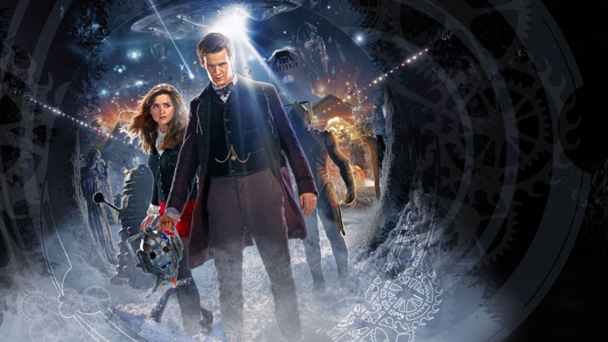
We didn't even get a chance to get over the brilliance of the 50th Anniversary special before the information about the Christmas special started pouring out.  First, we got a teaser trailer at the end of "The Day of the Doctor," which revealed a few key things:  Daleks, Cybermen, Weeping Angels, Silence, Trenzalore.  Knowing Moffat, the inclusion of these four villains doesn't necessarily mean that any one of them is going to be a central villain.  They could all play a very small role in the episode, much like "The Pandorica Opens."  However, a recently released poster showing the Doctor holding a severed Cyberman's head in his hand suggests that, at least the Cybermen will play a major role.

That the episode takes place on Trenzalore is not a surprise to anybody who's been paying attention.    The plot of the Eleventh Doctor's final episode has been obvious since "The Wedding of River Song."  "On the fields of Trenzalore, at the fall of the eleventh, when no living creature can speak falsely or fail to answer, a Question will be asked, a question that must never, ever be answered."  The Doctor's going to be on Trenzalore, in a situation where the entire planet acts as a sort of truth serum, and then he's going to be asked his name (which is, for some reason, dangerous for him to say) and this will lead to his regeneration somehow.

Then the title was released, which is "The Time of the Doctor."  This suggests that Moffat thinks of this episode as part of a sort of trilogy with the two episodes before it, "The Name of the Doctor" and "The Day of the Doctor."

Then, Moffat finally came out and said, the Doctor definitely has only 12 regenerations, not 507 (fuck you Davies!), and that he is currently out of regenerations!  Obviously, the show's going to continue as there's already another Doctor waiting on deck, but the Doctor is supposed to be out of regenerations right now and that will be addressed "head on" in the Christmas special.  His interviews have heavily implied what I've already guessed:  That he used up a regeneration in "The Stolen Earth" without actually changing his face.  The pervading fan theory seems to be that River fixed the whole thing when she gave him her remaining regenerations in "Let's Kill Hitler" (presumably that's 10 more regenerations, unless there's another River regeneration we never saw).  This seems a little obvious but, remember, every now and then with Moffat, the easy answer is the correct answer (e.g. "Who is the impossible astronaut?")

However, would this mean that River's in the Christmas Special?  Nothing has said that she will be, but I can give you a list of about 100 reasons she fucking should be.

Then came the most intriguing news, at least to me.  Irish actress Orla Brady will be appearing in the special.  Who is she?  I don't know and I don't care.  Here's the part of the announcement that entices me:

"Brady's character is someone from the Doctor's past, with the plot of the festive episode revolving around her."

She's Susan.  She's Susan, she's Susan, she's fucking Susan Fucking Foreman!  If there was a bookie who took obscure bets on Doctor Who, I'd put a lot of money down on this woman being Susan.

Show your work?  Sure.

1.  I've been saying for a long time that the Doctor's role as a father (or grandfather) is going to come around in a big, big way.  The biggest hint is the cot in "A Good Man Goes to War," which Alex Kingston (River Song) told us in a Doctor Who Confidential episode, is a big hint.  The Doctor says it's his cot, but Kingston told us that someone else slept in it.

2.  The Eleventh Doctor has had a pretty self-contained story.  I don't think Moffat wants to wait until Capaldi's Doctor or later to unravel what he's started.  Right now, it looks like the hunt for Gallifrey is the only thing set up in the Matt Smith era that's going to be resolved in the Peter Capaldi era.

3.  In "The Day of the Doctor," there's a scene where Clara takes a nice big, long look at the picture of Susan on Kate's board that she has put up in the Black Archive with all the information about the Doctor.  It's a set up for a scene where Clara acknowledges that she knows who Susan is.

Now, "The Night of the Doctor" made the audio stories officially canon, which means the Doctor has reunited with Susan since her last appearance on the show in "The Five Doctors" (presumably the most recent we've seen her in her timeline is "The Dalek Invasion of Earth").  But the show is still long overdue for the return of the first ever companion, especially since she's related to the Doctor and, therefore, should have come up in some way, shape, or form by now.

Sunday, November 24, 2013

A Doctor's Carol: An Overanalysis of "The Day of the Doctor"


Have you ever thought what it's like to be wanderers in the fourth dimension? Have you? To be exiles? Susan and I are cut off from our own planet, without friends or protection. But one day we shall get back. Yes, one day. One day. -The First Doctor in An Unearthly Child

Once upon a time, an old man got bored.  So he ran away from home, and shit got crazy.  It's a simple story, and it's held up for 50 years, and now thirteen different actors playing the titular role.  The infinitely flexible premise could potentially go on forever.  No show has ever proved as flexible and as durable.  And yesterday, the whole world celebrated how powerful, flexible, and ultimately endearing the show has become.  16 years of cancellation failed to kill it.  Much like the title character, the show has proven infinitely regenerative.  And just because it's hit the 50 year mark doesn't mean it shows any signs of stopping.  This was far from a finale.  This was a statement to the world that the show is still going strong and has many more stories to tell.  I regret that I'm a late-comer to this fandom, but, in case you haven't noticed, I'm damn well dedicated it, and was glad to join in on the celebration.

The old saying goes that bad writers steal, good writers borrow.  If that's the case, then Moffat is very good at borrowing from Charles Dickens.  Because that's what this was.  I mean, I'm not the only one who got that, right?  Billie Piper as Bad Wolf as The Moment as The Ghost of Christmas Past, Present, and Yet to Come.  It's a 12 Wonderful Lives!

The 1963 opening titles?  Nice touch.

I have to admit one thing I was completely wrong about.  Some people suggested that Billie Piper would be playing another role other than Rose.  Their reasoning was that her outfit was bizarre and she was only seen talking to True 9 in the trailer.  I insisted that the stuff about her only talking to True 9 in the trailer was a coincidence, and that Rose had often tried out some bizarre outfits that didn't quite work (like the Union Jack shirt).  I was wrong, but I have to admit that I was happy to be wrong.  Billie Piper as the guide was a way more interesting idea than somehow awkwardly trying to put Rose into an episode where she clearly would not have belonged.  And, while I'm not crazy about Rose, I loved Billie Piper as The Moment.  Her first few moments as The Moment were probably the best acting she ever did on the show.  She played a sly, sexy, wise, and powerful entity that was ultimately smarter than the Doctor himself.  Bad Wolf as the Doctor's savior.

I was going to write a big Eve of the Doctor write up to go up on Friday and give some of my opinions on things you should know for the episode, as well as a few predictions.  Unfortunately, I pulled a back muscle at work, and it's hard to write a blog while you're lying with your back flat on the floor to try to realign your spine.  I was going to try to give a little explanation of the Zygons.  Actually, at one point, I wanted to write one of my Doctor Who Book Reports on the Zygons.  But there's not enough information--or enough interest in me--to fill up one entire blog about them.  They're not a bad villain, but they're mostly unremarkable.  The only significant thing about the Zygons is that they have the technology--not the biological ability, mind you, but the technology--to turn themselves into other living creatures.  I knew that there was nothing else Moffat could possibly want them for other than their ability to shapeshift.  And boy, did he use that one.  Although, I don't understand why they needed to keep some humans hooked up to their machine to turn themselves into humans, and some of them they could pull it off on the fly.

There was a poll I saw asking people what they were most looking forward to in the special, and one of the options was the return of the Zygons.  It got the least votes, but I fail to see how it got any votes at all, or why it was even included on the list at all.  Who cares that much about Zygons?  Even Moffat didn't intend to use them for anything particularly big.  The Zygon plot was a parallel story designed to do nothing else but show the Doctor what he needed to do.

I was about 20 minutes from the end of the episode and thought "Why is Moffat focusing so much on this mediocre Zygon storyline?"  Then came the moment where Kate asks the Doctor if he's ever had to make the calculation of sacrificing the few to save the many and he said that he did it once, but that it was the wrong decision, that's when I realized what Moffat was doing.  I realized that this was the story that was going to teach the Doctor that he had to save Gallifrey, not burn it.  It was a parallel story to teach a lesson.  And I realized it was going to result in the Doctor saving Gallifrey.

That's when I started crying.

The other thing I was going to do in my "Eve of the Doctor" blog was remind you all about the significance of Queen Elizabeth.  Trust Moffat to take a one-off gag and turn it into a major plot point of the most important episode in the history of the series thus far.  Gareth Roberts, one of the better writers on Doctor Who right now, introduced the joke in the end of "The Shakespeare Code" where the Virgin Queen is ready to kill the Doctor for reasons that he didn't know because he was meeting her out of order.  Davies and Moffat seemed to appreciate the joke, as they both took it and ran with it.  Davies had the Doctor marrying Queen Bess in "The End of Time (Part 1)," and Moffat brought it up in "The Beast Below" and "The Wedding of River Song."  Not only is it hilarious to blow up such a small joke into something big like that, it's also the only thing that tells us where this episode takes place in the 10th Doctor's timeline.  Presumably, this has to take place, for him, between "The Waters of Mars" and "The End of Time," as that's when he said he married Queen Elizabeth.

Similarly, the "it doesn't do wood" line, which began way back in "Silence in the Library," became such a major plot point, it actually resulted in the ultimate outcome of the episode.  The Doctor finds a way to finally take down a wooden door using his screwdriver, just that it would take 400 years to pull it off.  It turned out that that wasn't necessary, but it was the inspiration for the end of the episode.  Because the same exact logic used in taking down that door was used to save Gallifrey.  If anyone is going to come in and try to tell me that saving Gallifrey was some sort of "Deus Ex Machina," I will again direct them to the fact that the definition of a Deus Ex Machina is a solution that comes out of nowhere and was not set-up in the episode.  The scene with the screwdrivers and the doors is what set up the plot to save Gallifrey, and that, by definition, is not a Deus Ex Machina.

In related news, I want a smaller word or phrase to have to type out than "Deus Ex Machina" because it comes up a lot when writing about Doctor Who.

The last thing I was going to predict in my post--and I swear this isn't just 20/20 hindsight--was that the Time Lords would be re-established in the Universe by the end of this episode.  I was half right.  The cool thing is that he saved Gallifrey (probably), but now has a new mission in life:  to find the planet he saved.  But there's a problem now, and one they never addressed in this special:  In "The End of Time (Part 2)," the 10th Doctor says that he had to kill the Time Lords because they wanted to basically destroy all of time, space, and existence itself and ascend to a higher plane of existence.  It could be that they were only planning to do that to destroy the Daleks, but it sounds like the kind of megalomaniacal plan that wouldn't change once its original justification is removed.  So basically, I think they would probably try and pull it again once they're removed from stasis.  This means the Doctor has a pretty tough task ahead of him when he does find Gallifrey:  he still has to deal with some crazy ass Time Lords after he's rescued them.  That's not entirely unprecedented.  Honestly, the Doctor's relationship with his own people is a strange one, one of antagonism, but not hatred.  He disapproves of his own people's actions, and they disapprove of his.  But that doesn't mean he wants them to die.

My friend Dawn pointed out that Osgood is probably, somehow, Clara's sister.  I didn't think of this until Dawn told me, but now it makes perfect sense.  Her name sounds a lot like Clara's last name (I'm assuming Osgood is a last name), and her Zygon copy said she was jealous of her more attractive sister.  But, while Osgood and Clara didn't share much screen time, they did see each other enough that, if they knew each other, one of them should have said something.  The most likely scenario I can imagine is that Clara doesn't know she has a sister, and Osgood knew but kept it a secret for some reason.

Speaking of Clara, the idea of her teaching at Coal Hill School was a stroke of genius.  I mean, is it a bit of a stretch for her to go from being a nanny to a teacher?  Maybe a little.  But she's teaching at the same school as the Doctor's first companions, Ian and Barbara, and a sign says that Ian is now the Chairman of the Governors at the school.  So, clearly, it was a little nepotism that got her the job, with the Doctor calling in a small favor.  Still, a great idea.  I hope she's still working there when we see her next.

I'm not touching the part about Clara meeting Kate out of order.  I can't think of a less interesting or important mystery to bring up in the episode.

I have one apology to make.  Months back, I did a write-up of a trailer that turned out to be a fake.  I didn't realize this until yesterday when I realized that not a single shot from that trailer appeared in this episode.  I don't know how a fan made trailer was that deceiving.  I didn't recognize a single shot or line from the trailer from a past episode.

Peter Capaldi's brief cameo made me stand up and applaud.  (I was watching this with a group of Whovians on a projector at a store that was primarily used for Magic: The Gathering tournaments, so it was not that weird to stand and applaud at a science fiction show.)    It was a brief moment, but it was a glorious moment.  As the Doctors unite, 12/13 won't stand idly by.  He's certainly going to lend a hand.  I like him already.

When the girlfriend saw the mind eraser devices in the Black Archive, she thought this was going to be the convenient way to make it so the 3 Doctors don't remember each other.  She thought this was a little lazy, but she didn't find it nearly as lazy as what actually happened.  She thought they were going to intentionally erase True 9 and 10's memories because, otherwise, the 11th Doctor couldn't ever get involved in this situation and keep himself from destroying Gallifrey.   Cool idea, but the show's never really been that worried about that type of paradox.  And the simpler explanation that, once the timelines cross, the memories of the other Doctors were erased, has two benefits:  1) It explains all the other multi-Doctor episodes (except "Time Crash," which it actually contradicts directly) and 2) It allowed for the 13 Doctors United scene without anyone having to stop off and erase 8 other Doctors' memories.  (The girlfriend found the Doctors United scene lazy as well.)

The Doctors United scene was beautiful and touching.  Yes, it required a bit of a stretch in logic.  Yes it was a little cheap to bring in all the Doctors in stock footage rather than in live action.  But, come on, that scene was fun!  For the first time, all of the Doctor's regenerations worked together.  The man who has saved so many worlds is finally able to save his own, united with all of his selves.

Tom Baker's cameo, however, was a little bit more interesting of a moment.  Rule 1, Rule 1, Rule 1!  Why do I let Moffat convince me that he's not lying about things?  He's proven himself to be a big fat liar before, and then he does it again and I believe he's not lying this time.  He's kind of like my ex-girlfriends in that way.  So I let him convince me that he was telling the truth when he said there would be no classic series Doctors in the special.  He's going to try to couch this into language, saying that "No, he's not playing a Classic Doctor," and he'll be wrong.  He knows what we really meant when we, the fans, bombarded him with questions about which past Doctors would come back.  He knew full well that we didn't think that past Doctor actors playing different parts (which may or may not be future Doctors) didn't "count."

So Tom Baker is a future Doctor?  The character of The Curator was left very ambiguous so as to explain the significant difference in age between Tom Baker as the 4th Doctor and Tom Baker now.  But basically implies that, somewhere in the distant future, the Doctor will "revisit" some of his old faces.  But only his favorites.  A bizarre idea, to be sure, but one that makes a little more sense than pretending Tom Baker is the same guy he was in the 70s.

The return of Tom Baker is so significant simply because of his obstinate refusal to return for decades.  It was 2009 before he agreed to come back to do audio adventures.  Hell, he even refused to do the 25th Anniversary special!  Thankfully, Moffat must have been more persuasive than the late Jonathan Nathan-Turner was.  I'd have to look this up, but this might give Moffat the record as the person to have written for the most different Doctors in the series:  4, 5, 8, True 9, 9, 10, 11, and 12.

Moffat has said that the next regeneration, Peter Capaldi's, is going to be dark.  I thought this made sense, as Season 7 was pointing the show in a darker direction.  But, after this episode, I don't see it.  This should be the happiest and least-dark era of the Doctor's life since before the Time War started.  The Doctor will always have blood on his hands, but now he has gallons less than he thought he did.  Why would the 12th Doctor go darker?  It seems like he should be facing the Universe now with a much lighter heart than he has for the past 7 seasons.

I guess it all depends on what happens on Trenzalore.

Monday, November 11, 2013

Beyond the End of Time Itself: An Overanalysis of the New Trailers for "The Day of the Doctor"

RASSILON: We will initiate the Final Sanction. The end of time will come at my hand. The rupture will continue until it rips the Time Vortex apart. 
MASTER: That's suicide. 
RASSILON: We will ascend to become creatures of consciousness alone. Free of these bodies, free of time, and cause and effect, while creation itself ceases to be. 
DOCTOR: You see now? That's what they were planning in the final days of the War. I had to stop them. ("The End of Time Part 2")


This weekend, the BBC released another full trailer for the 50th Anniversary Special, "The Day of the Doctor," as well as a short clip from the episode, both of which are above.   If you remember, I already gave my analysis of the first trailer they put out a few months back.  Then the BBC put out this teaser trailer that everyone but me felt the need to dissect and analyze.  Personally, I think trying to learn anything from a trailer that has literally no footage from the episode is fruitless.  It's a cool looking trailer, but it tells us nothing we didn't already know.  But this trailer is an actual trailer that gives us some new information, so it's time to dive in.

If you ask me, it seems pretty clear that this episode is, first and foremost, the sequel to "The End of Time."  "The End of Time" told us how The Time War ended, and this episode is going to show us in greater detail.  I'm not surprised that fans speculated that this episode would be titled "The Time War." I think we're finally going to see what really happened.  Perhaps, we're going to see the very moment when the Time Lords and the Daleks were destroyed.

The 10th Doctor, the 11th Doctor, and True 9 are somehow brought together for this episode.  But the 10th Doctor says in the trailer "Why are we all together?  Why are we all here?"  That means that they didn't just stumble upon each other, or seek each other out by choice.  Something forced them together, a direct violation of the Time Lords' First Law of Time (which they broke when they felt like it).  Furthermore, there's something that never dawned on me before:  If they can meet True 9, then the time lock is broken.

In "Journey's End," we learn that the entire Time War is "time locked," meaning nobody and nothing should be able to get in or out of the time period in which the war happened.  However, Dalek Caan found a way to break through, yet it cost him his sanity (not that Daleks are really sane to begin with).  Then, in "The End of Time," Rassilon found a way out, but it was not easy to pull off.  True 9, as far as we know, only existed in the Time War, and his regeneration almost certainly happened in that war.  This means that either the 10th and 11th Doctors, along with Rose and Clara, are going to be breaking into the time lock, or True 9 is breaking out.  My money is on the former.

It's never been known when and exactly how the Doctor regenerated into the 9th Doctor.  Up until "The Name of the Doctor," it was assumed that Paul McGann's Doctor regenerated into Christopher Eccleston's, but now we know that's not true.  That leaves us with 2 regenerations we've never seen on the show, and a lot of wiggle room as to when things happened.  However, there's one important clue:  In the beginning of the episode "Rose," the 9th Doctor checks himself out in the mirror, and it looks like it's for the first time.  "Ah, could've been worse. Look at the ears. "  So True 9 presumably regenerated into 9 moments before the events of "Rose."  I think it's fairly safe to assume that his regeneration occurred because of the event that caused him to end the Time War.

It's been said that Eccleston was approached to come back for this special, but that he turned them down.  I've been wondering about this:  was True 9 supposed to be in the script, or was he added into the script because Eccleston turned down the special.  Is True 9 playing the role that Eccleston's 9 was going to play?  This would have required Moffat to completely ignore the mirror scene I mentioned earlier, but perhaps the special was supposed to be about how Eccleston's 9 ended the Time War.  Regardless, it's going to be very difficult to do this story without Eccleston, if this is the story I think it's going to be.  How do you not show True 9's regeneration into 9 if Eccleston refused to come back?  Maybe Eccleston is lying, but I doubt it.  He does seem like he's too much of a dick to come back for the fans.  But maybe he's going to surprise me.

The other little clip they released, referred to as "But That's Not Possible!"  Other than introducing a character in the background, who's supposedly going to be named Osgood (I don't feel like unraveling that little puzzle) and who seems to be wearing the 4th Doctor's scarf.  The whole clip seems pretty pointless to me.  It tells us very little.  UNIT (it sounds like Kate Stewart) is showing the Doctor a painting, and Clara sees something that she thinks is "not possible" (a phrase that is used often on Doctor Who and is almost always proven wrong).  I couldn't understand what Clara was shocked by the painting.  My girlfriend said "She saw herself in the painting."  That would be interesting, as the painting is clearly of Gallifrey burning to the ground.  But I'm afraid we're looking at a much more commonplace and tired plot device:  Clara saw the same image in a dream that's in the painting.

Next Saturday, the minisode "The Night of the Doctor" will be released.  The description they've given out says:

"The 50th Anniversary features Matt Smith, David Tennant and a mysterious incarnation played by John Hurt. Only one appears in this mini episode, 'The Night of the Doctor.' But which?"

I'm thinking of the phrasing of this.  "Only one appears in this mini episode."  One of those three?  Or one Doctor?  Moffat said that no other past Doctors will appear in the special.  He said nothing about these minisodes that he's so fond of making.  Furthermore, Paul McGann, the 8th Doctor, seems to have potentially let something slip on Twitter.  Back in October, Paul McGann said on Twitter:

"Spent forty minutes this pm having to imitate Matt Smith’s dramatic delivery in VO. You have been warned….”

After fans got crazy excited, he followed it up by saying:
“I should explain. It was by way of an aural experiment to find out how similar we might sound. We didn’t. And he’s better looking too.”
What the fuck does that mean?  What kind of aural experiment?  For what?  What could that possibly mean?  It sounds like a weird, fumbled excuse that he came up with when he realized he had just said way too much.  Even if Moffat is telling the truth about none of the past Doctors coming back for the special, that doesn't mean that none of them can come back for the minisode.  Plus, he's one of the easiest Doctors to bring back because we know so little about him.  He could have stayed in that regeneration long enough to really, truly age within that regeneration, which would explain the 20 year age difference since the last time we saw him.  You can't really say that about any other Doctor.
I think McGann is in "Night of the Doctor."

Thursday, October 17, 2013

Counting to 13 the Hard Way: A Quick Response to Moffat's Latest Hints

Steven Moffat dropped some hints a few days ago about what was coming in the coming specials this year.  First, he confirmed that the Doctor can only regenerate 12 times.  But then he said, regarding the number of regenerations the Doctor's had:

"I think you should go back to your DVDs and count correctly this time...there’s something you’ve all missed.”

Dear Steven, trust me, I did not miss this:


I just assumed that you'd missed it.  And no, I don't have any doubt whatsoever that this is what you're talking about.

I've always noticed this, I just assumed that the writers were choosing to ignore it.  But when the Doctor was shot by a Dalek in "The Stolen Earth," he regenerated, but he siphoned all of his regeneration energy off into his hand, keeping him from regenerating completely.  While this was exceedingly stupid writing, it should count towards his regeneration count.

So now we know that the 11th Doctor is actually the 13th Doctor.  So that means that, as Moffat has confirmed that he will be following the 13 Doctors rule, something in either the 50th Anniversary Special or the Christmas Special will deal with the fact that the Doctor's out of regenerations.

So we deal with the Doctor's end of his regeneration cycle in the next few months.

But if the 11th Doctor is really the 13th, then where's the Valeyard?  The GI said that the Doctor would be known as the Valeyard by the end, but if he really is the 13th Doctor, the Valeyard should have been created already.

Thursday, June 6, 2013

The Order of Rassilon #1: Matt Smith, The Ancient Amateur

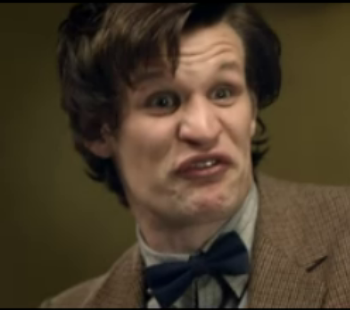
Hair, nose, chin.  I guess that everything on Matt is abnormally large...
When I started writing this list about 10 days ago, I had no idea that, when I got to number 1 on the list, that very Doctor would have already announced his retirement, leaving me to write an obituary for my favorite Doctor in the franchise.  When I first saw a picture of Matt Smith, I thought "This is going to be the ugliest Doctor of all time."  I was very wrong about that, as his pure charm and attractiveness shine through when he's moving around.  Matt Smith's Doctor was a truly excitable child with the wisdom of an ancient soul.  Something old, something new...

If you want to talk about big shoes to fill, Smith had his work cut out for him just as much as Peter Davison did, if not moreso.  Smith not only had to replace the most popular Doctor of his time, he had to replace Doctor Who's first real male sex icon, a man whose screaming fangirls could contend with the Beatles' concert at Shea Stadium.  But Steven Moffat said that, while he expected it to take about a season and a half for the audience to accept Matt Smith, he really felt that everyone fell in love with him the second he popped out of that TARDIS and said "Hello, I'm the Doctor."  His first landing on the ground showed his new trademark Doctor stance. The way that Matt Smith moves is simply unique.  The way he stands.  The way he moves his hands.  The way he jerks around exaggeratedly with his head flopping all around.  It just gives this lovably manic quality to him that is both endearing and exciting at the same time.

"My anger at the Daleks has turned me into a ferret!"

Where Tennant's Doctor was cool as a cucumber, Smith's was a little different.  He had an unshakable confidence when staring down a Dalek battle fleet, but fell into a bumbling mess when trying to talk to women.  His first kiss with River is hilariously awkward.  I feel like that's the appeal of the Eleventh Doctor to really awkward nerds:  It gives us this hope that, even though we're terrified of everyday social situations, if the chips were really down, we could be just as brave as the Eleventh Doctor.  All the Doctors have shown a striking confidence in themselves to be a primary trait (the Second Doctor appeared to be very terrified and/or stressed, but still knew that he was strong enough to handle the situation), but none have combined it with awkwardness the way Matt Smith did.  That's the brilliance of his performance:  he's awkward and confident, childish and ancient, silly and serious, handsome and gawky, sometimes all at the same time.

Smith was lucky, as well, as he was surrounded with some truly amazing people.  Karen Gillan and Arthur Darvill were the first multi-companion pair since the 5th Doctor's outings with Tegan and Turlough, which was also the last time we saw a full-time male companion.  The "no hanky-panky in the TARDIS" rule that had been instituted in the classic series by Jonathan-Nathan Turner was violated once or twice with Amy, but for the most part hers was a love story that was going on inside the TARDIS, with the Doctor merely as a chaperone.  Traditionally, companions left the Doctor when it was time for them to get married.  Jo Grant, Leela, Peri, and even the Doctor's granddaughter, Susan, all left the Doctor because they fell in love a man they met during their adventure with the Doctor.  The Amy and Rory storyline taught us that that wasn't a coincidence.  The Doctor doesn't want to become too attached to someone.  "He hates endings" River tells us.  The Doctor ducked out on his companions that wanted to get married because he didn't want to see them grow old and die, or become too involved in their new life to stay with them.  Remember the end of the second Whinnie the Pooh book where Pooh just turned back into a stuffed animal because Christopher Robbin grew out of him?  The Doctor didn't want to turn back into the little, stuffed, raggedy Doctor puppet.  He got out first.

Amy was the first and only companion to convince him to stick around and bring her husband with her, allowing their relationship to grow and develop over a decade of their lives (and 300 years of the Doctor's).  It went into a deeper Doctor/Companion relationship than ever before, and not in a simple romance way like the Tenth Doctor/Rose relationship.  Colin Baker at Denver Comic Con last weekend said that he thought the Doctor and his companion should not even notice that they are of different genders, and that it should be a strictly paternal relationship.  The Doctor's relationship with Amy, despite her early on misinterpreting it as sexual, was actually extremely paternal.  Rory was, in some strange ways, a son-in-law to the Doctor, which made them both friends and, in some cases, rivals.

The Eleventh Doctor's awkwardness with women made you wonder how the First Doctor could possibly have had a granddaughter.  Thus, it only makes sense that the woman to win his heart would have to be someone assertive enough to be the pursuer.  Thankfully, Moffat had just such a character lying around ready to be used from an earlier episode he wrote in the David Tennant era:  the aggressive, and sexually aggressive, River Song, played brilliantly by Alex Kingston.  Moffat claims to have not had a plan for River when he wrote "Silence in the Library" (I'm not sure if I believe him), but it seems funny that a character who was created before the Eleventh Doctor had been cast actually turned out to be a better match for the Eleventh Doctor than for the Doctor she originally appeared with.  River became an important part of the Eleventh Doctor era.  The entire era is defined by the characters of Amy, Rory, and River.  Jenny, Vastra, Strax, and Clara, who are the primary supporting characters at the moment, really seem to be more of an entourage that's been made in preparation for the 12th Doctor.  The Pond family was the real focus of the entire effort:  Amy (mother), Rory (father), River (daughter), Doctor (son-in-law).  Yet, while these may have been the biological and legal labels for how they relate to each other, in a brilliant irony, the way they act towards each other completely flips these relationships around.  The daughter and the son-in-law end up actually being the experts, becoming parent figures for their own parents/in-laws.

This should be hanging over the fireplace in the TARDIS.
Alex Kingston and Matt Smith were a match made in heaven.  She was sexy and fiercely independent.  He was horrified of her sexually, and she was almost his equal intellectually.  While they may have disagreed about the neccesity of violence in battling evil, the Doctor always respected River's ability to get things done.  Moffat once said that he had an endgame planned for Amy, Rory, AND River.  I can't imagine how there could be an endgame for River, as her first appearance was her death.  It would be a tough way to write her out of the show at this point.  Hopefully, she'll stick around to annoy the 12th Doctor.

Most importantly, Matt Smith was backed up by the greatest writer in Doctor Who history:  Steven Moffat.  Those people who say that Moffat ruined Doctor Who and want Russel T. Davies back must be the kind of people who would wait in line for an opening night screening of Fast and Furious 6 and call The Godfather boring.  Moffat's writing is light years ahead of even the best of Davies's episodes.  He created fascinating stories that didn't just lean back on the classic villains for excitement.  With the exception of the Great Intelligence, most of the season-arcs were focused more on a new villain that Moffat invented, most notably The Silence.  Not seen until "The Impossible Astronaut," The Silence are implied to have also been secretly involved in the explosion of the TARDIS, meaning that they were the primary villain of the entire era, despite appearing in only 3 episodes.  In all of Moffat's season finales, classic series villains and races show up, but they are always side characters, added for flavor, who serve as extra menaces in an episode about something else.  A Dalek attacks the Doctor in a library, but while trying to repair the universe from a Silence plot.  Another Dalek gives the Doctor the information about trying to find the Silence.  A Silurian and a Sontaran appear in "The Name of the Doctor" but, unlike the classic series, they are exclusively protagonists of the stories.  Moffat took his own original, imaginative stories and sprinkled them with a little bit of familiar Doctor Who flavor by placing these iconic characters in the background.  It's distinctly Doctor Who, and distinctly Moffat.

Moffat's most unique talent is actually steeped in a Freudian concept called "the uncanny."*  While this isn't something Moffat has ever cited as an inspiration for his writing, the definition of "uncanny" sounds strikingly Moffatian:  "The uncanny is a Freudian concept of an instance where something can be familiar, yet foreign at the same time, resulting in a feeling of it being uncomfortably strange or uncomfortably familiar" (from the Wikipedia page).  Moffat says he does just that:  he tries to make something strikingly unfamiliar, grotesque, and horrifying out of something that is commonplace and familiar.  He's done this with gas masks, clockwork toys, statues, dust in sunbeams, "the smilers," whispers in the darkness, and, most recently, wi-fi.


"Are you my mummy?"
The truly terrifying concepts behind Moffat's best episodes are emphasized perfectly by Matt Smith, whose Doctor is so optimistic and brave that the darkest moments of the Eleventh Doctor's era become less scary when you realize exactly who is standing in the way of these monsters:  A man who, unarmed, can taunt an entire fleet of ships, telling them to come and get him.  Matt Smith's Doctor is the man who stands firmly in the way of everything terrifying in the Universe.  He is what monsters have nightmares about.

Now, as he departs, he will leave behind a legacy of being in the shadow of what many will continue to call the greatest Doctor in the new series, or possibly in the whole franchise.  Few will give Smith the credit he deserves for being his own, unique, and brilliant version of this 50 year old character.

The age of the David Tennant vs. Tom Baker debate is over.  Long live the age of the Matt Smith vs. David Tennant debate!


It's a tie, guys!  You're both pretty!
*I owe this concept of linking Moffat to "the uncanny" to someone I saw at the Popular Culture Association conference.  I don't remember her name, but can look it up upon request.