Showing posts with label Listen. Show all posts

Saturday, December 5, 2015

Room Without a Window: An Overanalysis of "Heaven Sent"


The Simpsons used to have a rule that every season had to have one episode that pushed the boundaries of what a Simpsons episode should be.  Personally, I think every show should have a rule like this.  Not every episode should be an experiment, but once a season I think every show should push themselves and see if they can go somewhere very different creatively.  "Listen" was probably Steven Moffat's most obvious attempt at an experimental episode, as it really was, in every way, a complete deconstruction of a Doctor Who episode.  It took the most basic concept of a stereotypical Doctor Who plotline, broke it down to its basic components, and reassembled it in a very different way that challenged the very premise of what this show is and what it's about.  Perhaps it was Steven Moffat's confidence after three seasons as showrunner that gave him the confidence to push the boundaries of the show's structure.  I would argue that there are a number of moments when Moffat deconstructed traditional narratives that were not necessarily looked at as "experimental" episodes, such as "A Christmas Carol" and "The Day of the Doctor," but "Listen" is where he really stretched himself.  "Heaven Sent" is the work of a writer at the top of his game, confident in the abilities of his lead actor, sure of the BBC's confidence in him and his show, and confident in his audience's ability to grasp the complexity of the episode.  Sure, a work of genius like this will not silence Moffat's haters, but nothing ever does.  They will talk about how much they love the 11th Doctor, Amy Pond, Rory, River Song, Danny Pink, the 12th Doctor, "Listen," and now, certainly, "Heaven Sent," but will still insist that Moffat is ruining the show.  But while I'm still not entirely sure why Moffat chose to call the episode "Heaven Sent," I do know that it is a work of pure, unadulterated brilliance that will forever be remembered as one of the most important episodes in the show's history.

The show has been dangling out a few mysteries this season hinting at the plot of the finale, and I haven't entirely understood them all, or even cared to understand them all.  I've been more interested in figuring out who the Minister of War is or what Missy's "clever plan" was, but it now seems like those are setting up for farther down the road so let's focus on the mysteries that seem to be setting up for this finale.  The first was The Hybrid.  It's interesting, but incredibly vague, and leaves me with very little to chew on.  But, more importantly, it completely destroys the premise of the show.  We've always known the reason for the Doctor's departure from Gallifrey, and the story of The Hybrid throws that reason out entirely.  To be honest, the original explanation we've had all these years, that the Doctor was simply bored, makes complete sense to me.  It speaks to the true spirit of the character.  Regardless of which generation we're talking about, the Doctor is always insatiably curious.  So why throw out his original motivation when it fits so perfectly with the character?  Unlike Davros, I never once doubted that the Doctor was just bored.

But the revelation at the end of this episode that the Doctor is The Hybrid does give us an explanation that is more in keeping with the Doctor's character.  The Doctor running from a prophecy is silly.  The Doctor doesn't run from enemies, no matter how deadly they are, at least not for very long.  But running from responsibility?  Yeah, the Doctor has done that many times, and that is quite in keeping with his character.  The Doctor has been offered the position of Lord High President of Gallifrey on multiple occasions and turned it down because...well, because damn the man.  The Doctor doesn't want that kind of power over his own people.  But if he needs to set them straight about a few things, which would be necessary even if Clara hadn't been killed in the trap that they set for him, then he's willing to show up and accept his responsibility as the one destined to fix Gallifrey.

Remember that "Day of the Doctor," taken on its own, is a very happy episode, but when you remember the events of "The End of Time," "Day of the Doctor" seems to be glossing over a few things.  Great, the Doctor has saved his own planet, and the Time Lords have been restored to the Universe.  Except that he destroyed them because they were about to destroy the Universe and rise to a higher level of consciousness.  So when the Doctor did finally find Gallifrey, we knew one thing for sure:  The Doctor was going to need to lay a serious smack down on some people.  I'm guessing Timothy Dalton was not available for "Hell Bent," but there are still some people who are going to need to be dealt with.

But how is the Doctor a hybrid?  I was really, really hoping we weren't going to go here, but I think I know what Moffat is referencing, and I'm not the first Doctor Who fan to have noticed it.


There are a lot of things that are wrong with the 1996 movie.  Somehow it manages to be too simplistic and too complex at the same time.  The line about him being half-human on his mother's side was so despised by fans that it has pretty much been rejected.  Expanded universe materials have retconned the line and explained it as an elaborate ruse to fool the Master.  Russel T. Davies pretty much ignored the line when he wrote "The End of Time," and fully admitted that the mysterious Woman was supposed to be The Doctor's mother, but also insists that that shouldn't be considered canon as he never got around to actually putting it into dialogue.  You wouldn't think that Moffat would even want to touch such a controversial line, but I have a bad feeling that that's what it means. 

If this is where Moffat is going with the whole Hybrid plotline, then there are far reaching implications for it.  The Doctor may have been established as half-human almost 20 years ago, but the show has refused to acknowledge it as real, and fans refuse to accept the line.  A half-human Doctor means something very different.  It means the Doctor's tie to this world is not just a fondness for it, but a birth connection.  I always liked the idea that it isn't his planet, but his adopted second home.  I don't know if I like the idea of it being just where his mother was from.

 My co-host from Mile High Who Podcast, Shelley, pointed out the other possibility that he's not saying "Me" as in he himself is the Hybrid, but rather referring to Ashildr by the name that she insists on calling herself, "Me." It's not a terrible theory, but I don't understand why Ashildr would show up on Gallifrey, unless she now feels really bad about what she did to Clara.  I don't think that the Doctor is going to literally "stand in the ruins" of Gallifrey.  To do that to the planet would be to really spit on Clara's legacy.  She saved the Time Lords from him and, even if they're partially responsible for her death, he would never take that legacy away from his good friend.  I think "stand in the ruins" refers to the fact that he's going to completely dismantle their government and institute a new leader, and maybe he's going to decide that Ashildr is just who should do it.  Or maybe one of the Osgoods, another Hybrid the Doctor created.  But he won't do it himself.  The Doctor is the most fit to govern Gallifrey precisely because he doesn't want to do it.

I'm just going to leave this riiiiight here.
I was also surprised about the Confession Dial.  The Doctor kept referring to it as being similar to a human concept of a "Last Will and Testament," but that wasn't true at all.  It was an interrogation chamber to get him to admit his final secret.  There's one thing though:  even if he is the Hybrid, the Doctor went through a lot of trouble to keep from telling the Time Lords something that he knew about the prophecy of the Hybrid, which means that there's still something we don't know yet.  So I'm really excited to see what it is now.  Regardless, I'm really excited for "Hell Bent," but I'm also a little skeptical.  "Heaven Sent" only really stands up if "Hell Bent" answers a lot more of the questions that it brought up.  So here's hoping it does!


Wednesday, September 17, 2014

The Nightmare Child: An Overanalysis of "Listen"


I was a very frightened child, which should not be surprising to anyone who has spent any amount of time with me.  I can't say that I ever had a dream of a hand reaching out from under the bed to grab my foot.  I had a lot of other weird ones, though.  One was that there was a duck that would walk into my room every night and do a lap around the room, and as unfrightening as that sounds, it scared the bejeesus out of me that somehow it got in there every single night.  The other involved the villain from the Care Bears showing up in my window every single night to scare the shit out of me.  I had a night light for so long, that it was eventually just determined that it would be easier to install a dimmer switch in my room.  I remember sometimes I would sit up in bed and think that I couldn't wait until, some day, when I was a grown up, I would completely lose that fear of the dark and not be scared even a little bit.  I'm 30 now, and I'm still waiting for that day to come.  Apparently, even 2,000 year old men are still waiting.

What this episode was was a radically new idea of how to tell a Doctor Who story.  This wasn't the story of the Doctor meeting a megalomaniacal foe and stopping them from destroying the Universe.  This felt something more like a horror film, but not a traditional horror film.  It brought to mind a more cerebral, artistic horror film in the vein of The Sixth Sense (honestly, I'm racking my brain for an example that doesn't give so much credit to M. Night Shaymalan, but we all do know his first film was actually very good).  Instead of following a linear story with a basic good-guy and bad-guy, the Doctor searches time and space in search of the literal boogeyman, as the episode waxes philosophic about the very nature of fear itself.

I've seen at least one person on Facebook complain about the typical Moffat theme of "something in the corner of your eye."  It's true that we have seen similar ideas before, but that's what writers do.  Some writers have favorite themes.  Ever seen a Tim Burton movie?  Then you've seen all of Tim Burton's shitty movies.  Have you ever read a John Irving novel?  I love John Irving, but I'll be the first to admit that he reuses the same themes, settings, and even the same characters obviously passed off under different names.  Moffat is pulling out some of his favorite themes that he touched on in "The Girl in the Fireplace" (the creature under the bed), "Silence in the Library"/"Forest of the Dead" (fear of the dark), "Time of Angels"/"Flesh and Stone" (fear makes you stronger), and perhaps my favorite episode of all time, "The Impossible Astronaut"/"Day of the Moon" (a creature always in the corner of your eye, responsible for the creakings that go on in your house at night).  Moffat is guilty as charged, and I admit that I criticized "Into the Dalek" for rehashing old themes, but when handled as expertly and intelligently as "Listen," I'm more than willing to forgive Moffat for reusing some themes.  Although, I have to admit, when I saw the opening scene with the Doctor going off about a creature with "perfect hiding" who can always be in a room without you realizing, I thought for a moment that we might see my favorite villain, the Silence, again, but alas it was not to be.

Or was it?

I heard a few people suggest that the monster, if there was one, was a Silent.  Both my girlfriend and a friend of mine from Mile High Who said that, when the monster took the blanket off of its head, it had a "bulbous" head that looked like a Silent.  I thought I remembered that scene having an actually quite clear shot of the monster's head, and I thought it looked more like a Sontaran than anything.  It was one of my favorite moments, because it felt so creepy to see that reveal happen so casually and in the background.  It made me think of that scene in the beginning of Signs (honestly, I'm not a Shaymalan fan) where we first saw the aliens walking by on grainy video.  Such a casual shot of something so unusual is just so shocking that, when I saw it in this episode, I remembered it being way more prominent than it really was.  So, I went back and looked for the shot of the monster, and it's far less clear than I remembered it being.  But, you will notice something:

Sontaran!
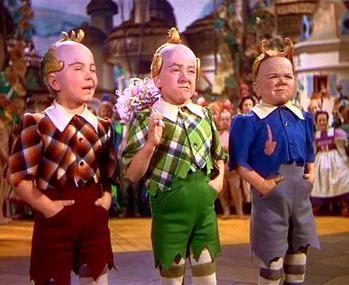
I don't know what you think, but that looks to me like a Sontaran!  The head is more squished down than the elongated head of the Silence.  Also, it's somehow shorter than Clara, which means its either a Sontaran or a member of the lollipop guild.

We represent the creepy thing under your bed!  Under your bed!
In fact, I thought this was about to be given away when, in a later scene, the Doctor jumps awake from a dream saying "Sontarans perverting the course of human history!"  A moment later, the outburst is forgotten, chalked up to the Doctor thinking he was still in a dream.  But it does seem an odd coincidence.  I'm kind of hoping it stays a coincidence, because I don't want to know whether there was a monster or not.  Although the scene with the creature in the blanket did seem to show some sort of alien that might be a Silent or a Sontaran, there's still so much ambiguity in this, and that was clearly meant to be the point.  I'd like that to stay the point.

The Doctor and Clara's chemistry just keeps getting better and better.  I feel like I called that one, that the biggest problem with 11 and Clara was that the plot was set up for them to not be able to trust each other, which is a natural impediment to chemistry.  Capaldi has a much better rapport with her, and I think their first scene interacting together demonstrated that perfectly, where the Doctor rudely barges into Clara's room.  Clara shows her strength again, being able to tell the Doctor to shut up (not something many companions can do), but also being able to be the one who discovers the Doctor's secret fear.

The idea that Clara is the reason the Doctor has the fear of something grabbing him from under the bed in the first place is called a "bootstrap paradox," and I love bootstrap paradoxes because I love to say the phrase "bootstrap paradox."  A bootstrap paradox is when, in time travel fiction, something seems to create itself, or has no clear origin or creator.  The best example I can think of is in Back to the Future, where Marty plays "Johnny Be Good" because he heard Chuck Berry playing it when he was growing up, but somehow Chuck Berry learned it from hearing Marty play, which means that nobody really wrote the song.  Obviously, this would be impossible if time travel were real.  Moffat loves to use bootstrap paradoxes.  The Doctor was essentially rescued from the Pandorica by a bootstrap paradox, and "Blink" is almost entirely one giant bootstrap paradox.  But, while they are seemingly impossible, they're always fun and make for a really exciting reveal in the end.  So no, I'm not faulting Moffat for creating yet another bootstrap paradox.  I really just wrote this paragraph to say the words "bootstrap paradox" over and over again.

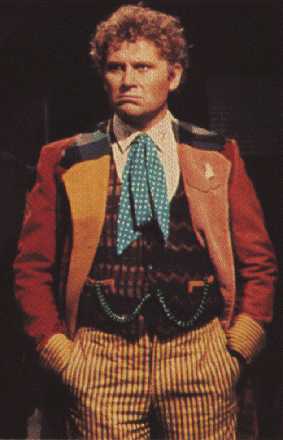
In this episode, we get the third variation on the 12th Doctor's outfit in 4 episodes, basically confirming that there isn't really a "12th Doctor outfit" per-se.  That's fine with me.  Some Doctors have more distinct outfits than others.  Sometimes, trying to be too unique and outside the box in designing a Doctor's outfit can backfire:

Why do you always pick on me in this blog?!
The 12th Doctor's main defining costume piece seems to be a suit jacket, and I'm okay with that.  Peter Capaldi pulls off the casual-dress-with-a-suit-jacket look quite well!  I realize that, for a straight man, I'm abnormally preoccupied with the Doctor's appearance.  I think it's because the Doctor is a character I admire and sort of live vicariously through when I watch the show, and so I want that person to be attractive.  Peter Capaldi, when dressed correctly and given a good haircut that doesn't make him look like a frumpy doofus, is quite attractive.  That being said, I couldn't figure out what was going on with the Doctor's shirt.  Even with a 1080p resolution on my big screen TV, I couldn't figure out if the shirt had a pattern on it, or if the Doctor is just the world's messiest eater and just finished off a powdered donut.  It didn't help that the pattern seemed to change based on the lighting in the room.

Speaking of costumes, why do the Time Lords (who I'm presuming are the Doctor's parents) look like 17th century Puritans?  They're millions of years ahead of us in technology, but their fashion style is all Hester Prynne?  "Pray, Goody Clara, thoust dost need to become more learned in the ways of iPlayer."  (Okay, so I don't know how people talked in the 17th century.)

Another thing I have to address is something a friend of mine brought up on Facebook:  The Doctor, in this episode, seems to be picking on Clara's body a little bit.  There are two times the Doctor makes some jokes about her appearance, basically calling her fat--and at one point, very directly calling her fat.  I don't think it would have noticed this if someone hadn't pointed it out on Facebook before I saw the episode.  But it's a fair point.  I'm not saying it would be appropriate if it were more accurate, but I would like to point out that calling Clara fat is like calling me a dwarf.  I fail to understand why Moffat thought that was a good idea.  Not only was it a little offensive to some of the viewers, it was freaking bizarre and unnecessary.

The overarching plot of this season--The "Promised Land"--didn't appear in this episode, but another "arc" of sorts came back around:  Danny Pink.  Honestly, the one frustration I had in this episode was that Clara never explained to the Doctor why they were landing in Danny's timeline rather than hers.  It seemed a perfectly reasonable thing to bring up.  The scenes with Clara and Orson seemed to want to leave a touch of ambiguity as to whether or not Clara and Orson were related, but they failed because there was no ambiguity whatsoever.  Orson is clearly her great grandson, after she someday marries Danny, and there's no way that the plot is going anywhere else.  End of love story.

Some people have suggested that, like "Blink," this is going to be an episode we're going to be talking about for a very long time.  I think that's true.  Peter Capaldi's 12th Doctor has more vulnerability than the Doctor has had in a long time, but never lets go of that Doctor swagger that David Tennant and Matt Smith's Doctors truly perfected.  Moffat pulled off another classic here, doing what he does best:  scaring the hell out of children, and many of us adults in the process.  But Moffat understands that his job isn't just to invoke fear, but also to keep us from letting that fear overpower and defeat us.  Usually, this means the Doctor defeating the bad guy.  This time, it was in reminding us that "fear is a superpower," an amazingly important lesson to learn.

I wouldn't want to be Stephen Thompson right now, as he wrote next week's episode, "Time Heist," and I don't think any episode will really be able to follow "Listen."