Showing posts with label Matt Smith. Show all posts

Thursday, August 28, 2014

The Doctor is Not Your Boyfriend: An Overanalysis of "Deep Breath"

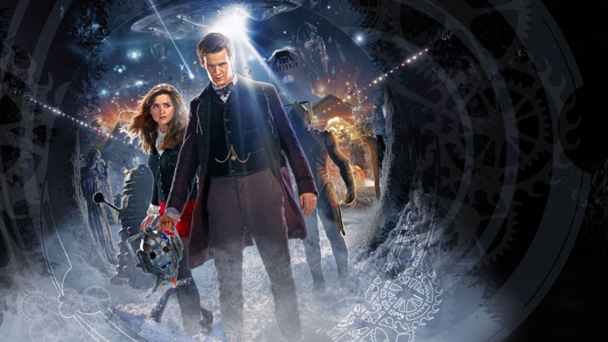
It was much easier last year when each episode had its own unique movie poster.


It's been a long time.  I've been a little lax in the Doctor Who off-season the past few months.  Sorry about that.  But the season's started back up, and much like the Doctor, I'm not quite dead yet.  So let's kick off another season!

First and foremost, I have to bring you my new Doctor Who podcast that I'm a part of.  Ever since the collapse of The 900 Year Diary (RIP), I've been hoping to find a good place to be able to discuss Doctor Who in a group setting with really funny people.  I finally found that place when I got the chance to start a new podcast with members of the Mile High Who Meetup Group in Denver.  Check out the Mile High Who Podcast with my friends Shelly, Scott, and Somer.  "Shit, Trevor, your name doesn't even fit the alliteration scheme!"

Now, onto the blog...

There is only one unwritten, yet highly important, rule when it comes to the first episode for a new Doctor:  this is no time to get fancy.  A debut episode of a new regeneration is not a time to come up with some sort of overly complicated plot.  In the new series, Davies started out by using the Autons to introduce the new Doctor, much the way they were used to introduce the 3rd Doctor (and the first Master, for that matter).  The Autons are always a great villain to use to introduce a new Doctor, because they don't have the most complicated powers or agenda.  Davies's choice to keep the 10th Doctor in bed for most of his premiere episode is still one I strongly disagree with, but the Sycorax were still not that complex of a villain with a fairly simple plan.  And Moffat knew the rule very well with his first episode as show runner, where he had to introduce both a new Doctor and a new companion, and he used a pretty simple plot when the Atraxi simply wanted to blow up the Earth to stop Prisoner Zero.  The reason for this rule is that the first episode is about establishing the character of the new Doctor, not showing off what you can pull with your imaginative, complex science-fiction twists.  This isn't to say that the rule is never broken, simply that you're off to a pretty bad start when you do break it, as was learned with the stillborn relaunch of the series in 1996 in a plot that was somehow dumbed down yet too complicated to allow a proper introduction of the Eighth Doctor to a new generation of fans.

"Deep Breath" isn't the most simple plot that Doctor Who ever produced, but it's simplified somewhat by bringing back an old enemy, albeit one that only appeared once before.  In fact, in both episodes that Moffat wrote to introduce a new Doctor, he seems to have stolen a part of the plot of "The Girl in the Fireplace."  Allowing the episode to rest on a villain that has already been explained six seasons ago gives the script plenty of time to focus on the introduction of a new regeneration of the Doctor--and his relationship with his companion.

While I'm not a Clara hater like many of the fans, I know I've yet to really bond with her and I know that many others have been even more disappointed than me.  A few months ago, my girlfriend pointed me towards an article called We're Losing All Our Strong Female Characters to Trinity Syndrome that she thought I could learn something from.  The article has apparently even caught on enough that I saw it mentioned in the New York Times review of Guardians of the Galaxy so that the author of the article could try to hold up Gamora as an example of a great female character (proving that the author of the review clearly misunderstood the point of the article). The tl;dr of this article is that it's not enough to create a strong female character if she ultimately doesn't do anything to advance the plot (like Trinity in The Matrix) or if her ultimate point in the plot is to be rescued by the male character or to simply make the male character look better as he surpasses her.  There are ways in which the basic structure of Doctor Who unfortunately resists the recommendations this article makes, the same way Doctor Who, by virtue of being about a man traveling around with a woman, can almost never pass the famous Bechdel Test (despite an article of questionable accuracy that recently came out claiming otherwise).  That being said, that doesn't mean that you can't do something to improve the strength of the female characters on Doctor Who, and Clara, while admittedly not following all of the recommendations this article makes, certainly becomes a much stronger character.

When Clara is seemingly abandoned by the Doctor, she's not crazy to despair.  Regeneration is a lottery.  While the core of the Doctor's character is always good, there's no guarantee that every regeneration will come out as kind or as moral as previous regenerations (The Valeyard) or that a newly regenerated Doctor is necessarily to be relied on to protect you (The Sixth Doctor).

You look tense, Peri.  How about a nice throat massage?

This is the first time when Clara really does have reason to despair that the Doctor might not be coming back to save her this time.  And that is when she shines the most!  While the flashback to her first day as a teacher certainly seemed like a bizarre non-sequitor at first blush, it tied into the plot quite nicely, and led her to a tactic that no companion has ever really thought of before:  daring the villain to kill her.  Her logic is sound through and through, and she overcomes a superior physical force with nothing but wits and sheer force of will.  And then the Doctor comes to save her and yadda yadda, but the point is, she kept herself alive long enough for that to happen.  While maybe not a shining moment for feminism, it was certainly a strong moment for Clara.

And Clara's other main role in this episode--the stand-in for all of the shallow fans who have complained about the new Doctor being too old--didn't make me dislike her either, even if it reminded me how much I hate the fans she's representing.  Her flaws in judging the Doctor's new face reminded me that she's not perfect, but never made me feel like she was a bad companion or a bad person.  Just a flawed person, like anyone else.  At first, I wondered why she was so confused as to why the Doctor had changed.  Her insistence that he change back to the Eleventh Doctor seemed bizarre in light of "Time of the Doctor," where she met literally every regeneration of the Doctor.  But it soon became clear that her insistence wasn't based on a misunderstanding, but sheer denial.  She was always aware that the Doctor had past faces that looked older, but she never cared as long as his current face was young and attractive.  The Doctor, as he reminded her and the fans, is not your boyfriend!

I didn't even mind the Eleventh Doctor's not-so-surprise cameo to remind her to stand by the Twelfth Doctor.  Like it or not it was just the kick int he pants that Clara--and the fair-weather fans--needed.  My favorite moment was when Clara accused the Twelfth Doctor of listening in on her phone call, and he had to remind her that he wasn't listening in...he made the call himself!

As for the Doctor himself?  While Peter Capaldi was brilliant in this episode, I still feel like I've yet to meet the new Doctor.  The first episode of a regeneration is always incomplete.  The Doctor is confused and still developing his new personality.  It's usually not until his second episode that he's truly stable mentally, and even then he's still figuring his new personality out a bit.  Ten and Eleven showed this instability a little bit, but not as much as some of the classic series Doctors.  The Fifth, Seventh, and Eighth Doctors each suffered a severe case of amnesia, while the Sixth Doctor attempted to strangle his own companion.

I'm sorry, I just have to post this again because I think it's ridiculous that this ever happened.

By comparison, spending a whole episode in bed is pretty mild.  Twelve really showed the most serious regeneration confusion of the revived series, which is part of why so many fans were confused by Capaldi's first moments at the end of "Time of the Doctor" when he seemed to forget how to fly the TARDIS.  Capaldi played this regeneration effect with true brilliance, particularly his first scene where he seemed confused by basic things like trying to tell people apart by color, gender, or even species.

Yet, the defining moment of the episode for Twelve seems to be when he threw the clockwork droid out of the hot air balloon, killing him.  The Doctor said that killing went against his "programming," and his retreat on that statement may look like the Doctor is going into much darker territory.  The Doctor has always been a strong pacifist...to a point.  True, the Doctor's famous pacifism has developed over time, and has moments of lapsing.  I don't only refer to the Time War--although that was perhaps the most significant lapse--but the Sixth and Seventh Doctors both had their violent streaks.  The Sixth Doctor had moments where he seemingly abandoned pacifism altogether, even shooting a gun at Cybermen, something that would seem to go against his "programming."

Also, this!

Seven was known for being the master manipulator and, while he did not like to kill people, he seemed to find a moral loophole in that he was fine with tricking others into taking their own lives.  Even Nine, Ten, and Eleven, who are supposed to be the true pacifists of the Doctor's regenerations, have lost their tempers against such villains as Cassandra, The Family of Blood, and Solomon the Trader, respectively.

Yet, at the same time, we have to remember that the person he killed was not a person...entirely.  While the clockwork droids had adopted a lot of human parts, they weren't really human.  They weren't really humanoid for that matter.  Whether they constituted true "life" is a question up for debate, and they had reached a point where their death could almost be considered a mercy.  Still, that doesn't seem to negate the fact that the act of killing the clockwork droid was...dark.  The look Peter Capaldi shot directly into the camera right afterwards was proof enough of that.  The Doctor is venturing into darker territory, but don't imagine yet that he's that far removed from his past incarnations.  Yes, it was hinting at a potentially darker Doctor--something Moffat has made very clear that we should be ready for--but we haven't really seen him stray too far from his "programming" yet.

I watched this episode with my friends from the Mile High Who group, and one of the members told me he read that this season wouldn't be as "arc-y" as the last few seasons; this season was to be a return to the one-off style of the Davies era episodes.  While he was delighted by this news, it disappointed me.  Everyone who knows me knows that I love a good, long plot arc.  But thankfully, the episode itself proved that either my friend there misunderstood what he read, or Moffat was simply being Moffat again.  Rule 1.  If there was any question as to whether or not this was going to be an arc-y season, that was answered swiftly at the end of this episode.  And that gives me plenty to theorize about.

First, there's the mystery woman, who IMDB seems to refer to as "Missy."  Her insistence that the Doctor was her boyfriend rang of River Song, but there are too many problems with that--the sheer lack of a place for her in River's timeline, not to mention the fact that this woman seems to be evil.  Another friend of mine suggested she may be the Rani, a classic series villain that many fans have been clamoring to see return, despite the fact that she only ever appeared in two serials of the classic series.  While this is an interesting theory that I refuse to rule out, this barely seems to fit the Rani's modus operandi.  The Rani was, first and foremost, a scientist (a neurochemist to be exact) and, in her first appearance, she showed no signs of wanting to conquer or kill other creatures, but simply to perform experiments, with no regard whatsoever for the intelligent humanoid test subjects she tortured and killed to carry on her experiments.  It wasn't until her second appearance that she took on the normal universe-dominating attitude of a Doctor Who villain.  Furthermore, I can't see why the Rani would refer to the Doctor as her boyfriend.

The Rani attempted to take over the Universe by creating a giant brain,
and it still wasn't the silliest plot of the 7th Doctor era.
I realize there's a good chance that she's a completely original villain, and there's good reason to believe that as Moffat usually prefers to create his own villains rather than pull them from the classic series.  That being said, he has been more warm to the idea of reusing classic series as of last season, where he not only wrote a Dalek episode, but used an obscure 2nd Doctor villain as the season's primary villain.  So I submit my own theory:  with all the rumors that the Master is returning this season, I submit the possibility that Missy is the first on-screen example of a Time Lord regenerating between genders.  I think she could be a female incarnation of the Master.  While this may seem strange considering how seemingly hostile Moffat has been to the idea of a female Doctor, remember Rule 1.  His seeming hostility could be a mislead, and let's not forget that Moffat, for all his professed resistance to the idea of a female Doctor, is actually the first person to really lay the groundwork for the possibility of Time Lord's regenerating between genders.  In the Eleventh Doctor's first scene--which Moffat wrote without accepting a credit in the episode--he fears that he has regenerated into a woman, suggesting that it is possible.

Only on a family show would someone check their Adam's Apple first
when trying to determine if they've changed genders.
Neil Gaiman may have written "The Doctor's Wife," in which the Doctor talks about an old friend of his who regenerated between genders, but it was written on Moffat's watch.  And, most importantly, "The Night of the Doctor" establishes without a doubt that, at least with artificial technology, Time Lords can regenerate between genders.  Also, let's not forget that Moffat's 1999 official Doctor Who parody sketch, "Curse of the Fatal Death," actually shows the Doctor regenerating into a woman.  Is it possible that the Master has taken The Sisterhood of Karn's potion that could have allowed the Doctor to regenerate into a woman?  If so, Moffat is treading on shaky ground.  After all the accusations of sexism, he's not likely to win a lot of fans for creating a female Master before creating a female Doctor...even if he handles it very carefully.

The last question we have before us concerns who is trying to keep the Doctor and Clara together.  At the end of the episode, the Doctor references that--between the woman who gave Clara the TARDIS number in "The Bells of Saint John" and the person who placed the newspaper ad in this episode that brought the Doctor and Clara back together--someone clearly wants to keep them together.  I always operated under the assumption that the woman who gave Clara the phone number was either River Song (God I hope she comes back) or a future version of Clara, or a less likely possibility of it being a surprisingly well disguised Madam Vastra.  We now also face the possibility of it being "Missy."  The interesting thing is that, whoever it is, both allowed Clara to enter the Doctor's life, allowing her to save him from The Great Intelligence, but also led them to the restaurant that was the headquarters of the clockwork droids.  This leaves us in an unusual situation of not only not knowing who is trying to keep them together, but also not even knowing for certain if this mysterious party is friend or foe!

The performance of Peter Capaldi in his first outing as the Doctor, like I said, is truly brilliant, but also doesn't feel like the definitive Twelfth Doctor yet.  In the coming weeks, I hope to learn more about who the Twelfth Doctor is, and what sets him apart from his predecessors.  But one thing is for sure:  despite all the memes and jokes about Peter Capaldi's playing the Doctor like his most iconic role of Malcolm Tucker in In the Loop, Capaldi didn't feel like he was playing Malcolm Tucker.  He felt like he was playing a new regeneration of the Doctor, one that is very different but still tethered to the basic tenets of the Doctor's character and philosophy, and one that I'm looking forward to getting to know better!

SCOTTISH EYEBROWS!

Thursday, December 26, 2013

The Doctor is Dead; Long Live the Doctor: An Overanalysis of "The Time of the Doctor"

Not what I expected the severed head of a Cyberman to be.
Regeneration episodes are desperate.  The Doctor, more or less, dies.  So it has to be a story that is at least partially about defeat.  The Doctor saves the day, but at the cost of his own life.  The Doctor, therefore, is usually in an extra-desperate situation, because that's the kind of situation where he's likely to die.  It's something you don't get in most shows:  a hero that is, at least partially, defeated every few years.  Superman died once.  Imagine if Superman died every few years!

But Steven Moffat has never been one to follow past patterns, and so he decided to do something that had never been done before.  For the first time in the history of Doctor Who...the Doctor's very death itself was his victory, not his defeat.

I have some friends (from the now defunct 900 Year Diary) who like to criticize a lot of things as "Deus Ex Machinas."  I've heard these same friends of mine use those three words for tons of Doctor Who episodes, as well as other things like Dexter.   They use it so often, I'm starting to think they don't know what those words mean.  So, in the spirit of Inigo Montoya, I'd like to explain that this phrase might not mean what you think it means. From Dictionary.com:
1.   (in ancient Greek and Roman drama) a god introduced into a play to resolve the entanglements of the plot.
2.  any artificial or improbable device resolving the difficulties of a plot.
The key point of a Deus Ex Machina is that it has to be introduced at the time that it resolves the plot.  Otherwise, it's been set up already, and not only is it not a Deus Ex Machina, there's really no reason to even complain about it.  The Doctor-Donna is a Deus Ex Machina.  The Time Lords were not.  The Time Lords were in the episode from the very beginning, and not just because they were necessary to save the day at the end of the episode.  The Time Lords were necessary to the plot of this entire episode.  It couldn't have happened without them.  As for their power to hand out more regenerations, while it may have been rude for Moffat not to re-explain this to those who have never seen the classic series, it doesn't change the fact that the Time Lords' ability to hand out new regeneration cycles was established already in "The Five Doctors."  So nothing about it was a Deus Ex Machina.

Now, were there holes in the plot?  Yes.  The regeneration energy does seem to be a little more destructive than it was before "The End of Time," and I always took the destruction in "The End of Time" to be due to him releasing the radiation he absorbed.  But you could explain that away in a million ways, including it being some sort of help that the Time Lords gave him or the side effect of it being such a long time since the last regeneration, or it being a by-product of it being his first of a new cycle of regenerations.  The thing that would have been a little more satisfying to me is if Clara saved the day by giving the Time Lords the Doctor's true name, which she should know!  I thought that was going to be the solution, and it would have been much neater, and might have shut some people up to boot.  Of course, that would have brought the Time Lords right back into a battle with the Daleks, and then everything that happened in "The Day of the Doctor" would have been for nothing.

It might also seem unsatisfying that Gallifrey wasn't released from the crack in the end.  For a moment, I thought maybe the Doctor had fought this whole war for nothing.  But really, that's not the case.  Had any of the Doctor's enemies gotten to the planet, they could have gone through the crack and destroyed Gallifrey at its most vulnerable.  The Doctor didn't succeed in bringing Gallifrey back in this episode, but he did keep it hidden and protected to be found another day.  That's still a big victory.

But even if you weren't satisfied with how the end of the episode resolved the situation set up in the beginning of the episode, how about the way that this whole episode resolved all of the Matt Smith era?  Because it did that very well.  I was completely wrong about why the Doctor's name was dangerous to say.  I never imagined that it would be a situation in which the Doctor would want to say his own name.  It proved that Moffat had taken the 50th Anniversary special into account when he started writing "The Eleventh Hour."  Everything has been planned for the past 4 years, and that became glaringly obvious.

Except for the fucking cot!  Moffat promised to solve all of the mysteries.  He even solved the mystery of what was behind Door 11 (I still like my friend Gary's theory about Adric better).  But not the cot!  What the hell was the deal with the cot?  Did he forget about it?  Because it's still dangling out there, waiting to be solved, Steven!

It became clear that, while Moffat had the idea for this episode from the beginning of the 11th Doctor era, he never intended it to be the Christmas Special.  But I think he did a good job of making it Christmassy.  Setting it in a town where it's Christmas all the time may have seemed a little forced, but at least it was better than "The End of Time" where someone has to suddenly remember every 20-30 minutes or so "Oh yeah, we haven't mentioned for a while that it's Christmas."

The Silence, my favorite villains, return and we find...that they are nothing like what we thought they were.  Really, they were priests.  Priests!  I had my best Doctor Who nightmares ever about priests!  I guess, as a former Catholic, that's strangely appropriate.

Truly, a lot of the stuff about the Papal Mainframe and the Anglican Marines was really confusing before this episode.  In "The Time of Angels"/"Flesh and Stone," they not only seem to be helping the Doctor, but are participating in the punishment of the woman who killed him.  Then, in "A Good Man Goes to War," they are fighting against him and supporting those that created the woman who killed the Doctor.  This was easily explained away in one line "The Kovarian chapter broke away."  Simple, yet satisfying, explanation.  Most of the events of Season 5 and 6 were the result of one small sect within the Papal Mainframe going rogue and trying to stop the Doctor by going back in his timeline.  It's unclear, though, why this sect was referred to, in the Tesselecta's computer, as "The Silence," where Tasha Lem, in narration, referred to the creatures themselves as "The Silence."  The naming is super confusing now.  So let's just call the creatures "The Silence," call that sect "The Kovarian Chapter," and assume that the Tesselecta was just talking out of its ass.

Most of the spoilers that I knew about that had been printed in the Sun turned out to be accurate, which means somebody is a huge dick and really did tell all the plot points to a newspaper, which actually had the nerve to print the damn things.  Why would someone do that?  That's not journalism.  That's just being a douche.  The only spoiler that I know that they got wrong was that they said the Doctor would lose a leg before he regenerated, which would have been extra dark.  The spoilers also claimed that the episode would take place over 300 years.  That was partially true.  The first time we checked back in with the Doctor, 300 years had passed.  But who knows how many years had passed for him at the end.  It could have been another 300, 500, maybe even 1,000.  My guess is that the Doctor is now around 2000 years old, making the 11th Doctor the longest living regeneration the Doctor has ever had.

And it confirmed that the Doctor can age within a regeneration.  I mean, we already knew this to an extent, as the 1st Doctor couldn't have been born looking like William Hartnell.  But we've never seen him significantly age within the same regeneration.  But there's one big advantage that this gives us, and, as the guy who had to write and cast the 50th Anniversary special, I'm sure that Moffat did this intentionally:  Matt Smith can now be brought back for future specials no matter how old he is when the special airs.  For the 75th Anniversary Special, for example, they can simply bring him back and his increased age can be chalked up to him being taken from a point in his own timeline during "The Time of the Doctor."  Was it a little bit of a cop out to reset the Doctor to a younger version of himself for his final speech?  Sure.  But didn't we all want to see that anyway?  And I thought it was cool that a very old 11th Doctor looked a lot like the 1st Doctor.

The cameo from Amy was awesome and unexpected.  Two actors wearing wigs because they shaved their heads for other roles stood across from each other: one with a believable wig, the other with a very fake looking one.  But there was one thing about that brief cameo that bothered me, and that's the weird way that the Doctor and Amy touched each other.  It looked like they were going to kiss each other.  Russel T. Davies did away with Jonathan Nathan-Turner's classic series "no hanky-panky in the TARDIS" rule by bringing the Doctor and Rose together.  This angered a lot of the classic series fans, as well as some of the actors from the classic series.  Colin Baker said at this year's Denver Comic Con, he didn't believe the Doctor and his companion should even notice that they're of different genders.  Moffat has done a nice job of kind of playing both sides.  Amy and the Doctor had romantic overtones, but they had to do more with Amy's fear of commitment than any real romantic feelings towards the Doctor.  Amy ended up with Rory, as she was always supposed to.  Even Clara's attraction to the Doctor, which was brought to further light in this episode, is a fleeting thing we know will never come to anything, especially now that she'll be opposite Peter Capaldi's Doctor.  (Somehow, I don't think any young twentysomethings are going to be kissing Peter Capaldi on this show.)  So the way that the Doctor and Amy touched each other in that scene seemed just...inappropriate.  I would have preferred a good, tight, friendly hug between them.

Were there flaws in it?  Yes.  After the episode, I had a debate (which I alluded to above) with some friends from The 900 Year Diary who I almost never agree with.  They loved "The Name of the Doctor," where I hated it (although it's still growing on me).  I loved "The Big Bang," where they found that to be (surprise) a Deus Ex Machina.  (We all liked "The Day of the Doctor," though.)  They pointed out some things to me that I had to admit they were right about.  But, to be honest, not one of those things popped into my head during the episode.  The flaws didn't get in the way of my enjoying my favorite Doctor's last episode.  And, unlike them and some other people, I had no complaints about the episode's pacing.  Moffat hooked me in with his typical hyper-imaginative and complex plot (and the mental image of Clara naked), and kept me hanging on through to the end with the 11th Doctor's greatest speech ever:
“We all change when you think about it. We’re all different people all through our lives. And that’s okay. That’s good, you’ve got to keep moving, so long as you remember all the people that you used to be.”
And then, we were given the greatest Christmas present of all:  Peter Capaldi's first few lines as the Doctor!  They weren't much, but they were enough for us to see how much fun he's going to be.  Was it my favorite episode?  My favorite 11th Doctor episode?  My favorite Christmas Special?  No on all accounts.  But it was one hell of an episode, nonetheless.

So may I wish you a Merry Christmas, and a wonderful new Regeneration!

Wednesday, December 18, 2013

There is, You Know, Surprisingly, Always Hope: An Open Letter to Matt Smith


Dear Matt,

I have a Doctor Who blog.  I'm known now for my love of Doctor Who.  I wish I could say that I grew up on this show, because you'd think I did based on my fervent love of this television show.  Sadly, it's a relatively new obsession.

Let me explain:  I've always been a nerd.  First it was Star Trek in grade school.  Then I got into Star Wars in junior high around the time that the movies were re-released in theaters in the 1990s.  Then The X-Files in early high school.  I became obsessed with Kevin Smith movies in late high school, which is kind of a meta-nerdism, as it's being a nerd about things that are about nerds.  But his works still create an interconnected Universe that you can follow.  In college, my girlfriend got me into Lord of the Rings, and subsequently Harry Potter.  In all of these, the appeal was that there was a large, interconnected Universe that I could explore and imagine.  The more there was that was available to be learned within that Universe, the more fascinating it was.  I loved finding connections and bizarre, obscure facts.

Frankly, anything that offered me a large amount to explore and learn from appealed to me.  Rock music was the same way, too.  I became a particularly big fan of punk rock, as you seem to be yourself judging by the t-shirts I see you wearing in interviews.  Punk is a much wider and more complicated genre than people think.  There are different types of punk, from crust punk to pop-punk, and various off-shoots from post-punk to alternative rock.  Punk is the basic DNA of all rock music since the 1980s, and I spent countless hours of my life deconstructing that double-helix to look at what it's made of.

In 2007, my mother died very suddenly of lung cancer.  It's the most tragic event in my life, and by far the one that most defines my adult life.  People who know me know how hard this hit me.  I was a momma's boy, plain and simple, and I lost my mom.  The world was suddenly less predictable than I previously thought it to be.  It was chaotic and painful, not orderly and kind.

Suddenly, many of my passions died away.  I didn't want to dig through large Universes of fantasy and science-fiction.  I didn't want to listen to music because it left me in my own head too much.  I started listening to sports radio and podcasts because I prefered it to any form of music.  The basic, primal love of music that had driven me since I was very young had disappeared.  All music started to sound boring to me.  Even punk.  The world was dark and grey and dull and it was something I just walked through with little joy.

After my mother died, the first times I started to get excited about sci-fi or fantasy again were when I stumbled Johnny-come-lately into two major nerd fandoms.  The first was Buffy the Vampire Slayer.  A great show, I poured through its 7 seasons quickly, finding much to relate to in the tales of loss and sorrow, as well as the redemption of characters coming from places of darkness and regret.  But with only 7 seasons to sift through, all of which had already aired, I found myself making very quick work of Buffy.  I couldn't find the intense joy I used to find from reading the Star Trek Encyclopedia or the expanded universe novels of Star Wars.

I turned to an ex-girlfriend for suggestions.  My college girlfriend, who I now spoke to very rarely, made me some suggestions for good sci-fi.  I wanted something that I might be able to find that joy and passion in again.  Something that could light the fire I once had for science fiction and fantasy.  She made me two recommendations:  Battlestar Galactica and Doctor Who.  The former I tried and found dull.  Years later, I'd give it another try and enjoyed it, but wasn't thrilled by it, and I found the finale utterly stupid.  Doctor Who, on the other hand, was just what I was looking for.

This was just before you started as the Doctor, but after you had already been cast.  Most of David Tennant's episodes had been released.  I started with Eccleston's episodes, which I found silly at first, but which I grew to appreciate more as I worked my way through that first season.  Tennant, on the other hand, was a Doctor I could really grow to love.

Confidence has never been my strong suit.  But, like many men, I've always looked for inspiration in male characters who possess the confidence I often lack.  I think this is the real reason that men gravitate towards action heroes and superheroes.  It's not that they are big and strong, but that they are confident.  It's why less action-oriented characters, like Sherlock Holmes, sometimes draw the same sort of obsession and fandom.  More than strength, I think men value decisiveness, self-assuredness, and the ability to make quick decisions.  The Doctor--and, in particular, David Tennant's Doctor--demonstrates that sort of strength without ever needing to throw a punch.  The Doctor is the pacifist action hero.

But where Tennant sold me on the show, you're the one that made me fall in love.  You were the first Doctor that I got to watch starting from the first episode, in real time.  I watched "The Eleventh Hour" the day it came out, where I had watched most of the other episodes much later than they were released.  Where Tennant's Doctor was as cool as a cucumber, yours was awkward, uncomfortable, and often missed social cues.  My girlfriend, recently, has suggested that I might actually have a mild form of Aspergers that has never been diagnosed, especially in that I sometimes find myself saying things that I think are perfectly kind and polite that other people are offended by.  Perhaps this is why I so relate to the 11th Doctor.  If the 11th Doctor doesn't have Aspergers, then nobody does.

But where the 11th Doctor struggles in social situations, he has as much confidence as any other Doctor when it matters.  No, he doesn't know the first thing about talking to women, but when facing down a legion of Daleks, he won't even flinch.  This is nerd empowerment at its finest.  It makes some of the geekier amongst us feel like, maybe, in a clinch, we might be as brave and as confident as the Doctor.  And, just like Tennant's Doctor, the 11th Doctor never needs to throw a punch. "It's all about the triumph of intellect and romance over brute force and cynicism."

Your Doctor lit the flame in me that made Doctor Who my new obsession.  I went back and watched every episode of the classic series that still survives, as well as the reconstructions of all the lost episodes.  Every Doctor, every actor, every companion, every villain, every episode.  I've seen them all, Matt, and it was because of the love of the show that you triggered in me when I first saw you climb out of the TARDIS.

It was the first time, since my mom's death, that I found something like this that brought me so much joy.  It was a level of joy I didn't think I would ever find again.  The grey world I used to trudge through now had as many colors as Colin Baker's hideous coat.  I can't say that I don't still struggle with depression, but there's a brightness in my mind and imagination that was lit by the Doctor.  The Doctor has seen darker days than I ever have, but he still assures those around him that "there is, you know, surprisingly always hope."

There is hope, Matt.  There is always hope.  And it's in the joy that you've brought to the hearts of millions of people of all ages around the world.  When you leave the show, I'll continue to watch, because I've fallen in love with the character of the Doctor at his very core.  Even my least favorite incarnations, William Hartnell and Christopher Eccleston, are still part of my great hero, the Doctor.  And it's all thanks to you.  But, while I'm sure I'll love Peter Capaldi, and all the incarnations that come after him, you will always be my Doctor, Matt.  And I thank you so much for that.

Your Fan,
Trevor Byrne-Smith

Saturday, December 14, 2013

The Clock is Striking Twelve's: An Overanalysis of the "Time of the Doctor" Trailer (and Other Tidbits)

If this Silent isn't actually singing in this pose in the episode, then that's just a wasted opportunity.

I haven't talked about "The Time of the Doctor" lately, mainly because of the spoilers that were leaked in The Sun a few weeks ago.  I haven't read the entire list of spoilers, just the summary on Zap2It.com.  If there are more spoilers in the actual article than what I've read, I don't want to know about them.  I regret what I've read so far.  Granted, a lot of the things in the Sun have been confirmed by the BBC since then, but a few things have not been confirmed.  So I know of about two things that are alleged behind-the-scenes spoilers that have not come out from official sources.  I decided not to put them in this blog.  This blog has a spoiler warning, but that's because I try to dig out things that have been released by the BBC and the producers, not stuff they're trying to save as surprises for us for when we watch the episode.  I trust that if it's been released by the BBC, then it's not something that's going to truly spoil my enjoyment of the episode.  Just the chapter titles, like River would say.  Then I try to guess what's going to happen next.  But I'm not going to try to ruin episodes for you.

Also, whoever told the Sun these spoilers failed to even mention the Silence, who are clearly in this episode, so take the Sun with a grain of salt anyway.

But that doesn't mean there isn't still a ton of shit to analyze.  The recent issue of Doctor Who Magazine, which is completely legit, gives me plenty to work with.  Not to mention the new trailer.

It's Not Susan

In my last blog, I insisted that the actress Orla Brady was going to be playing Susan in this special.  This is because her character, named "Tasha Lem," is supposed to be someone from the Doctor's past.
Well, DWM squashed that hope in my heart.  This is what it said:

"Tasha Lem is an old friend and someone from the Doctor’s distant past. Someone who knows him very well, but we have never met. She’s the Mother Superious of the Papal Mainframe."

So it can't be Susan or Jenny.  But...Susan's mother, perhaps?

The Trailer


The trailer is badass.  It confirms the basic plot revealed in the Sun spoilers:  The Doctor must fight a siege on a town called Christmas (the town's name has been confirmed elsewhere) on Trenzalore from a combined onslaught from the Daleks, Cybermen, Weeping Angels, and Silence.

I have to give Doctor Who TV credit for figuring out something about the trailer that I should have found blatantly obvious:  the Daleks say "The Doctor is regenerating."  Why is this weird?  The Daleks shouldn't know who the fuck the Doctor is!  Totally forgot about that.  What's changed since the end of "Asylum of the Daleks."

Why are these 4 species working together in the siege?  It seems highly improbable.  The Daleks and Cybermen don't get along, as seen in "Doomsday"--although they worked together well enough in "The Pandorica Opens."  The Angels don't really communicate with other species, and they have to murder someone and rip out their voicebox to even do that.  And the Silence are supposed to be trying to keep the Doctor from ever getting to Trenzalore, so I don't know why they're joining in.

On a more symbolic level, though, they represent the best of the old and new villains.  Off the top of my head, I'm pretty sure that the Daleks and the Cybermen are the only active villains remaining on the show who originated in 1st Doctor episodes.  The Angels and the Silence are probably the most iconic of the villains that have originated from the new series, or, at the very least, from Moffat's episodes.  It's pretty appropriate that these four should be the ones to take down the Eleventh Doctor.

The Silence

The Silence are my favorite Doctor Who villain of all time.  They terrified me in the most fun way imaginable.  I had nightmares about them, and then tried to go back to sleep so I could continue the nightmares because I was really enjoying them.  So I was thrilled to hear that they were coming back.  There are still a lot of questions about them that have yet to be answered.

And one that I thought was answered, that apparently was not.

Moffat has told us recently that we should be asking why they're called The Silence.  Um, I thought we covered that.  They're a religious order, or sect, named after their primary belief, that "Silence will fall when the question is asked."  Wait, there's more than that?  I have no idea what that could possibly be.

Nudity?!

Doctor Who Magazine says this episode will have a "fair bit" of nudity.  Uh...say what?

Regeneration Breakdown

It seems that, almost daily, I see another new article on my Facebook feed about an interview with Moffat where he either confirms that Matt Smith is the 13th Doctor, technically, or he re-explains the numbering to us.  Maybe some casual fans might still be confused, but if you're enough of a fan that you're looking up interviews, haven't you figured this out a while ago?  Eccleston was the 10th regeneration, but since True 9 didn't call himself "The Doctor," True 9 doesn't count in the numbering.  Tennant's Doctor regenerated without actually changing his face, which makes him technically the 11th and 12th regenerations.  Matt Smith is 13, and therefore the final regeneration, so the regeneration problem will have to be addressed in the special.  Doctor Who Magazine even confirmed this by releasing a small section of the script:
CLARA: But you don’t die. You change – you pop right back with a new face.
THE DOCTOR: Not forever. I can change 12 times. 13 versions of me. 13 silly Doctors.
CLARA: But you’re number eleven, so -
THE DOCTOR: Are we forgetting Captain Grumpy? I didn’t call myself the Doctor during the Time War, but it was still a regeneration.
 There's not even a question of it anymore.  The 13 Doctors Problem will be addressed this Christmas!

Wednesday, November 27, 2013

She Will Be Home for Christmas: Some Initial Thoughts on "The Time of the Doctor"


We didn't even get a chance to get over the brilliance of the 50th Anniversary special before the information about the Christmas special started pouring out.  First, we got a teaser trailer at the end of "The Day of the Doctor," which revealed a few key things:  Daleks, Cybermen, Weeping Angels, Silence, Trenzalore.  Knowing Moffat, the inclusion of these four villains doesn't necessarily mean that any one of them is going to be a central villain.  They could all play a very small role in the episode, much like "The Pandorica Opens."  However, a recently released poster showing the Doctor holding a severed Cyberman's head in his hand suggests that, at least the Cybermen will play a major role.

That the episode takes place on Trenzalore is not a surprise to anybody who's been paying attention.    The plot of the Eleventh Doctor's final episode has been obvious since "The Wedding of River Song."  "On the fields of Trenzalore, at the fall of the eleventh, when no living creature can speak falsely or fail to answer, a Question will be asked, a question that must never, ever be answered."  The Doctor's going to be on Trenzalore, in a situation where the entire planet acts as a sort of truth serum, and then he's going to be asked his name (which is, for some reason, dangerous for him to say) and this will lead to his regeneration somehow.

Then the title was released, which is "The Time of the Doctor."  This suggests that Moffat thinks of this episode as part of a sort of trilogy with the two episodes before it, "The Name of the Doctor" and "The Day of the Doctor."

Then, Moffat finally came out and said, the Doctor definitely has only 12 regenerations, not 507 (fuck you Davies!), and that he is currently out of regenerations!  Obviously, the show's going to continue as there's already another Doctor waiting on deck, but the Doctor is supposed to be out of regenerations right now and that will be addressed "head on" in the Christmas special.  His interviews have heavily implied what I've already guessed:  That he used up a regeneration in "The Stolen Earth" without actually changing his face.  The pervading fan theory seems to be that River fixed the whole thing when she gave him her remaining regenerations in "Let's Kill Hitler" (presumably that's 10 more regenerations, unless there's another River regeneration we never saw).  This seems a little obvious but, remember, every now and then with Moffat, the easy answer is the correct answer (e.g. "Who is the impossible astronaut?")

However, would this mean that River's in the Christmas Special?  Nothing has said that she will be, but I can give you a list of about 100 reasons she fucking should be.

Then came the most intriguing news, at least to me.  Irish actress Orla Brady will be appearing in the special.  Who is she?  I don't know and I don't care.  Here's the part of the announcement that entices me:

"Brady's character is someone from the Doctor's past, with the plot of the festive episode revolving around her."

She's Susan.  She's Susan, she's Susan, she's fucking Susan Fucking Foreman!  If there was a bookie who took obscure bets on Doctor Who, I'd put a lot of money down on this woman being Susan.

Show your work?  Sure.

1.  I've been saying for a long time that the Doctor's role as a father (or grandfather) is going to come around in a big, big way.  The biggest hint is the cot in "A Good Man Goes to War," which Alex Kingston (River Song) told us in a Doctor Who Confidential episode, is a big hint.  The Doctor says it's his cot, but Kingston told us that someone else slept in it.

2.  The Eleventh Doctor has had a pretty self-contained story.  I don't think Moffat wants to wait until Capaldi's Doctor or later to unravel what he's started.  Right now, it looks like the hunt for Gallifrey is the only thing set up in the Matt Smith era that's going to be resolved in the Peter Capaldi era.

3.  In "The Day of the Doctor," there's a scene where Clara takes a nice big, long look at the picture of Susan on Kate's board that she has put up in the Black Archive with all the information about the Doctor.  It's a set up for a scene where Clara acknowledges that she knows who Susan is.

Now, "The Night of the Doctor" made the audio stories officially canon, which means the Doctor has reunited with Susan since her last appearance on the show in "The Five Doctors" (presumably the most recent we've seen her in her timeline is "The Dalek Invasion of Earth").  But the show is still long overdue for the return of the first ever companion, especially since she's related to the Doctor and, therefore, should have come up in some way, shape, or form by now.

Monday, November 11, 2013

Beyond the End of Time Itself: An Overanalysis of the New Trailers for "The Day of the Doctor"

RASSILON: We will initiate the Final Sanction. The end of time will come at my hand. The rupture will continue until it rips the Time Vortex apart. 
MASTER: That's suicide. 
RASSILON: We will ascend to become creatures of consciousness alone. Free of these bodies, free of time, and cause and effect, while creation itself ceases to be. 
DOCTOR: You see now? That's what they were planning in the final days of the War. I had to stop them. ("The End of Time Part 2")


This weekend, the BBC released another full trailer for the 50th Anniversary Special, "The Day of the Doctor," as well as a short clip from the episode, both of which are above.   If you remember, I already gave my analysis of the first trailer they put out a few months back.  Then the BBC put out this teaser trailer that everyone but me felt the need to dissect and analyze.  Personally, I think trying to learn anything from a trailer that has literally no footage from the episode is fruitless.  It's a cool looking trailer, but it tells us nothing we didn't already know.  But this trailer is an actual trailer that gives us some new information, so it's time to dive in.

If you ask me, it seems pretty clear that this episode is, first and foremost, the sequel to "The End of Time."  "The End of Time" told us how The Time War ended, and this episode is going to show us in greater detail.  I'm not surprised that fans speculated that this episode would be titled "The Time War." I think we're finally going to see what really happened.  Perhaps, we're going to see the very moment when the Time Lords and the Daleks were destroyed.

The 10th Doctor, the 11th Doctor, and True 9 are somehow brought together for this episode.  But the 10th Doctor says in the trailer "Why are we all together?  Why are we all here?"  That means that they didn't just stumble upon each other, or seek each other out by choice.  Something forced them together, a direct violation of the Time Lords' First Law of Time (which they broke when they felt like it).  Furthermore, there's something that never dawned on me before:  If they can meet True 9, then the time lock is broken.

In "Journey's End," we learn that the entire Time War is "time locked," meaning nobody and nothing should be able to get in or out of the time period in which the war happened.  However, Dalek Caan found a way to break through, yet it cost him his sanity (not that Daleks are really sane to begin with).  Then, in "The End of Time," Rassilon found a way out, but it was not easy to pull off.  True 9, as far as we know, only existed in the Time War, and his regeneration almost certainly happened in that war.  This means that either the 10th and 11th Doctors, along with Rose and Clara, are going to be breaking into the time lock, or True 9 is breaking out.  My money is on the former.

It's never been known when and exactly how the Doctor regenerated into the 9th Doctor.  Up until "The Name of the Doctor," it was assumed that Paul McGann's Doctor regenerated into Christopher Eccleston's, but now we know that's not true.  That leaves us with 2 regenerations we've never seen on the show, and a lot of wiggle room as to when things happened.  However, there's one important clue:  In the beginning of the episode "Rose," the 9th Doctor checks himself out in the mirror, and it looks like it's for the first time.  "Ah, could've been worse. Look at the ears. "  So True 9 presumably regenerated into 9 moments before the events of "Rose."  I think it's fairly safe to assume that his regeneration occurred because of the event that caused him to end the Time War.

It's been said that Eccleston was approached to come back for this special, but that he turned them down.  I've been wondering about this:  was True 9 supposed to be in the script, or was he added into the script because Eccleston turned down the special.  Is True 9 playing the role that Eccleston's 9 was going to play?  This would have required Moffat to completely ignore the mirror scene I mentioned earlier, but perhaps the special was supposed to be about how Eccleston's 9 ended the Time War.  Regardless, it's going to be very difficult to do this story without Eccleston, if this is the story I think it's going to be.  How do you not show True 9's regeneration into 9 if Eccleston refused to come back?  Maybe Eccleston is lying, but I doubt it.  He does seem like he's too much of a dick to come back for the fans.  But maybe he's going to surprise me.

The other little clip they released, referred to as "But That's Not Possible!"  Other than introducing a character in the background, who's supposedly going to be named Osgood (I don't feel like unraveling that little puzzle) and who seems to be wearing the 4th Doctor's scarf.  The whole clip seems pretty pointless to me.  It tells us very little.  UNIT (it sounds like Kate Stewart) is showing the Doctor a painting, and Clara sees something that she thinks is "not possible" (a phrase that is used often on Doctor Who and is almost always proven wrong).  I couldn't understand what Clara was shocked by the painting.  My girlfriend said "She saw herself in the painting."  That would be interesting, as the painting is clearly of Gallifrey burning to the ground.  But I'm afraid we're looking at a much more commonplace and tired plot device:  Clara saw the same image in a dream that's in the painting.

Next Saturday, the minisode "The Night of the Doctor" will be released.  The description they've given out says:

"The 50th Anniversary features Matt Smith, David Tennant and a mysterious incarnation played by John Hurt. Only one appears in this mini episode, 'The Night of the Doctor.' But which?"

I'm thinking of the phrasing of this.  "Only one appears in this mini episode."  One of those three?  Or one Doctor?  Moffat said that no other past Doctors will appear in the special.  He said nothing about these minisodes that he's so fond of making.  Furthermore, Paul McGann, the 8th Doctor, seems to have potentially let something slip on Twitter.  Back in October, Paul McGann said on Twitter:

"Spent forty minutes this pm having to imitate Matt Smith’s dramatic delivery in VO. You have been warned….”

After fans got crazy excited, he followed it up by saying:
“I should explain. It was by way of an aural experiment to find out how similar we might sound. We didn’t. And he’s better looking too.”
What the fuck does that mean?  What kind of aural experiment?  For what?  What could that possibly mean?  It sounds like a weird, fumbled excuse that he came up with when he realized he had just said way too much.  Even if Moffat is telling the truth about none of the past Doctors coming back for the special, that doesn't mean that none of them can come back for the minisode.  Plus, he's one of the easiest Doctors to bring back because we know so little about him.  He could have stayed in that regeneration long enough to really, truly age within that regeneration, which would explain the 20 year age difference since the last time we saw him.  You can't really say that about any other Doctor.
I think McGann is in "Night of the Doctor."

Sunday, June 30, 2013

Is The Answer in the Question?: A Further Rundown of The Eleventh Prophesy


The Universe is cracked.  The Pandorica will open.  Silence will fall when the question is asked.  The first question. The oldest question in the universe. Hidden in plain sight.  On the fields of Trenzalore, at the fall of the Eleventh, when no living creature can speak falsely, or fail to answer, a question will be asked. A question that must never, ever be answered.  "Doctor who?"

Above is what I'm going to start calling The Eleventh Prophesy.  It is a combination of three interconnected prophesies given to the Doctor in the course of the three seasons, all of them copied verbatim, their only changes that were made were made to fit them together into one coherent paragraph.  The words have not been rearranged in a way that might cover up a second meaning that Moffat hid in the words.  The first comes from Prisoner Zero, the second from the Teselecta, the third from Dorium.  If you put them together, you kind of get one full prophesy about the entirety of the Eleventh Doctor era.  An entire religion was created with the sole mission of preventing the fulfillment of this prophesy.  Essentially, every single episode of the Eleventh Doctor era, from "The Eleventh Hour" to "The Name of the Doctor" is held together with this one, strong, overarching prophesy.


So let's start taking another look at that prophesy.  Because I thought it had come to a terribly unsatisfying conclusion in "The Name of the Doctor."  But it occurred to me that I might have something wrong.  Maybe the prophesy's fulfillment just hasn't ended yet.  What if we're not done yet?

My biggest problem with "The Name of the Doctor" was that it failed to fulfill The Eleventh Prophesy.  On the fields of Trenzalore, the Doctor was asked the question that must never be answered.  But, the prophesy said that "no living creature could speak falsely, or fail to answer."  As a matter of fact, the Doctor distinctly failed to answer.  I had a problem with that, because I took it from the prophesy that it meant that the fields of Trenzalore were a place that acted like truth serum and forced any person there to answer any question posed to them truthfully.  Clearly, this didn't happen in "The Name of the Doctor."

But there's one thing that can't be overlooked:  "the fall of the Eleventh."  The Doctor did not really "fall" in any way in "The Name of the Doctor."  He was attacked in every part of his timeline, but Clara saved him.  So it's hard to believe that the events in "The Name of the Doctor" were "the fall of the Eleventh."  But I think I was expecting this episode to be the fulfillment of the prophesy so badly that it ruined my enjoyment of it when it turned out not to be what I thought it was.


It became clear at the end of the episode that the title "The Name of the Doctor" was a mislead.  Moffat wanted us to think that we'd learn the Doctor's name in this episode, as that was assumed to be his greatest secret.  Instead, his greatest secret was True 9, who he said didn't deserve "the name of The Doctor."  Essentially, this explains the title of the episode, and Moffat's promise that the Doctor's greatest secret will be revealed, in a way that has absolutely nothing to do with what we thought he meant when he named and teased the episode.  I was pissed because I thought that this meant that he had chosen to just throw out entire sentences of the prophesy and pretend they weren't even there to begin with.  But now I've realized:  just because this was a mislead from Moffat doesn't mean that he's not going to do what we were expecting.  It just means it didn't happen in this episode.

Okay, hopefully I'm still making myself clear.  This is the simple of it:  We all thought that "The Name of the Doctor" was going to be the fulfillment of the prophesy.  It failed to fulfill the prophesy.  But that doesn't mean the prophesy won't be fulfilled.

Credit where credit is due, it was my friend Dawn Gabriel who helped me realize something I hadn't thought of:  just because the Doctor went to Trenzalore in "The Name of the Doctor," doesn't mean he can't go back.  It's possible that this planet does have such "truth serum" properties, but only at certain times of the day, or the week, or the year, or every few millenia.  The prophesy does not say "where no living creature could speak falsely, or fail to answer."  It says "when."  The situation in which no living creature can speak falsely or fail to answer might not simply happen in a place, it might happen only at a particular time, most likely a particular time in a specific place.  That time has not come yet.

"The Fall of the Eleventh" is obviously meant to be the Eleventh Doctor's regeneration into the Twelfth.  This could be Moffat lying or misleading us, but remember that sometimes, when we think Moffat's being too obvious, it's because he actually is being obvious.  The best example was "The Impossible Astronaut" where many people guessed River was the astronaut, and many of us said "No, she can't be, because that's what Moffat wanted us to think."  I try to remember that now.  It's possible that, when he says "The Fall of the Eleventh," it really is the "Fall" of the Eleventh.


With Matt Smith's announcement that he's leaving after the Christmas special, it all makes sense now.  There are only 2 more episodes of the Eleventh Doctor era.  One will be the 50th Anniversary special.  We know that that will involve the Tenth and Eleventh Doctors teaming up to fight the Zygons and that somehow True 9 will become involved.  The Christmas Special will be Matt's farewell.  At the end of the Christmas special, the Doctor will probably face the moment on the fields of Trenzalore when he is asked the question and cannot fail to answer.  He will then somehow be rescued from having to say it aloud, but will then regenerate, possibly due to the effect of the answer itself, or from what he has to do to be able to keep from answering.  It's also fairly likely that there is a strong arc from "The Name of the Doctor" through both the 50th Anniversary special and The Christmas Special that will slowly bring us to the Fall of the Eleventh.

What I find fantastic about this is that, if I'm correct, then Moffat has engineered one entire story arc that covers the exact lifespan of one whole Doctor.  One whole Doctor played out one long plot that pretty much made up his entire era.  Season arcs have been tried before, but never has there been an arc that literally ran from a single Doctor's first to last episodes; from regeneration to regeneration.  The slow march towards the Eleventh Doctor's farewell literally started on the first day of the Doctor's life when he first encountered the cracks that were made (presumably) by The Silence to kill him, and heard the first third of the prophesy.  That is a huge and amazing accomplishment, with the one arc being separated into three, equally fascinating sub-arcs, each of which took up one season.  Everything has interconnected perfectly, from the Doctor meeting Amy, to Amy's daughter turning out to be created by The Silence, an Order of the Question.  It wove in and out of the story so much that we almost forgot it was there sometimes, or thought it was about to resolve itself.  And every time we learned that there was at least one more corner we had to go around to finally get to it.

This would mean that True 9 isn't the end of the story, although it's possible that the 50th Anniversary special is so tied in to the prophesy and the overarching plot of the Eleventh Doctor era that Moffat actually thought up the plot for this special before writing "The Eleventh Hour."  Somehow, I think True 9 is the first to last surprise Moffat has in store for us.  Will the last one wow us even more than True 9 did?

It's possible that my faith in Moffat is misplaced and he'll just come up with something that doesn't satisfy the prophesy at all.  But I take back some (not all) of my comments about "The Name of the Doctor" very tentatively, and will reaffirm my complaints if the later specials fail to fulfill the prophesy properly.  Perhaps "The Name of the Doctor" was actually only part 1 of a 3 part answer to the questions we've been asking since 2010.

Or perhaps Moffat just gave up on the prophesy and doesn't care anymore.

Friday, June 7, 2013

The Fall of the Eleventh: Some Thoughts on Matt Smith's Departure and the Search for the 12th Doctor


Sadly, it seems that my campaign to make Richard Ayoade the next Doctor is in vain, because Wil Wheaton claims to have known who the next Doctor is for weeks.  Perhaps I needed to start my Richard Ayoade campaign a year ago.  That's a shame.  Maybe I can get him in next time.  Unless Wil Wheaton is just the spitting image of his fictional portrayal of himself on The Big Bang Theory--which makes him look like a completely petty douche--then I think he's probably telling the truth.  Unless this falls into Rule 2:  Moffat gets other people to lie for him.  But why Wil Wheaton?  Certainly, Star Trek has always been a sister franchise to Doctor Who, as each started in approximately the same year and each one is about as popular in its own country as the other one is in it's country.  There's a long list of actors that have appeared in both franchises--such as Daphne Ashbrook and John de Lancie--but nobody has been a significantly important part of both franchises.  So why does Wil Wheaton, an American who is mostly known as an ironic, post-modern camp celebrity who has somehow reopened the door to his former popularity with his online presence know who the 12th Doctor is?  Why would he be privvy to this information?

My only guess is that, by coincidence, Wheaton happens to be friends with whoever is cast.  However, I wasn't aware that Wheaton had a lot of friends who are British actors.  When it comes to British actors that Wheaton is close to, there's only one name that pops up as glaringly obvious:  Patrick Stewart.  I put this as an unlikely option, though, but it would be an interesting and bold choice.  Stewart would not play the character with as much whimsy as the last few.  I can't imagine Stewart being whimsical.  Furthermore, he'd have the most epic science-fiction career ever, having played The Doctor, a Star Trek captain, and Professor Xavier.  He'd go down as the greatest science-fiction icon in history.  Still, I don't like this option.  The change from Matt Smith would be too abrupt and I don't think that the fans would follow.

The shirt isn't just a visual joke, it's also a statement about the infinite capacity of Wheaton's ego.
Colin Baker at Comic Con said last week that he really wants the next Doctor to be an older man, or black, or maybe even a woman.  Apparently a "Helen Mirren for Doctor" campaign started in Denver.  However, Moffat recently polled an audience at a comic con and more than half of the audience said that they'd stop watching if there was a female Doctor.  The thing is, we assume these were men who don't want to see a female Doctor, but the last few Doctors have become sex symbols.  Maybe the women don't want a female Doctor, either.  Regardless of my own mixed feelings on the subject, whether or not a female Doctor would be a progressive and positive thing to do is irrelevant:  It's such an unpopular concept that it would likely sink the show.  (Although, I don't doubt for a second that River would carry on her romance with a female Doctor.)

Skybet has started placing odds on who the 12th Doctor will be, allowing people with way too much money to actually bet on it.  If you look at the odds, you'll notice one thing:  they're fucking stupid.  What possible information could there be to predict this?  Sports have Vegas-style odds because you can analyze the strength of the teams and the players and estimate the likeliness of each team winning.  Horses are similar, you can judge them on their past performances.  Even the odds that are put out on the Oscars are based on some inside industry insight.  How can you possibly create odds based on zero clues?  Clues are being kept under very tight raps until the announcement (with the exception being that somehow the news has leaked to Leslie Crusher).  I feel like those that are being given good odds are given those because the odds makers want a certain Doctor to be cast.  It would be like a more underhanded version of my Richard Ayoade campaign.  If I put out that the odds were good that Richard Ayoade would be the Doctor, that might help me get him cast in the role.

Nothing about a website that offers you your first bet for free makes them sound like scam artists or drug dealers.  Nothing at all.
The biggest bullshit about these numbers is this:  Skybet put a fluctuating number on the possibility of David Tennant coming back to take over the role again, floating his odds between 15/1 and 50/1.  50 is a pretty low number in that situation.  If it were me making this list, that first number would have a lot more digits on it.  You could be hit by lightning in a submarine full of gay, black, Jewish rednecks before David Tennant came back to the role of the Doctor.  These people are making these up based on wishful thinking.  If they actually believe that the chance of David Tennant's return to the role is high enough that it might actually happen, then they fail to understand how Doctor Who works.

Of the actors that are being tossed around, there are three that usually fall near the top:  Ben Singer from Law and Order:  UK, Chiwetel Ejiofor who won a Lawrence Olivier award in 2008 for Othello, and Russel Tovey from Being Human.  I know nothing about Singer, but I love Being Human, and Russel Tovey was the main part of that.  The thing is, he's already appeared on Doctor Who twice playing the same role, Alonzo Frame, in "Voyage of the Damned" and "The End of Time (Part 2)."  However, there is precedent in the franchise to suggest that Time Lords do have (at least limited) control over how they're going to look when they regenerate, and some of them, such as Romana or, depending on how you interpret it, the 6th Doctor may have intentionally based his new image on Commander Maxil as that was Colin Baker's role before he became a Doctor.  Even River in "Let's Kill Hitler" said, as she regenerated from Mels into River, that she was "trying to focus on a dress size," but it seems mostly random.  You might even suggest that Time Ladies can do it and Time Lords can't

The problem is, Tovey pretty much always plays excruciatingly shy characters.  I can't imagine Tovey playing such an extroverted character as the Doctor.  A shy Doctor is an oxymoron.  I can't even imagine it.  And I simply can't imagine Tovey as an extrovert.


A real Doctor wouldn't need to hide anything.
I don't know much about Eijofor, other than that he was in Dirty Pretty Things, a movie that I watched for no other reason than the fact that it was Audrey Tautou's first English speaking movie (because I was in Emerson film school, and everyone on campus was all about Amelie that year).  I've been told he was also in Serenity, the film that wrapped up the plot of Joss Whedon's science-fiction franchise, Firefly.  While I've certainly seen Serenity (I am a Buffy nerd, too, after all), it's not a movie that I've watched more than once.  Personally, when it comes to post-Angel Whedon, I lean more towards Dollhouse than Firefly.

Even though I don't know much about him, Eijofor is my first choice of the names being batted around, simply because I think it is long past time for the Doctor to stop being a white man.  Of course I would prefer Ayoade, but I'd be happy to see a black Doctor.  I just hope that the first black Doctor is brilliant.  I don't want it to be a poor performance that can be used as some ridiculous excuse for all the future Doctors to be white.  Of all the dumb excuses I've heard as to why the Doctor shouldn't be a woman, one was someone citing the way a female captain screwed up the Star Trek franchise.  Which is bullshit because Kate Mulgrew should be considered a national treasure.

Yet, there's one important thing to remember:  When David Tennant stepped down, the Internet was filled with people speculating over who the next Doctor would be.  And wouldn't you know it, not only did they pull out an actor nobody had been speculating about, they pulled out someone nobody had ever heard of.  Apart from a supporting role on a show called Party Animals, Smith was primarily a stage actor when he was cast as the Doctor.  Neil Gaiman recently said that he thought the Doctor should be played by an unknown actor because he wanted the Doctor to be the Doctor and didn't want to think of all the famous work that this actor had done instead of thinking of him as the Doctor.  I totally understand that.  Most Doctors started as character actors, really.  It's actually a subset of the acting community that is uniquely suited to play the role of the Doctor.  And the Doctor is pretty much the only role that can give these actors such a high level of notoriety.

So what I'm saying is that, while I love the speculation, we have to acknowledge that all of our guesses are probably wrong.  I wonder how much money Skybet makes if nobody on their list is chosen?  Hmm...sounds suspicious to me.


And, with the introduction of the John Hurt Doctor--which technically makes Matt Smith the 12th Doctor, not the 11th--and the announcement that Matt Smith is leaving at the Christmas special, that means that the Doctor is actually going to have his final regeneration this Christmas.  Of course, there's going to be more regenerations in the future, I just hope there's an explanation why the Doctor gets more regenerations.

But my point is that, if this is his last natural regeneration...where is the Valeyard?