Wednesday, November 4, 2015

Suspect Device: An Overanalysis of "The Zygon Invasion"

You're all wondering about the sexual implications of what Osgood
did with her own twin in private as much as I am, aren't you?

The 50th Anniversary special was marvelous, but it did change the nature of the show significantly.  Anyone who heard the Mile High Who podcast's April Fools' Day episode where we discussed Star Trek III:  The Search for Spock knows that I firmly believe that a show can bring a character--or, in this case, an entire planet--back from the dead, but it has to be difficult.  There have to be significant obstacles, and there have to be consequences.  Buffy the Vampire Slayer was a perfect example of this, as their resurrection of a main character in the beginning of their 6th season triggered a series of consequences that the characters would be dealing with for the remainder of the series.  "The Day of the Doctor" rewrote canon in a very serious way, and there have to be serious consequences for that.  Besides the fact that it was so insanely difficult for the Doctor to pull off that he doesn't even know if he's actually successfully saved Gallifrey, it triggered some major repercussions.  First was the war on Trenzalore that he fought for hundreds and hundreds of years, eventually costing him a regeneration.  Second was the return of his most diabolical enemy, The Master (now Missy), who wrought chaos and destruction on the Doctor's favorite adopted planet.  Now the third terrible consequence of the events of "The Day of the Doctor" comes around:  The Zygon peace, which The Moment used to demonstrate to the Doctor the importance of finding a peaceful solution in desperate situations, is broken and threatening the human race.  I think, by this point, the show has done more than enough to earn the resurrection of Gallifrey.

This was the very first episode of Doctor Who to air on Halloween since 1964's "Planet of the Giants" (spoiler alert:  the planet is Earth, the giants are humans, the TARDIS just shrank).  Sadly, my understanding is that, while they celebrate Halloween in England, it isn't as big of a holiday as it is over here in America.  It's a shame because I think that a Doctor Who Halloween Special might just be the most amazing thing we could ever hope for.  But still, we got what we could have hoped for this Halloween:  a big, campy, fun episode with a few cheap thrills and chills.  There was little about this episode that was very surprising or innovative, but it was a good, enjoyable romp.

Again, I can't stress this enough, a Doctor Who Halloween Special would be amazing!
The first and most obvious prediction I'm going to make about the second part of this episode, "The Zygon Inversion," is that it's going to reveal that the Zygons have a perfectly legitimate grievance against the human race.  More than likely, the humans broke the cease fire first.  I say this because anything else would be downright un-Whovian.  It's just a classic Doctor Who plot; the humans have always done something to provoke the enemy in situations like this.  There's no possible way that the Zygons just picked the name "Truth or Consequences" because it was the name of a town in New Mexico.  (Which it totally is, by the way, and Zygon-Clara was absolutely telling the truth.  The city was named after the game show of the same name because the host promised to do an episode of the show in the first town that legally changed its name to Truth or Consequences.  The town formerly known as Hot Springs, New Mexico won the contest and has never changed its name back to this day.)

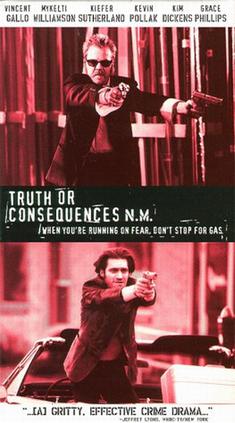
The name also inspired this movie, which I now have to watch sometime when very drunk.
The slogan, "Truth or Consequences" is going to have a much deeper meaning.  I have no idea what the humans will be guilty of, but either they or the Zygon leadership--or, more likely, both working together--will be guilty of hiding the "truth" about something, which will be why this rebel cell chose to start fighting back.  This is probably going to cause a shift in the Doctor's approach to the situation, at which point I don't know what is going to happen, but I'm very excited to find out.

I also loved the very slight nods towards human xenophobia.  While I still think that we're going to find out that the humans are guilty of some pretty messed up shit, there was the very interesting, but very brief mention that the Zygons got the idea that they wouldn't be welcome on Earth after watching our media and seeing how poorly we treat other human beings who simply have different colored skin.  I think the Zygons, upon seeing that, have good reason to think that we'd be dicks to a whole new alien race that we found on our planet.

"They even think that the phrase 'Black Lives Matter' is controversial.  Zygon lives are just fucked."
The return of Osgood teaches us that, once again, Moffat lies, as we were promised over and over again that the return of Osgood would not be explained away by simply saying that Missy killed the Zygon version of her.  Okay, that wasn't entirely a lie, but only if you're going by the strictest interpretation of all the words in the previous sentence.  Moffat perhaps can be accused of cheating a little bit by having another writer bring back a character that he killed off largely for emotional effect, but the frustrating thing is that it actually works quite well.  I can buy that the two Osgoods were so dedicated to this peace that they stopped differentiating between the two versions of themselves and just started to think of themselves as both being Osgood.  (They also both seem to have adopted an obsession with the Doctor as, much like his real life fans, both of the Osgoods seem to enjoy Doctor cosplay, now adding some 7th Doctor accoutrements to the Osgood outfit.)  I'm pretty satisfied with the explanation as it stands now for why Osgood is back, so hopefully the writers can just let it stand like it is and not try to dig too much farther, where they might risk ruining the delicate balance and a vaguely plausible explanation for bringing back a populare dead character.  However, as the writer of this episode, Peter Harness, found himself unable to foresee that his last episode would become viewed as an anti-abortion metaphor, I wonder about his ability to judge what will and will not upset fans and what they will and will not accept.

However I will give Harness some credit.  The episode was largely a predictable, by-the-numbers action movie plot with silly-looking rubber suits, but Harness did throw in some really fun ideas in this episode.  Most notably he understands that the most important thing about making an old monster scary again in Doctor Who is to give them new abilities.  Now that the Zygons have the ability to take on the appearance of their enemy's loved ones, we now have a much more formidable mindfuck of an enemy to take on.  Additionally, they now require far less technology to maintain their shape shifting (although "The Day of the Doctor" was really inconsistent about the rules governing their technology anyway), which makes them more agile, making them a greater threat.  In "The Day of the Doctor," they were really a side plot, so "The Zygon Invasion" is really only the second time in the history of the show that we've seen the Zygons at center stage of their own story.  As much fun as the 4th Doctor story "Terror of the Zygons" was, I think the reason they were not brought back again for so long was because they were seen as a pretty one-note villain.  "The Zygon Invasion" does find a few more notes to play, even if it's not exactly enough to conduct a full symphony.

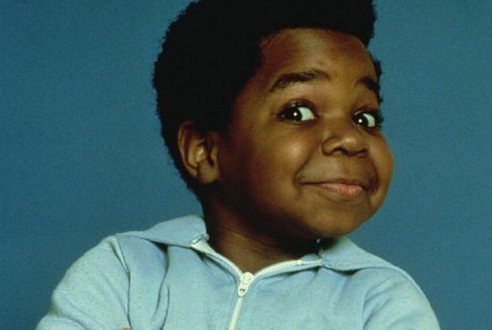
Funnily enough, that even looks vaguely like a Zygon.
I seriously doubt that whatever the larger arc is that we're getting into in this series--the Minister of War, The Hybrid, and whatever kind of circle-jerk that Missy is currently having with the Daleks--is going to have anything to do with this two-parter.  Despite how intimately linked this episode is with the 50th Anniversary Special, I don't think it's going to be linked very closely with any of the episodes that come after it.  Still, I look forward to part two.  It feels like classic series style campiness on a new series budget.  In fact, as this is now the fourth consecutive two-parter in this series, we're getting a bunch of stories that run about as long as the classic series stories, but with much more depth of character, much darker plots, and much, much better special effects.

And of course:


Diamonds and Guns: An Overanalysis of "The Woman Who Lived"

She looks like Zorro, if Zorro was a little girl.  Then again, so did Antonio Banderas.

Sorry about the lateness again.  I started a new job last week, and it requires a lot more mental energy than my last one.  On top of that, my new "companion" and I had the best Halloween weekend of our lives, so I was quite busy having fun.  But I'm here, and it's time to play catch up.  So, on with the show:

I've seen every episode of the classic series, and I love the classic series, but it never dove into the heart of the Doctor's character  the way that the new series does.  In fact, I would argue that the classic series's one and only real attempt to do a strong emotional character arc failed so spectacularly that it ultimately killed the show.  Well, okay, it wasn't the only reason the show was cancelled in 1989, but it was a big part of it.  (I could literally write an entire paper about the very complex confluence of factors that came together to cause the show's original cancellation, but its failed attempt at a Sixth Doctor character arc is certainly one of those factors.)  Some call it a sign that the classic series wasn't very good or that the writers didn't know how to write, but actually using very shallow characters to examine a fascinating scientific concept, thus putting the focus on the concept first and foremost, is kind of what science fiction has traditionally been all about.  Isaac Asimov is still considered one of the greatest science fiction authors of all times, and with very good reason (the Robot series notwithstanding), and his books featured virtually no depth of character whatsoever.  Getting deep into character like this is more of a characteristic of post-Star Trek science-fiction, a fusion of science-fiction with drama and melodrama.  Thankfully, Doctor Who's current writing staff are very good at what they do (yes, even Mark Gatiss, as mixed as my feelings are about him) and know how to blend that character depth and conceptual science fiction without sacrificing either side of it.  No, Doctor Who isn't hard science, as little real theory ever appears in the scripts, but it proposes some truly classic science fiction concepts, from 2-dimensional universes to the bootstrap paradox to the very concept of immortality.

"The Woman Who Lived" isn't the first time that the new series has shown us an immortal character.  As if conceding that, the episode even goes so far as to point it out in dialogue.  That Torchwood writer Catherine Tregenna penned this episode feels like another tip of the hat.  It's almost as if the show is specifically asking permission from its audience to do this again, which I appreciated.  However, the fact that they had done this before made me wonder about Ashildr's moments of forgetfulness.  The explanation given was that Ashildr has the Doctor's lifespan, but a human brain, making it difficult to retain all of her memories.  Yet, Captain Jack never had a similar problem.  Yes, it's true that Jack is about 1/8 the age of Ashildr at this point, but he can remember every detail in startling clarity, from his childhood on another planet through the entire 20th century until the present.  But Ashildr also has a child's mind, which might be a part of it.

Speaking of which, wasn't Ashildr a child when she was made immortal?  This made for a few terrifying implications when you think about it.  She lost three children to the Plague, but the stork didn't bring those babies to her.  Someone clearly had sex with her at some point, and most likely those weren't triplets, so it happened at least three times.  Furthermore, everyone seems to be flirting with her current incarnation, Lady Me, in a way that seems very inappropriate considering that she's trapped in the body of a child.  I did some research, and it looks like Maisie Williams was 17 when these episodes were shot, and yes, as anyone who had to read any Victorian literature in school knows, in past centuries dirty old men married teenage girls and it was treated like it was completely normal.

"You're almost 14 years old, it's high time I sold you into a marriage to one of my 50 year old business partners!"
But Maisie Williams was chosen for this role because of the fact that she looks a lot younger than she really is.  I don't think the character she plays on Game of Thrones is supposed to be anywhere near adulthood.  And Ashildr was referred to as a young girl in "The Girl Who Died." Hell, look at the title of that episode!  "The Girl Who Died"!  The follow up episode became "The Woman Who Lived" because, after 800 years, she certainly is a woman mentally, but physically she still looks like a child.  So...ew.

Ashildr is an interesting character to throw into the Doctor's path, because she understands him on a level that no other companion ever really has, other than possibly Romana.  Some of my friends thought it was a tortured logic that the Doctor uses to explain why the Doctor can't take Ashildr with him as a companion.  To me, it made perfect sense, he was just phrasing it more delicately than he phrased it in his head.  Perhaps this was another one of Clara's cards about how to be polite.  What the Doctor really meant to say was "I don't want to bring you with me because, if you're as immortal as I am, you'll never be that impressed with me, so I have no use for you."  Again, the only companions that even approached the Doctor's longevity were Romana, who was forced upon him, and Jack Harkness and River Song, both of whom he has refused to ever take on as full time companions (although, in a moment of weakness, he did ask River).  He has little use for an equal in his TARDIS.  He needs someone very different from himself.

The Doctor prefers companions that are weak and can die.  Preferably ones that can die often.
Speaking of companions, this was a weirdly companion-lite episode, to the joy of millions of Clara haters around the world.  It's obvious that Clara is gearing up for a really sad exit from the show, as a lot of the discussion about Clara is mirroring the discussions about Amy and Rory from their final handful of episodes in Series 7.  The Doctor is worrying about how close he's getting to Clara, and how hard it will be to lose her.  Moffat has hinted in interviews that her departure is going to be very big, very heartbreaking, and very final.  Will she become the first full-time companion since Adric (not counting expanded Universe) to actually die while travelling with the Doctor?  Because, if so, that's going to send shockwaves through his character, and take us to a darker place than we've ever gone before with the Doctor.

"Sam Swift the Quick," also known as "Sam the Redundant Who Always Repeats Himself" is saved in much the same way that Ashildr is, but the Doctor implies in dialogue that Sam may or may not have the same immortality as Ashildr.  This leaves a lot of potentiality open, or perhaps this was just Tregenna trying to explain away why Sam Swift will never be coming back.  But there's one thing I'm sure of that I said in the last write-up:  this is not the last we will see of Ashildr.  No way.  I don't think that she's The Hybrid that we keep getting hints about, but as soon as we saw her become immortal at the end of "The Girl Who Died," I was sure we were going to see her again after "The Woman Who Lived," and her brief appearance in the 21st century at the end of this episode confirmed that for me.  In fact, much of this episode felt like the enemy and the crisis in it was perfunctory, just thrown into the background while we spend most of our time chatting with Ashildr to set up her presence and her immortality so that we can bring it back around and use it again later.  Mark my words, Ashildr will be back.

And now, this!:


Friday, October 23, 2015

The Resist Stance: An Overanalysis of "The Girl Who Died"

If on your journey should you encounter God, God will be cut.
I stand by my belief that an episode being "co-written" by Steven Moffat is just a sign that Moffat wanted to insert some of the season-long plot arc's narrative into the script and give himself credit for it.  There was absolutely nothing Moffat-esque about this episode.  The episode wasn't particularly creepy, there was nothing darkly fantastic about it, and nothing mundane was trying to kill people.  There wasn't even really anything that rung of the writing style of Jamie Mathieson, who gave us last season's "Mummy on the Orient Express" and "Flatline," two episodes so good that it led both myself and my podcast co-host Shelly to start calling for him to become the next in line to Moffat's throne when he's ready to leave the show, even though Mathieson had only given us two episodes so far.  Really, there was nothing about this episode that was exciting and super fun, but it felt like it was a huge build up for something.  I have no doubt anymore that "The Hybrid" is this season's plot arc.  Now it's a question of where is it going, what does "The Hybrid" refer to, and, the clue I forgot to speculate on last week:  Who the hell is the minister of War?

THAT NAME IS SO METAL, MAN!
The episode, by and large, was setting up something, and I predicted that it was probably going to be the first part of a two-parter.  Moffat has told us that he's going to make it hard to tell whether something's a two-parter or not this season and, even though "The Girl Who Died" wasn't officially listed as a two-parter, I noticed that the episode following it was going to be called "The Woman Who Lived," and I assumed the titles were implying that they were connected.  Because now the Doctor has created something that has gone a step too far.  A young girl who can never die and, from the looks of what's coming up, will never even be able to age, suggesting that the chip the Doctor put in her head will interpret any sign of aging as damage and correct it, keeping her a child forever.

Trust me, Ashildr, it sucks!
Also, I was really excited when I heard that Moffat was putting into place Davies idea about why there are multiple Peter Capaldi's in the Doctor Who universe, and that Mathieson would be writing the first episode about it.  I even rewatched "Fires of Pompeii" that morning to get me prepared for "The Girl Who Died."  However, what came up could not have been the infamous plan that Davies thought up, and that Moffat asked him about when Davies called to compliment him about choosing Capaldi for the 12th Doctor.  Davies was thinking of writing this idea into the show at a time when there was no plan to make Capaldi the Doctor yet.  Davies's plan was supposed to be to explain why Caecilius and John Frobisher had the same face.  So either something's changed about the plan, or there's more to come about the connections between Pete, Pete, and Pete.

There have been reports out in the press questioning about whether Maisie Williams's character is going to be coming back after "The Woman Who Lived."  I feel like the idea of a girl who can never die is such an interesting idea that I can't see this just being an idea for a two-parter.  I feel like this has to come around to the larger season arc.

But how?  The dialogue hinted at there being some connection to The Hybrid, but a lot of dialogue in Doctor Who that hints at being connected to the larger plot arc turns out to be a complete red herring.  Remember the ending to "Vampires of Venice" where the Doctor pointed out that there was some strange silence in Venice?  Remember how that had absolutely nothing to do with what The Silence were (even though we flashed back to this moment anyway when The Silence were first identified by name)?  It could be a pretty simple mislead.  But The Hybrid is coming up a lot this season, which leaves me wondering, are the Daleks created in "The Witch's Familiar" The Hybrid, or is Ashildr?  Or were both mentions misleads and The Hybrid is something completely different?  If you think about it, a lot of things in the Doctor Who universe could be called hybrids.  Both Daleks and Cybermen are, by definition, hybrid creatures.  Donna Noble is a hybrid.  If you take the most hated line from the 1996 Doctor Who movie to be true, the Doctor himself is a hybrid.  So it could be anything.

It could even be...

I'm half attractive, half horrifying
I still stand by the fact that I think there's something more that's going to happen to explain the events of "Listen," so I do think it's possible that Danny is coming back some how.

Also, Davros was a little vague about this prophesy of The Hybrid.  What's supposed to be so terrible about it?  Why is the Doctor running from it?  What makes it so terrifying?

I made this blog primarily to make predictions about the show based on clues, and I totally forgot to pick up on the huge, huge, huge clue that was dropped last week, when O'Donnell, who like Osgood seems to be a real life Doctor fan (and who, liked Osgood, is dead because of it), mentioned a whole bunch of stuff that happened to the Doctor between 1980 and 2119 and she brought up one phrase that the Doctor did not recognize yet:  "The Minister of War."  Sure, it could be a throw away line that has no bearing on anything, but I really feel like Whithouse was just shouting "Clue!" at us pretty loudly at that moment.  It's possible that it's not a clue for this season's finale, as we all know that, in the Moffat era, big twists can be set up many seasons in advance ("Silence Will Fall," "The Woman in the Shop"), but I have a feeling that Missy is the Minister of War, possibly the title she's assumed by staying behind on Skaro to join forces with the Daleks.

Moffat hasn't left us this vague of a mystery in a while, but it's an interesting one to start speculating on.  I'm really curious to see where this is going.  Missy has a plan, I'm sure of it, the Hybrid is a dubious evil lurking in the background, and Ashieldr is now a poor, cursed girl who can never die or even age.  So what's the connection?  How does this all lead us to a season finale two-parter called "Heaven Sent" and "Hell Bent," the former of which is supposed to have no other actors but Peter Capaldi in it for the whole thing?!  I'm so curious about what Moffat is building here.  But I'm ready for the ride, because so far, it's been fun.  While this wasn't my favorite episode, I get the feeling it's building so, so, so much more, and I'm really intrigued to see where we go from here.

Next week, I look forward to Torchwood writer Catherine Tregenna becoming the first woman to write an episode of Doctor Who since "The Sontaran Stratagem"/"The Poison Sky."  Really, that writing staff has been far too much of a sausage party for several seasons now, and this season we have not one, but two different female writers for the first time in far too long.  Catherine Tregenna is the only writer to have been nominated for a Hugo award for working on Torchwood, so hopefully we're going to get something really special next week.  I really look forward to it!

And now, this!:


Saturday, October 17, 2015

Words and Guitar: An Overanalysis of "Before the Flood"

"I drink your milkshake!"
I've taken a lot of time to explain bootstrap paradoxes on this blog.  Mostly it's because I love the phrase bootstrap paradox.  It's my username on a couple websites, most notably, one of the larger Doctor Who message boards on the Internet, Gallifrey Base: 

I hope a lot of people tried to register with this name on Saturday!

So I was very happy to see the phrase show up in the beginning of "Before the Flood."  It's hardly the first bootstrap paradox we've seen in the show.  The Moffat era is riddled with them.  The Doctor getting himself out of the Pandorica is a bootstrap paradox.  The Doctor finding Craig's apartment in "The Lodger" was entirely thanks to a bootstrap paradox.  "Blink" is literally a bootstrap paradox from beginning to end.  So I'm glad someone finally gave an explanation of what it is so I don't have to explain it over again to every person I try to talk to about Doctor Who.

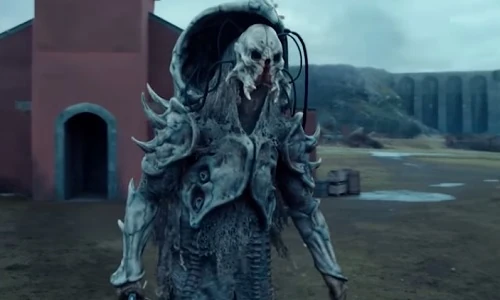
Part one of this story was a lot more exciting than part two, because part one was about building a very intricate mystery, and part two was about bringing that all back down to Earth and explaining everything.  But "Before the Flood," much like "Under the Lake," benefited from some really great work from multiple different departments.  Doctor Who doesn't particularly scare me much (with the delightful exception of The Silence) and almost nothing scares me in broad daylight, but this particular shot takes the cake for the only thing I've ever seen in any media that was still fucking terrifying despite being shot in broad daylight (or, well, cloudlight as the case may be):

MAKE IT GO AWAY!
Wow, the Fisher King was one of the most terrifying Doctor Who creatures I've ever seen.  This is not cheap prosthetics, this is a very well thought out and detailed construction of someone's worst fucking nightmare.

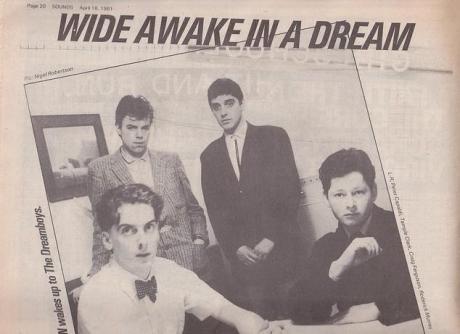
The Doctor's electric guitar is, thankfully, becoming a recurring part of the 12th Doctor's persona, with clips from next week's episode, "The Girl Who Died," showing brief flashes of it as well.  The 2nd Doctor was known for playing a recorder sometimes when he was trying to think, while the 12th seems to absently strum at an electric guitar with his special sonic sunglasses for much the same reason.  Regardless of how much cooler the guitar and sunglasses may seem to us than the recorder, its all ancient artifacts to the Doctor.  Yet, somehow it seems so appropriate that the man who is tied for the oldest actor to ever play the role would adopt such a "cool" look to him.  And why not, if it's Peter Capaldi.  He's a total punk rocker.  He was in that band in a punk band when he was younger with Craig Ferguson.

What's even more freaky is that the guy on the right is Geoff Peterson.
Peter Capaldi can pull it off because we know that that's who he is.  Have you ever known someone who had been a big punk rocker in their teens once they got older?  Because I know quite a few of them, and they all remind me of Peter Capaldi.  I'm glad he's building a persona for this particular Doctor, and I'm glad that it seems to reflect quite a bit of Capaldi's real personality.

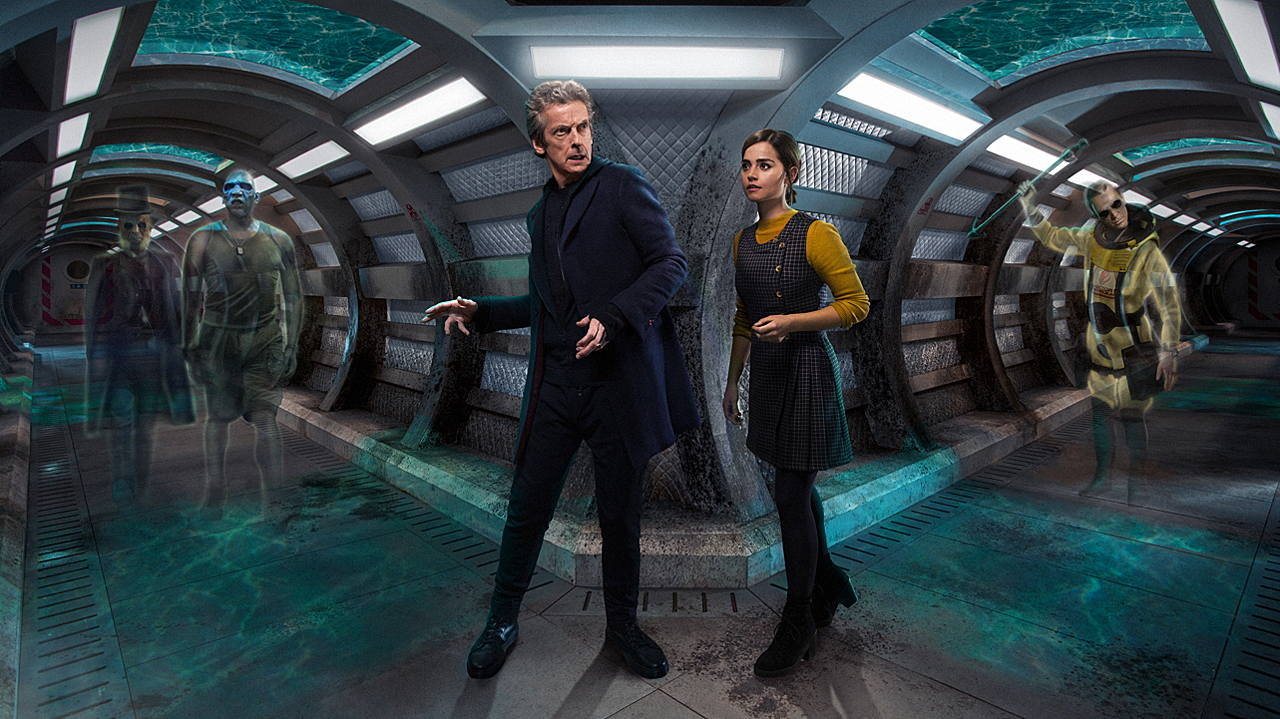
Last week I was left confused as to why the ghosts had no interest whatsoever in Lunn.  This week, when Clara figured out it was because he was the only one who hadn't seen the writing yet, I literally had to smack myself in the head for never having figured that out.  I guess you are a smart one, Clara.  I felt an equal smack to my head at the reveal that the Doctor's ghost was a hologram, after we had already established that the Drum can create holograms.  Wow, I feel like a doofus now.  I had already figured out that the Doctor was in the stasis chamber, but admittedly only because I had seen someone else guess it on Facebook and said "Oh, yeah, of course, that's who's in there."  It was an interesting take on the concept of fixed points in time.  It's not the first time that the Doctor has found a way to change the future by simply tweaking and modifying events he knows are going to happen but creating a scenario in which he doesn't have to die.  He essentially found the same loophole out of his death at Lake Silencio.  History said that the Doctor had to be there on that beach, and that someone looking like the Doctor had been killed, but that was it.  As long as he found a way to keep all of that true, nothing negative happens if he still walks away from it.  I liked that trick in "The Wedding of River Song" (regardless of what anybody else thought about it), so I liked it again now.

I keep trying to figure out if there's any larger plotline that this episode is setting up for farther down the road.  Frankly, there isn't a very clear indication that there is an overarching plot.  I'm presuming that Missy staying behind on Skaro in "The Witch's Familiar" was probably part of a set-up for the season finale.  I'm also guessing that the prophesy of the hybrid from that same episode is part of a set-up as well.  But other than that, I've seen nothing else in this season that is very clearly constructing a mystery or a plot arc that is leading us towards something specific.  I haven't seen this from Moffat since his largely disappointing series 7, which I found to be his weakest season-long plot arc if for no other reason than very little was done to advance the larger plot arc as the season moved along.  Yet, this series, so far, has me mesmerized.  So I'm hoping that we're moving towards something a little larger, a little arc-ier.  Is that a thing?  No, it's probably not.

And the next episode will likely grant my wish.  As I write this, it has technically already finished airing in the UK (sorry, I'm late again), but I'd heard reports before that "The Girl Who Died" would finally explain to us the big mystery of why Peter Capaldi's face appears three different times in the Doctor Who universe.  I've just rewatched "The Fires of Pompeii" because I understand that "The Girl Who Died" is going to call back to it somehow.  How, I do not yet know, but I'm thrilled to see what it is!  An idea thought up by Russell T. Davies, executed by Moffat, with the assistance of my first choice to follow Moffat when he finally does leave, Jamie Mathieson.  All with Maisie Williams as a guest star.  I can't wait to see where we're going with this.


Saturday, October 10, 2015

The World's a Mess; It's in My Kiss: An Overanalysis of "Under the Lake"

Day Mode.  Whoa-oh.  Fighter of the Night Mode.
Every time I try to think about why I love "Under the Lake," words and specifics fail me. I can't really give a good reason why it's special, why it's anything more than a middling, filler episode. There's not a huge, glaring reason to point to why this episode is significantly better than some of the other "Who cares?" boring episodes like "Curse of the Black Spot," or "Rings of Aka-Something or Other"--or, to pull from the same writer as this episode, an episode like "Vampires of Venice." And yet, every time I go back to rewatch "Under the Lake," I fall in love all over again. I don't know what it was I loved about this episode. Perhaps it's that the show's brilliant music producer, Murray Gold, has outdone himself yet again with this episode. Perhaps first-time Doctor Who director Daniel O'Hara is just the best director the show has ever seen and we've just never seen him before. Perhaps it's the stellar performances all around, including the most dignified characterization and portrayal of a deaf person I have ever seen seen in media (admittedly, I've never seen Children of a Lesser God). Perhaps it's that Toby Whithouse is a pretty amazing writer, albeit with a few duds here and there. Or maybe it's a combination of all of those things that results in an episode that fires on all cylinders.

It was so exciting that, at the point of the episode where the Doctor looks at the ghosts and says "What are you?" I caught myself literally saying the same thing as the Doctor at the exact same time. He owes me a coke.
I only accept Mexican Coke, Doctor.  Fuck corn syrup.
Toby Whithouse has been rumored more than once to be the successor to Steven Moffat for when he's ready to leave the show.  Moffat has not really given any indication that he's quitting anytime soon, but Whithouse has been thought of as a natural successor.  As I've been mostly saying I just want #anyonebutgatiss, I'd be happy to see Whithouse take over.  If we think back on his few episodes he's written, there are some pretty good ones.  He brought us the fun romp of "School Reunion" where he triumphantly brought back the most popular companion(s) of the classic series.  "The God Complex" is one of the smartest episodes of its or any other season.  The worst episodes he's written, "Vampires in Venice" and "A Town Called Mercy" are really only guilty of being dull, never of being silly or stupid.  Perhaps "Vampires in Venice" was always as riveting as "Under the Lake" in Whithouse's head, and the director and cast could never fully pull off his vision.  Whithouse is, of course, also responsible for the show "Being Human," which I still need to go back and finish, but which I do highly recommend (what I've seen of it, anyway) and I've even heard positive comments about the American adaptation of it.  So, overall, I wouldn't hate it if he took over for Moffat eventually.  Him or Jamie Mathieson.  Or Neil Gaiman, but that's a pipe dream and we all know it.

Whithouse is already building his own trademarks, though, as this episode actually sees the return of a species he created for one of his previous episodes.  Remember the Tivolian from "The God Complex"?  The most invaded race in the galaxy?  The one who surrenders so easily that their planet's anthem is called "Glory to <Insert Name Here>"?  


It's like having an entire planet full of Adrics!
Yeah, in case you didn't catch it because he was speaking so fast, the Doctor did identify the first ghost in this episode as another Tivolian, and points out how odd it is for them to become violent like that, because they're known for surrendering so easily.  The Tivolian is named "Prentis," something we only know so far from press releases and credits, because he didn't speak a single time in this episode, but he's clearly meant to be a much larger character in the next episode.  Creating your own recurring species?  That sounds like someone is setting up the Doctor Who universe for some plans he has down the road when he becomes showrunner.  However, where Steven Moffat did that in the Davies era with some of his creepier monsters like the Weeping Angles, Whithouse's creation of the Tivolians seems less terrifying, and more Terry Pratchett-esque in nature.  (The girl I'm dating has me reading the Night Watch books.  I'm hooked.)

I keep trying to think up some way that this episode is going to link into larger plot arcs in the greater series, and I keep coming up with nothing.  I get the feeling this two parter is probably going to be self-contained, but then again, you never know.  Remember how much "The Rebel Flesh"/"The Almost People" felt like a self contained episode until about 30 seconds before the ending?  I keep wanting the coordinates that the ghosts are shouting out to be the coordinates to Gallifrey, but try as I might, I can't quite get that scenario to make sense in my head, and I don't think we're going there in the next episode.


In the next episode, the Doctor blindly follows the coordinates like an idiot following a GPS.
Also, I have to take a moment to acknowledge the brilliance of the Doctor's cards.  Not just a great one-off joke, but also something that really taps into who the Doctor is right now as a character.  Plus, one of them, if you freeze frame the episode, is a joke about the Fourth Doctor dropping Sarah Jane Smith off in the wrong town, something that Toby Whithouse also referenced when he brought Sarah Jane back in "School Reunion."

I also have to give Whithouse some real credit for his diversity of characters.  In "The God Complex," I was very impressed not only that he included a Muslim woman as a character, but that in an episode about religion, Islam was the only major, real-life religion actually referenced.  Whithouse gave a lot of dignity to a religious and ethnic minority that is often maligned in media, and I thought it was very refreshing.  He does that again, this time for the hearing impaired, as Cass is not only a strong and capable deaf woman, but one that the Doctor refers to as the smartest person in the room.  She's a powerful leader, and a loyal one to her people, too.  I think Whithouse should be applauded for that characterization.

I'm really curious to see what these ghosts are.  They aren't just going to be ghosts.  As the Doctor already figured out, these are not a naturally occurring phenomenon.  Someone has created this situation, and trapped these souls somehow to be used as communication tools.  The Doctor is tremendously curious right now, and his curiosity is infectious.  But, in the end, they're not going to be significantly different than other types of "ghosts" we've seen in Doctor Who, from the digitally saved consciousnesses in "Silence in the Library"/"Forest of the Dead" or even in "Dark Water"/"Death in Heaven," to the psychic impressions left behind in Amy's house in "The Pandorica Opens," to the woman trapped in time in "Hide."  The Doctor is thrilled about finally having found real "ghosts, but ultimately, these souls are somehow trapped in something that's specifically linked to this ship, and that's going to turn out to be very technological, not otherworldly.  In Doctor Who, the explanations are almost always scientific and never otherworldly (with the ambiguous exception of "The Impossible Planet"/"The Satan Pit"), although, as we were reminded back in "The Shakespeare Code," there's a thin line between science and fantasy in the Doctor Who universe.

A theme that Whithouse is playing with here, and one that I don't think is seized on enough, is the idea of the Doctor as an adrenaline junkie.  Clara's catching it, too, and it's starting to scare the Doctor, as witnessed by his little speech in the TARDIS.  But clearly, there's a sense that the Doctor is too invested in his own thrill seeking right now, and the ghost of his future self that appears at the very end of the episode suggests a Doctor that inevitably lets his addiction to adventure take him down a dark and dangerous path.  In a way, he lost his last set of companions, and I don't think he's going to take it very well if he and Clara are separated, not by choice, but by force.  The Doctor might be learning by the end of part two that he needs to slow down a little.  But while he may have to, the pace of this two-part episode doesn't have to slow down at all, and I'm excited to see where it goes from here.

When I first heard the "I want to kiss it to death" line in the trailer, it really bugged me, but I like it in context.  So in honor, here's a little X!:


Mercy Me: An Overanalysis of "The Witch's Familiar"


Maybe if I stand in the most effeminate position possible, they won't see me...

I guess I have some apologies to make.  I've got some catching up to do, which is partially due to some slight ambivalence about this blog, but also partially due to being somewhat busy with a new relationship starting up.  And I've been trying to get her caught up on Doctor Who as well so we can watch it together but, ironically, she kept falling asleep during "Last Christmas."  I spend the whole of my weekends with her, so I won't really be able to watch the new episodes on the day they come out until she's caught up, which she will be soon.  Until then, I'm going to play a little catch-up.  So sorry that this blog is about a week late.  I'll work on that.  For now, on with the show:

The Daleks have always been a moral quandary for the Doctor.  The Doctor is the ultimate pacifist, at least in his philosophy if not always in his actions. His goal is always to prevent as many deaths as possible, including the deaths of his enemies.  The Daleks have shown up to throw a wrench in this philosophy more than once, because if your enemy serves absolutely no purpose in the Universe other than destruction, should your pacifism extend to them? He's been fighting the Daleks for almost 2,000 years now, and he has still failed to come up with a definitive answer to this moral dilemma.  Each regeneration seems to attack the problem again and each regeneration comes up with a slightly different answer.  That can be expected, as there isn't an easy solution to the quandary that the Doctor faces.  But when the option comes up in the shape of the opportunity to murder a young boy who hasn't done anything yet, the Doctor finds the question even more troubling than usual.

Could you kill baby Hitler!?  Look at him!  He's adorable!
My new go-to question whenever I have the honor of meeting one of the actors that has played the Doctor is to ask them what they think is consistent across all the very, very different incarnations.  I didn't think of this question until after meeting Colin Baker, so I never got to ask him, and when I asked Peter Davidson and Sylvester McCoy the question McCoy copped out and avoided the question with a "Well, that's the writers' job."  (You do Shakespeare, McCoy, I know you give more thought than that to your characters!)  However, Davidson gave a very interesting and insightful answer about the Doctor's recklessness.  If you ask me, the two traits that are consistent to all of the Doctors are curiosity and compassion.  That second one is big, even with regenerations like 6, 9, and now 12 who are notorious for how rude and pompous they can be to other people.  Their compassion may not be the first thing you notice about them, and they may not be the kind of person to stick around and put a blanket around you after they've saved you, but it's still very important to them to rescue all living creatures and ensure their survival.  Even when the Doctor's not particularly nice, he's still full of love and compassion, even for someone as terrible as Davros.

I've said before that I think the 12th Doctor is embarking on the redemptive arc that the writers originally planned for the 6th Doctor, the one that was never carried out due to Colin Baker's era nearly getting the show cancelled.  The low ratings, combined with the fact that the average fans were starting to agree with the conservative fanatics who thought Doctor Who was too dark and violent, led the production team to quickly cancel their plans and scramble to find solutions to save the show.  Their first solution was the bizarrely nonsensical "Trial of a Timelord" story arc, which only made things worse.  The abrupt firing of Colin Baker and hiring of Sylvester McCoy bought the show a few years of mercy from the BBC, but not much, and the show only lasted a few more years.  In the meantime, the long redemptive arc that was planned for the 6th Doctor never got carried out.  At the same time, though, I wonder if Jonathan Nathan-Turner and Eric Saward had the talent to carry off such a delicate arc.  Steven Moffat, on the other hand, does, and "The Witch's Familiar" is the episode that really makes it clear that we've set off on that path.  The Doctor is really trying to figure himself out, what his morals are now, if he is a good man, and if he's stronger than the darkness in his heart.  Never is that put to the test quite as much as it is in this 2-parter, and thankfully, the Doctor passes with flying colors.

Missy is having a big ball of fun in this episode, and we finally get to see how she managed to survive the end of "Death in Heaven."  Considering her quick return, I can only assume that Steven Moffat has been planning this for quite a long time.  The only real complaint that anybody (anybody with taste, anyway) had about Missy in "Dark Water"/"Death in Heaven" is that there wasn't nearly enough of her, especially considering that we got a chance to get to know John Simm's Saxon Master over a 3-part episode.  Granted, he only showed up at the very end of the first part of that episode, but it still means we got much more of him, as the reveal that Missy was the Master didn't even come until the end of the first part of her two-part introduction.  Finally, "The Magician's Apprentice"/"The Witch's Familiar" gives us some time to get to know Missy.

Doesn't she just look so inviting?  Don't you want to get to know her better?
As delightfully warped as Michelle Gomez's performance of Missy is, she also proves herself to be incredibly intelligent.  She has a very different moral compass from the Doctor, but that's about the only difference between them, as Missy demonstrates that she has as much intelligence and ingenuity as the Doctor.  Clara, in this episode, serves more as a companion to Missy than the Doctor, hence the title of the episode, making it the first time since the 1996 movie that the Master has truly had his own companion.  Missy's explanations of the Dalek homeworld and how it functions sound quite like the Doctor's explanations, but with the added danger of being willing to murder anyone without a moment's hesitation.

Michelle Gomez brings out a very interesting aspect of the Master that we've never really seen before.  We've known since back in the 3rd Doctor serial, "The Sea Devils," that the Doctor and the Master had been friends once at school, and we've seen glimmers of that friendship before.  There's been a begrudging respect between them, and a few temporary truces so that the two former friends can put their heads together to defeat a common foe, but Missy is the first version of the Master to make it absolutely clear how much the Doctor means to her, and is adamant that her multiple attempts to murder him over the years do not change how she feels about him.  Perhaps it's that her last regeneration (presumably) met his end trying to protect the Doctor (a long lost 3rd Doctor era plotline that Davies finally brought to fulfillment), but Missy genuinely cares about the Doctor.  In "The Magician's Apprentice" she expresses her friendship with the Doctor and explains why it isn't a contradiction to two people as ancient as herself and the Doctor, but it's only in "The Witch's Familiar" that she puts her money where her mouth is and mounts a rescue mission to save the Doctor.  In a way, she almost becomes a second companion in this episode, which is extremely refreshing.

Now, some people may have had a moment of hesitation that the Doctor is surprised at Clara's ability to get the Dalek tank to say the word "mercy."  Most notably because of this famous scene, which was also written by Steven Moffat:


This made me do a double take as well, because clearly, River gets the Dalek to say the word "mercy" a long time ago.  However, it occurred to me, the Doctor wasn't present for this scene, as he was busy wiring his vortex manipulator into the Pandorica.  (That might be the nerdiest sentence I've ever written.)  River is a brilliant woman, who knows a lot about the Universe, and certainly more than the average companion, but in many ways she is still a companion.  It makes sense that she wouldn't know as much about Daleks as the Doctor does, and that she would not notice that it was strange for a Dalek to know this word.  There's a good chance that she never got around to telling the Doctor about the time she made a Dalek beg for mercy, as whether or not he approves of this will largely depend on what mood he's in.  Even if she did tell him, it seems likely that he wouldn't have believed her.

The bigger discrepancy is this, which is also Steven Moffat's writing:


We don't actually see a shot of the Dalek from the outside saying the name "Oswin Oswald," but we do get it saying "I am not a Dalek" and a few other things which it seems, from Missy's demonstration, would be impossible.  Similarly, "Into the Dalek" features a Dalek saying a lot of things that "The Witch's Familiar" implies would be impossible for a Dalek casing to be able to interpret.  It's worth noting that Moffat is also credited as a co-writer on "Into the Dalek," although I do believe that's largely because Moffat gave himself partial credit for every episode in Series 8 where he threw in a little bit of story for the overall plot arc.

So yes, Moffat has created a bit of a plot hole here.  There are ways to rationalize this away.  We could say that this is a trait particular to the newly revived Daleks from after "Victory of the Daleks," but more likely than not it's just because Moffat decided that it was convenient to the plot, so fuck all those scripts he wrote in the past.  Personally, I think Moffat and Davies together have patched up almost every major plot hole leftover from the classic series, including the bizarre prophecy that the Valeyard would appear between the Doctor's "12th and final incarnations," and because of that I think Moffat can be forgiven for leaving a few very small holes of his own.

I got the distinct feeling that this episode was setting up the season-long plot arc for Series 9.  It would be very unlike Moffat to leave the series without a larger, overarching plot, and the stuff about the prophecy of the "Hybrid" sounded far too foreboding and interesting to leave it where it stands right now, especially considering that Missy continued to reference the prophecy after the Doctor had already defeated Davros.  At first, I thought the prophecy sounded too mystical for as scientific a race as the Time Lords, much like their "Visionary" from "The End of Time," but I decided that a time travelling race could have many non-magical or mystical ways to predict the future and see a "prophecy."  The fact that Missy said that she had just come up with a very clever idea once she was cornered by the Daleks seemed like it was also pretty clearly Moffat setting up a larger plot arc, with a return for a Dalek attack led by Missy later this season.  Remember, the Master has teamed up with the Daleks before, and last time the plotline was cut short due to the untimely death of the actor, Roger Delgado, so we never really got to see what comes of a Master/Dalek team-up.  Perhaps this is another lost plotline that Moffat intends to finally bring to fruition.

I've decided to do a little thing that's fun for me.  This series, I'm naming every Overanalysis after a punk song I like (that I think is appropriate) then putting the song at the end.  So, enjoy!


Saturday, September 26, 2015

Song for Your Enemy: An Overanalysis of "The Magician's Apprentice"


I was done, guys!  I was done writing this stupid blog.  I'm not entirely sure that anybody is reading, that anybody cares, or that there's any point to writing this stupid thing.  But then Steven Moffat wrote this little present for me, gift-wrapped it, and just dropped it in my lap and dared me to understand it.  What he seems to have given to me, and to all of us, is the long awaited spiritual sequel to the 1975 Tom Baker serial, "Genesis of the Daleks," where a gentle retcon of the Dalek backstory introduced us to Davros, the creator of the Daleks.  Frankly, I'm shocked that Moffat thinks that fans who have never seen the classic series have enough understanding of who and what Davros is to be able to follow this story just from what they learned about Davros from "The Stolen Earth"/"Journey's End."  But like the handmines (such a creepy idea!) that rose up from the ground to trap young Davros, Moffat's most epic script to date grabs us and refuses to let go, and I felt compelled to give another overanalysis this time around.  Perhaps the Horror of Fan Blog will live on this season.

We're going to go over the plot of "Genesis of the Daleks," which is actually a good, if overly long, classic series serial, so if you want to see it and never have, you'll want to stop reading.  But I'm going into it, because it's an important part of what we're talking about here, and I know that some people who read this blog have not watched all of the classic series and may be a little lost.

Genesis!
In "Genesis," the Time Lords intercept the Doctor and his companions and give him a mission:  To go back in time to the creation of the Daleks to either keep them from ever being created, or to change their development so that they never become such destructive, brutal killers.  The Doctor goes back to the end of the war that created the Daleks, the war between the Kaleds and the Thals on the planet Skaro.  Davros, the head of the Kaleds' science division, has promised his army a great and powerful new weapon:  The Daleks.  What they really are are genetic experiments that Davros has created out of the mutated remains of Kaled DNA left behind after the war turned nuclear.  He considered them to be the ultimate life form, which I always thought was strange considering that they were made partially by accident, and are incapable of surviving outside of a large metal shell.  But he created them to be the ultimate, genetically superior life-form and designed them to believe that it was imperative for them to kill all other lesser life forms, including Davros's fellow Kaleds.  He didn't care about winning the war for the Kaleds, he only cared about creating his Daleks, and beginning his great war against all other life in the Universe.  Unfortunately for Davros, when he designed the Daleks to want to destroy all other life in the Universe due to its inferiority, he forgot to teach them to treat him as the exception to that rule, and his Daleks turned on him and killed him, for the first time.  In fact, almost every Davros episode ends with his death, only for the following episode to show him resurrected with a hastily slapped together explanation.  Anyway, at the end of "Genesis of the Daleks," the Doctor finds himself unable to halt the Daleks' creation, and explains it to his companions with the following speech:


"If someone who knew the future pointed out a child to you and told you that that child would grow up totally evil, to be a ruthless dictator who would destroy millions of lives, could you then kill that child?"

Let's kill Davros!
If Davros and Moffat were both being a little too subtle about the links between this episode and "Genesis," they both played back that clip from that episode, and even went so far as to make sure that it was the one and only clip that was played alone and was focused on.  The plot of "The Magician's Apprentice"was literally laid out in another episode 30 years earlier.

Absolutely no explanation is given for why Davros is still alive, when we last saw him die at the end of "Journey's End." This is probably for the best because, when I'm in the middle of a great episode like "The Magician's Apprentice," the last thing I want to think about is a masturbatory shit show like "Journey's End."  There may still be some cursory explanation given in "The Witch's Familiar," but I got the impression that Moffat is past caring at this point.  Considering how flimsy the explanations always are on this show when a character is brought back from the dead, why not just gloss over it entirely?  Frankly, Moffat has been glossing over a lot of the details about the Daleks.  After giving Gatiss the task of bringing the Daleks back on a more permanent basis than they had been in the Davies era, the Daleks re-established themselves as a power in the Universe quite quickly, and the fact that they had ever been gone from the Universe was pretty much forgotten.  In "Asylum of the Daleks," some of the Daleks in The Asylum were survivors of classic series episodes, which is impossible considering that the new Dalek paradigm is made up of a completely new set of Daleks made from The Progenitor.  The Seventh Doctor tricked the Daleks into destroying their own planet, Skaro, back in "Remembrance of the Daleks" in 1988, but yet it seems surprisingly in tact in the 1996 movie, in "Asylum of the Daleks," and now in "The Magician's Apprentice," and nobody seems to care to explain it.  Viewers can plug in their own explanations, whatever they may decide those to be.  This is postmodern Who.  We have no time left for explanations.

Besides, in a Universe where Rory, Clara, and Jack can all die over and over again, who cares anyway?
Missy's return, however, is a little bit more immediately on our minds, her death only having happened about two episodes, and Moffat made sure to acknowledge her surprise return from the dead, even if that acknowledgement quite deliberately refused an explanation, and an explanation was not immediately forthcoming. I think her explanation isn't going to get glossed over at all, and that there will be a real reason why she's come back.  Moffat has a pretty big long game that he's been thinking about for a while now, and I think that Missy is more than just a passenger on this adventure.  Moffat has a great grasp on the Doctor/Master relationship, and Missy's description of it being infinitely complex was pretty perfect.

Oh, and by the way, Moffat has made a lot of very every day things scary over the years:  stone statues, dust in the shadows, WiFi, etc.  I have to say, though, 80's one-hit-wonders were not something I thought he was ever going to try to make terrifying.  Oh boy has he, though:

To be fair, though, this video was pretty creepy to begin with.

But Missy is playing a game here that we're not in on, and I wouldn't be surprised if she has a lot more to do with this than we originally thought.  The last few moments of this episode felt strangely dreamlike, with a strange sense of impermanence to everything.  Maybe it's just because both Clara and Missy were killed off, and we all know that that Moffat won't let that stand by the end of "The Witch's Familiar," so something about their death felt unreal.  The fact that Missy practically invites her own death, as well, makes me feel like something strange is up, as that's largely out of character for her.  The larger point that Davros is trying to make here isn't that far from the point that Missy was trying to make to the Doctor at the end of "Death in Heaven."  I wonder if perhaps everything we're seeing here is an extension of the lesson that Missy has been trying to teach the Doctor, and that a lot of this is an illusion, or possibly just a situation she set up.  Maybe Missy got her hands on some dream crabs.  In all of these scenarios, though, I remain cautiously optimistic because, like I said at Christmas, I think Moffat knows he can't use the dream crabs and things like that to Dallas too much of the show (yes, "Dallas" is now a verb) without a pretty big fan revolt.

By the way, if anyone is wondering where I came up with the title for this blog post, it's from an album that I've been listening to lately with quite obsessive fervor, American Spring by Anti-Flag.  The particular song, "Song for Your Enemy," keeps playing in my head when I think of this episode, and somehow, they remind me of each other.  You can hear it for yourself:


In the season to come, we have the promise of an explanation for the Doctor's face that Davies thought up and never implemented before leaving the show, we have the return of Jamie Matheson (co-writing an episode with Steven Moffat!), a guest appearance from Game of Thrones star Maisie Williams, and an episode to feature the Doctor alone without another character appearing in the entire episode, as well as the triumphant return of River Song for the Christmas special!  Moffat promised that these episodes will bleed together in such a way that it will be hard to tell when something is or is not a 2-parter, which is exactly the way I want to see this show run.  The "no 2-parters" rule from series 7 has mercifully been thrown out the window.  I never thought that rule was really Moffat's idea, and it feels like he's finally returned to what he knows he excels at.  At the end of Season 7, I wondered if Moffat had lost his touch, but I no longer feel that way and I have a feeling that this season is going to be as epic as its opening.  So Geronimo! 

Saturday, December 27, 2014

Screw Dave: My Love Letter to Shona McCullough from "Last Christmas"


On Christmas night, I have to admit to falling in love.  No, not with a real woman (I'm visiting family, there wasn't much chance of me meeting someone here) but with the most awesome side character in Doctor Who's recent memory.  Played by Faye Marsay, Shona McCullough proved to be the most memorable character of the Christmas special, beating out the appearance of the son of a former Doctor, and possibly even outshining Santa Claus himself.  Early reviews told us to expect great things from this Fresh Meat actress, early articles speculated that she might be the next companion before reports and the plot of the episode confirmed that Clara was coming back for season 9, and Dan Butler over at What Culture already put together a list of 10 reasons why Shona should be a companion.  While the episode ended up with Clara rejoining the Doctor, while Shona simply awoke to her horror movie/Christmas movie marathon in her messy apartment (which somehow made me love her even more), that doesn't eliminate the possibility of Shona coming back someday.  Need I remind you:

DOCTOR: Well, you could always
DONNA: What?
DOCTOR: Come with me
DONNA: No.
DOCTOR: Okay.
DONNA: I can't.
DOCTOR: No, that's fine.
DONNA: No, but really. Everything we did today. Do you live your life like that?
DOCTOR: Not all the time.
DONNA: I think you do. And I couldn't.

Donna first showed up in a Christmas special, like Shona, and later returned to become a full time companion, despite turning down the position the first time it was offered to her.  Also, lest we forget:


Jenna-Louise Coleman's gap between her first appearance as one of the Claras and her second was probably a lot more intentional than the reappearance of Donna as a full time companion a year later, but it shows that Doctor Who is perfectly okay with leaving a character behind only to pick them up again later.

My crush on Shona was because of so many things.  First, she danced into our hearts in a wonderfully, quirky, ridiculous dance that Faye Marsay, on her own Twitter account, referred to as "The Shona Shuffle."  However, as a Google search for that phrase turns up a drag queen named "Shona Shuffles," some people are calling it "The Shona Shake" or simply "The Shona."


Then, despite not being an actual scientist, as the Doctor figured out early, she proved herself to be inquisitive enough to be one.  Her interrogation of Santa was rational and unrelenting, continuing to question everything around her, but not fully discounting the possibility of Santa being real.

And that she woke up in the midst of a filthy apartment with a good day of proper media binging ahead of her made her just my kind of girl!  I'd gladly cuddle up for a quiet Christmas with Shona and watch some horror movies.  Screw Dave.  Dave doesn't deserve to be forgiven.  Do you remember what Dave did to you Shona?  C'mon.  Give Trevor a call.

That got weird for a second, there.

But my point is, there's no good reason to go searching for a new companion at the end of season 9, which looks likely to be Clara's exiting point.  The next companion is already here, waiting for the Doctor to come whisk her away.  She has little difficulty dealing with the 12th Doctor's particular brand of crass rudeness, she is smart, quirky, funny, and clearly someone who is a lot of fun.

When it's time for Clara to go, I think it's time for Shona to step on board the TARDIS.

Friday, December 26, 2014

Back Door Santa: An Overanalysis of "Last Christmas"

Last Christmas, I gave you my heart
The very next day, you gave me crabs...

Have you ever asked yourself the question "Hey, what if Inception was a Christmas movie?"  No, because you're a normal person.  Steven Moffat, not being a normal person, answered that question for us that nobody was asking.  A dream within a dream within a crab, all with Santa Claus thrown in.  Moffat did keep his promise when he told us this was the weirdest episode he had ever written, but I wasn't quite ready for just how bizarre it was going to be.  He promised us a story that combined "The Thing" or "Alien" (depending on which interview with Moffat that you read) with "Miracle on 34th Street," and he delivered on that.  Moffat clearly loves Alien, as evidenced by his brilliant references to it in the Coupling episode "9 1/2 Minutes," his choice of casting John Hurt as the War Doctor, and his both subtle and overt references to it in "Last Christmas."  That's really a better way to describe "Last Christmas":  Alien meets Inception with Santa Claus thrown in for good measure.

But he also promised us a few things that were outright lies, something I keep forgetting to expect from him, even though I made it a rule right at the top of my blog.  He told us that the Doctor and Santa were old friends, or rather old enemies.  Seeing as how Santa was actually a figment of everyone's collective imaginations, that particular Moffat statement was designated a lie.  Capaldi gave us a nice lie in an interview, too, promising Santa would remain "in tact" at the end of the episode and wouldn't be anything "sci-fi."  True, there's a hint at the end of the episode that Santa might still be real, but that's not the same as keeping him "in tact" and, overall, the explanation of him was particularly "sci-fi."

The Dream Crabs are continuing with a popular Moffat theme of a creature whose power is linked to your own perception of them, like the Weeping Angels and the Silence.  The continuation of this theme is so strong that I'm left almost tempted to say that he's gone too far with it, but the Dream Crabs are such a creepy variation on this theme that I'm willing to forgive it.  A creature who can only attack you when you are thinking of them?  Try not to think about pink elephants.  That's possibly the most terrifying idea yet, as at least the Silence and the Angels have a comparatively easy way to keep them at bay: simply keep an eye on them.  Trying not to think of something is nearly impossible.

The real solution to the Dream Crab problem!

By about halfway through the episode, I was left wondering why Santa was even there.  What purpose was he serving other than Steven Moffat's assertion that he wanted to see Santa and the Doctor standing side by side on screen together.  While Moffat proved to be lying about the Doctor and Santa knowing each other from way back, they did have an interaction like they did.  Santa and the Doctor had an instant chemistry, one that left me wanting to see more of it.  Nick Frost was a perfect Santa, and his appearance in the opening credits was well deserved.  He was very much a star of this episode.  Santa, the dream that tries to save you.  What better dream could you have?

I was wondering how Samuel Anderson (Danny Pink) had been signed on to do the Christmas special so many months back, and then his character died off in "Death in Heaven."  Now we know.  That's the fun of killing off a character when the actor playing them is actually still alive:  you get to do fun things like bringing them back in a tempting dream sequence.  But I still don't think Danny is done yet.  Moffat recently gave an interview in which he explained how "Listen" could have made sense even if Danny Pink never comes back, but everything about his explanation just screamed "I don't mean to say that any of this is true."  He didn't even give us a lie, he gave us an explanation that we could tell even he didn't believe.  Somehow, he's coming back.  How?  I don't know.  It's going to be hard.  Rory's return from the dead seemed easier; his death always seemed tenuous.  Whether it was because he died saving the world, or because it was part of the end of a season, somehow Danny's death felt more permanent.  But something has to give to make "Listen" make sense.  And because of "Listen," it won't feel cheap, because we know it's been setup all along.

If you expect me to stop making this joke, you're going to get very...irritated.

A lot of the press around this episode left us wondering if Clara was going to be leaving after this special or not.  Rumors came out a while back that Jenna-Louise Coleman (I refuse to call her by her shortened name) was done after this season, then rumors came out contradicting the original rumors (which amounts to the same as there having never been rumors in the first place, which makes the whole thing bullshit), and then it was announced just today that Jenna-Louise Coleman is back for the whole of season 9, to the consternation of many.  While I'm interested to meet someone new at this point, because I think we know a lot about Clara already, I also fail to see how anyone else is going to be able to put up with the Doctor's shit at this point.  He's at his most difficult point in a long time--probably the most stubborn and obnoxious he's been since his 6th incarnation--and, while he's on a redemptive arc, he's far from being redeemed enough to really be able to get anyone else to come on board the TARDIS without scaring them away.  If Coleman leaves at the end of Season 9, Clara will tie with Amy for longest running companion of the new series, which I'm fine with.  If she breaks the record, I might not be as happy.  But the arc of the Doctor and Clara's relationship played out very nicely in this episode, as that was, in the end, the whole point of the episode:  Clara and the Doctor realizing how desperately they'd miss each other if they parted ways right now.

You can't just give a girl crabs and then leave her...
Also, Faye Marsay's character Shona, who Moffat promised us would be very interesting, was somewhat speculated to be the new companion.  While she obviously isn't (unless Moffat's pulling a Donna Noble), she did prove to be possibly the most entertaining part of the episode, particularly with her amazing dance to Slade's "Merry Christmas Everybody," (which, as my co-host at Mile High Who Podcast has pointed out online, manages to appear in every BBC Christmas special).  While playing a more subdued role, I'd be remiss in not pointing out the appearance of Michael Troughton as the one victim of the Dream Crabs, Albert Smithe, as Michael Troughton is the son of the Second Doctor himself, Patrick Troughton.  Also, as one of the elves, we had Dan Starkey, usually seen in different prosthetics as Strax.

The very cute throwback to "Time of the Doctor" was appreciated, when the Doctor and Clara pulled a Christmas cracker, with the Doctor helping Clara pull it in exactly the way that she helped him pull it when he was old and feeble in last year's special.  It reminded us that Jenna-Louise Coleman is now the only actress to play a major role as a companion in more than one Christmas special, having now been central to three of them.  But, overall, the ending left me with more questions than answers.  So, the Dream Crab somehow attacked the Doctor right after he said goodbye to Clara at the end of "Death in Heaven"?  Presumably, we don't know how much time passed between the moment the credits began to roll at the end of "Death in Heaven," and when they were cut short for Santa's arrival.  It would appear that more time passed than we thought.  So why did the Doctor seem to wake up right outside the volcano from "Dark Water"?  Maybe that's not what it was (the volcano from that episode was a dream, after all) but that's what it looked like to me, and it seemed a strange and confusing call-back.  I was really surprised because the episode kept seeming to be offering a nice, neat solution to clean up all the messy bits about "Dark Water"/"Death in Heaven," including the deaths of two very beloved characters.  All it had to do was say that the Dream Crabs attacked them before the events of "Dark Water."  Instead, it chose not to offer us that out, and seemingly comes down in the end on the side of only this episode being a dream.  Furthermore, to get Danny and Osgood back in this way, we'd have to lose Michelle Gomez's brilliant performance as the first female Master.

Still, the Dream Crabs now leave Moffat with the option to just Dallas large chunks of the show, and yes I just used Dallas as a verb.  Naturally, I'm referring to the infamous time when the series Dallas deleted one entire season of their show, revealing the entire thing to be one of the characters' dreams.  While it certainly doesn't feel like Moffat's going to reveal that "Dark Water"/"Death in Heaven" was one big dream--as the appropriate moment to do that was really before the end of "Last Christmas"--the Dream Crabs now exist in the Doctor Who Universe.  They're out there, always capable of popping up and erasing large chunks of timeline without further warning.  It's the one and only way that someone could pull the it-was-all-a-dream ripcord and not be accused of a cheap deus ex machina, because the possibility for it was setup in this episode.  I simply hope that Moffat choses to use it wisely, if at all.  The Whoniverse now, officially, has crabs.  (Sorry, that joke is just too much fun.)
Seriously, the things I can find on a Google image search are way too much fun.

The ending credits promised us that the Doctor and Clara will return in "The Magician's Apprentice," a title that had actually been announced before this episode aired.  The second it was announced, I had to check Wikipedia to see if that was the name of one of the Narnia novels.  Turns out it isn't, and that what I was thinking of was The Magician's Nephew, although there is a fantasy novel called The Magician's Apprentice.  Still, I think the similarity between the name of this episode and this obscure fantasy novel are probably coincidence, while the vague similarity between it and the title of the Narnia novel is probably more likely intentional, given Moffat's affinity for Narnia that was displayed in The Doctor, The Widow, and The Wardrobe.  But we'll see, whenever the 9th gets going.

Who knows when that might be.