My Friend (and co-blogger at T9YD) Adam: I assume you're writing War and Peace right now?
Me: Oh yes! So much to analyze. So much to hate.
Steve: What I'm saying is, after the John Hurt part--
Susan: No, no, no, Steve! Can we just clear this up once and for all: Alien is not 'really about parenthood.'
Steve: Well...
Susan: For just this once, could we manage to discuss childbirth without involving John Hurt.
Steve: Susan! No man can do that!
Susan: Okay.
Steve: I mean, imagine what it's like for John Hurt.
Susan: Oh please, can we not!
Steve: If he was visiting a maternity ward all the guys in obstetrics would be crowding round going "Hey, it's da man! Cheers, John, you're the one that got me into this racket."
-Coupling, Season 4, Episode 1, "9 1/2 Minutes," written by Steven Moffat
Sometimes, if you sift through episodes of Moffat's brilliant sitcom, Coupling, you can see where some of his motivations in writing Doctor Who really come from. Here, we see why he cast John Hurt as the estranged 9th-ish Doctor. If you watch an episode called "Size Matters," I guarantee you that you will never hear the Doctor say "Geronimo" in quite the same way again.
 |
| The "John Hurt Moment" |
Moffat is a talented writer, and there's so much evidence to support that. He has bounced between genres freely, succeeding in nearly all of them, from children's programming (Press Gang), to sex comedy (Coupling), to horror (Jekyll), to popular, American animated films (Tintin), to a modern day adaptation of classic literature (Sherlock), to taking the reigns of the greatest science-fiction franchise in British history. While he's made a few slight missteps (Jekyll, his short lived sitcom Chalk, and some parts of the 4th season of Coupling), he's an excellent writer all around. He wrote an episode for each of the first four seasons of the revived series, and each one won or was nominated for a major award. When he took over the show, he had a monumental task ahead of him, recasting the Doctor after the wildly successful David Tennant era whose popularity may never be surpassed. Rather than try to copy his predecessor, Russel T. Davies, he took the entire show in a different direction, constructing a multi-year long arc that has kept the show extremely popular, despite all of the whiny teenage girls insisting that David Tennant be brought back. He created some of the most complex and satisfying individual episodes, as well as the greatest overarching stories that this show has ever seen. He has been, in my opinion, the best writer that the franchise has ever seen, and that's including both Neil Gaiman and Douglas Adams.
It is because of all of these things that I must say the following with a very, very heavy heart:
Steven Moffat has lost his touch. At least with Doctor Who.
Steven Moffat has lost his touch. At least with Doctor Who.
This season has been a disappointment from the beginning. "Asylum of the Daleks" was fun if you ignored the fact that the very premise of it made no sense whatsoever. "Dinosaurs on a Spaceship" was fun but idiotic. "The Angels Take Manhattan" was the first Angels episode without a strong internal logic to it that tied up the loose ends perfectly. Two of the greatest companions in the history of the series were unceremoniously ejected in the midst of a two-part episode that was uncomfortably shoved into 45 minutes like a 300 pound man uncomfortably shoved into a speedo. "The Snowmen" and "The Bells of Saint John" gave us hope for a better season, only for those hopes to be dashed by the uncompelling "Rings of Something or Other," the disappointing "Hide," the embarassingly horrible "The Crimson Horror," and an episode that is an insult to the very name of Neil Gaiman, "Nightmare in Silver."
GF: Do you have to pace around the room like there's a war on while you discuss Doctor Who? Sit down and discuss it with me like a normal person.
I understand a lot of people loved this episode, including my co-bloggers over at The 900 Year Diary, Adam Stone and Kevin Spak. Normally Spak and I disagree about Doctor Who, but it's normally me loving the episode that he hates, not the other way around. I have no idea how this episode is becoming so popular. With the exception of the last 30 seconds, this episode was a convoluted mess?
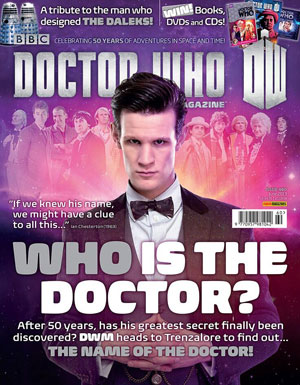
"The Name of the Doctor" will hopefully go down in Doctor Who history as Moffat's worst episode, as I hope he never produces anything as convoluted and nonsensical as this episode. After hearing for almost 2 years that the Doctor's name must never be said, it was barely consequential to the episode. The title, "The Name of the Doctor," in the end, seemed to have nothing to do with the actual "question," but was a trick phrase to refer to something we weren't thinking of. The prophesy was not fulfilled. Dorium said that, on the fields of Trenzalore, no living being can fail to speak or answer falsely. Well, that didn't fucking happen. The Doctor was asked his name point blank and failed to answer. River had to answer for him so that the door could be opened. It's like Moffat changed his mind about what this episode was going to be after "The Wedding of River Song" had already aired.
GF: The only good thing about this episode so far is that River is in it.
What the fuck, River? We were told we would be seeing a "post-Library" River, which was true, but it was pulled off in the most disappointing way possible. Somehow River can be brought into conversation with the Doctor and other people from her home in the computer in the Library? That's convenient. A pre-library River would have been much less convoluted. River was not entirely necessary in this episode, other than the fact that every Moffat season finale seems to have to have River in it as a requirement. I love River, but she added nothing to this episode.
The fact that the Doctor was forced to go to his grave would have been interesting, if pulled off successfully. Moffat said, in an interview after "The Impossible Astronaut," how fascinating he found it that, however far the Doctor travelled, he was moving through all of time and space, and somewhere out there is his grave. He could always stumble upon it. Fascinating concept, if it weren't for the fact that Dorium told us it was going to be something fundamentally different.
"It's like my mother always said: The soufflé isn't the soufflé, the soufflé is the recipe."
Shut up, Moffat. I know you think that's a profound metaphor for Clara scattering herself over the Doctor's timeline, but it's not. It's a tortured metaphor that doesn't really work.
Clara's splintering across his timeline was a bizarre explanation. It works for the ways she saved him in "Asylum of the Daleks" and "The Snowmen," but how did she save him from all the other times that the Great Intelligence tried to kill him? The only explanation is that the reason we've never seen Clara or the Great Intelligence in any of the classic series episodes is because they didn't reflect the altered timeline that the GI changed. But that doesn't make sense because, if that were true, we'd never have seen Clara in either the Asylum or Victorian London. Was she always just hiding in the shadows every time the GI covertly tried to kill the Doctor off-screen, battling him and winning for over 900 years? That seems highly unlikely.
And somehow Clara could jump into the time stream and make those echoes, but since the Doctor went in (went in where?) and saved her, the echoes still exist, but the original Clara doesn't die? Yeah, that makes a ton of sense. Was Moffat tripping when he wrote this episode? And the entire time between writing and production when he could have fixed the episode?
Furthermore, the sacrifice Clara made was a bit ridiculous because she doesn't seem to have enough loyalty to the Doctor yet to justify such an immense sacrifice. The mystery of Clara drove a huge spike between the Doctor and Clara, and really kept them from developing a strong chemistry. Now that they know so much about each other, hopefully that chemistry will really develop over the course of the next season. But so far, I don't buy that she cared about the Doctor enough to sacrifice her life for him. Amy would have. Rose would have. Even Martha or Donna would have. Clara isn't there yet, and it didn't seem plausible.
The brief glimpses at all of the past Doctors was excellent, and it looks like this might be the closest we'll ever get to a 12 Doctors special. I started yelling out each Doctor's number as they passed by, until my girlfriend asked me to stop. What I thought was interesting is that, while Clara adjusted her outfit in each era to make it appropriate to the time, some of her outfits looked suspiciously similar to outfits worn by the Doctor's companions. The one existing in the same time as the 6th Doctor had an outfit that did not match either of 6's companions in any way. But the one following the 2nd Doctor seemed to have the same outfit as the 2nd Doctor's companion, Victoria. And the one following the 7th Doctor looks a lot like the 7th Doctor's best companion, Ace. Even the 1st Doctor Clara looked a little Susan-ish. I was hoping to find out that Clara was actually Susan, since the expanded universe suggests that Susan might not be his actual granddaughter, just some girl he picked up to travel with him. I call this the "Amber Alert TARDIS" theory.
GF: Why is this guy so intent on revenge against the Doctor? It would be one thing if he was a central villain throughout the season who was responsible for nearly everything in the season. We didn't see enough for him to have this kind of vendetta against the Doctor.
Me: Yeah. He was an old 2nd Doctor villain, but even if you factor that in, this is only the Doctor's fifth time meeting him.
Good point, honey! While Clara's sacrifice for the Doctor is a bit of a stretch, the GI's strong desire for revenge against the Doctor is just as much of a stretch, if not more of one. The GI doesn't have enough of a history with the Doctor to be that hellbent on revenge. There are tons of enemies that Moffat could have used that would have made more sense in that situation, including the most drop dead obvious choice of them all: The Master. But Moffat apparently wanted to use a more obscure villain, even though The Master would have made his whole story arc make sense.
GF: This season sucked. There wasn't even a good plot arc that led to this.
Me: Yeah. As much as I loved Amy and Rory, I have to admit that it was a mistake to keep them on for half a season. The first half of the season revolved around their departure so much that they didn't even bother to get the real story of the season going until they left.
That's five episodes that could have been used to better set up this episode, and five episodes that were completely wasted in the process. They couldn't even make the Great Intelligence the villain in some Amy and Rory episodes? He wouldn't have to be the primary villain, he could just be someone lurking behind the villain, the secret, silent partner to someone. But instead, we were given two mysteries (the name, and Clara) that were never developed, just reiterated in dialogue. Actually, Clara's mystery was reiterated in dialogue without developing the plot any further. The Doctor's name has barely been mentioned since "The Wedding of River Song," which aired nearly two years ago. Good luck if you didn't remember that episode.
In the mire of stupidity that was "The Name of the Doctor," Moffat nearly redeemed himself with the last 30 seconds, which did exactly what Moffat said the episode would do: change Doctor Who forever. Because now there's a whole other Doctor in there that we never knew about it. It also means we have a whole new Doctor to learn about, and he's going to be a big part of the 50th anniversary special. John Hurt was announced as a cast member for the 50th Anniversary special months ago, but I never imagined he'd be a Doctor. It has rocked my world in a way that I never expected. My mind has been so set in an 11th Doctor world. I wasn't prepared to meet another Doctor in this episode, let alone a previous Doctor. The chronology of the Doctor's lives is stored in a large part of my brain, and I've just been told that there a huge and important chunk in the middle of there that I never imagined was there. It's a matter of cognitive dissonance. I'm literally going to need until November 23rd, the date of the big Special, to fully accept this radical change in Doctor Who chronology. Seriously, this is a matter of letting my brain recover. It really knocked me on my ass.
But even in rocking the entire franchise, Moffat did it in the most ridiculously convoluted way possible. I'm sorry to have to admit this, but my girlfriend actually had to explain the ending to me.
(The episode ends)
Me: (Throws a pillow in the direction) What the fuck was that?!
GF: I got it.
Me: You did?
GF: You've never seen what happened in the Time War, right?
Me: No. Even the expanded Universe stuff hasn't touched it.
GF: Yeah. That's the Doctor during the Time War.
Me: But that makes the current Doctor the 12th? How can that be?
GF: Because he doesn't acknowledge him as the Doctor. He said he didn't do things in the name of the Doctor, so he isn't a real Doctor.
Me: So he ignores him in the numbering system, and that's why he calls himself the 11th, even though he's actually the 12th.
So, here's a list of things that have significantly changed due to the ending of "The Name of the Doctor":
-The last 3 Doctors' numbers, even if they don't acknowledge them, are all bumped forward by 1 number. Eccleston was now the 10th Doctor. Tennant the 11th. Smith the 12th.
-The Doctor can only regenerate 12 times, meaning that there can only be 13 Doctors. This means that, after Matt Smith, the Doctor can only have one more regeneration before they have to at least acknowledge that the Doctor should be out of regenerations (if they don't decide to just ignore it like Davies planned to).
-The 8th and 9th Doctors* probably didn't spend much, if any time, in the Time War. The 9th Doctor appeared to have just been regenerating in "Rose," acting as if he had just seen himself in the mirror for the first time. The 10th Doctor said that he had to finally destroy the Time Lords to keep them from becoming God-like creatures, destroying the rest of the Universe so they could exist as the only creatures, in pure consciousness. I feel like this is probably the true chronology: The 8th Doctor regenerated early in the Time War into True 9. True 9 had a change of heart towards the end, and destroyed the Time Lords, forcing him to regenerate into 9 in the process. Alternately, True 9 might have regenerated into 9 before he destroyed the Time Lords, and his regeneration caused his radical change of heart.
-The 50th Anniversary special will actually have a past Doctor other than 10, it's just not a Doctor we knew about.
-If John Hurt has already been cast for the 50th Anniversary special (we have), then True 9 is going to be a sort of a villain in the special.
-The Doctor is even older than he claims. The 6th Doctor claimed to be 900 years old, and so did the 11th Doctor at the beginning of his regeneration. So the Doctor had to be much older than 900 at the beginning of his 11th regeneration. This might explain the lie better, because there's an entire regeneration he doesn't acknowledge. How many years did True 9 live? Because however many years True 9 lived, the Doctor is probably subtracting those years from the age he claims to be.
There's so much to be learned about True 9, and I can't wait to see what happens with him. The Doctor's hatred of True 9 seems to be a little irrational. When True 9 said he did everything he did in the name of peace and sanity, the 11th Doctor didn't disagree with him. He said it wasn't "in the name of the Doctor." I could understand the 11th Doctor being mad at him if he thought everything True 9 did was wrong. But it seems like he knows that True 9 had to do what he had to do, he's just pushing him to the back of his mind so he can ignore it. Some of us don't have the ability to section off our past and leave it behind, Doctor. You need to deal with True 9.
I'm guessing this is what we can expect from the 50th Anniversary.
Until then, I'll still be updating, just not with episode reviews. But stay tuned! Can't wait for Season 8.
*Since the introduction of another Doctor complicates the numbering system so much, I'm going to come up with my only special system. I'm still going to refer to Eccleston's Doctor as 9, Tennant's as 10, Smith's as 11. I'm going to call John Hurt's Doctor "True 9."